
No model yet, material choice and wall thickness are explained from a practical angle.
Knowledge Center
Blueprint News
lantu3D reviews wall thickness, structure, materials, process, quantity and finishing before quotation.
01Guides
02Materials
03Customer View
Content should help customer decisions
lantu3D articles focus on materials, processes, cost, modeling and manufacturability so customers understand key decisions before submitting a request.

Prototype, fixture, custom part, small batch and cost-control topics for business users.
lantu3D is positioned as blueprint realization and lifecycle management, not just a print shop.

news
Engineering Management of 3D Printing Quotations: From Costing Sheets and Validity Clauses to a Quantified Change-Order Loop
Many disputes in non-standard 3D printing projects arise not from price levels but from quotations that fail to define model versions, material batches, post-processing steps, and validity assumptions. This article outlines a five-part quotation field structure, a six-part costing framework, methods for linking validity periods to assumptions, and change-order thresholds that turn commercial commitments into verifiable, traceable technical terms.

news
Finite-Capacity Scheduling for 3D Printing Workshops: Engineering Controls from Capacity Load Calculation and Operation-Level Gantt Charts to Material Shortages and Rush Orders
A schedule may be fully booked while the shop floor remains in constant firefighting, often because it assumes infinite capacity. This article presents a practical finite-capacity scheduling approach for 3D printing workshops: operation-level standard-time modeling for printing, post-processing, changeovers, and rework; capacity-load and availability calculations; operation-level Gantt charts and two-tier buffers; material-readiness checks and rush-order cost assessment; and closed-loop reviews using OTD, schedule attainment, and scheduling variance.

news
Clause-Level Implementation of a 3D Printing Standardization System: From Standard Numbers and Conformity Criteria to Document Control and Audit Checklists
Many 3D printing companies stop at simply having documents, yet cannot identify the applicable standard number or clause during an audit. This article presents an actionable approach for breaking standards into clauses, mapping control points, defining measurable criteria, embedding them in controlled documents and audit checklists, and closing nonconformities.

news
Maintaining Vacuum Systems and Compressed Air Quality in 3D Printing Equipment: Engineering Controls from Vacuum Degradation to Dew Point Drift
Vacuum systems and compressed air quality in metal 3D printing equipment are often treated as utilities rather than quantitatively managed process conditions. Yet they directly affect build-chamber oxygen control, pneumatic component life, and powder recoating stability. This article presents three vacuum baselines—evacuation time, ultimate vacuum, and pressure-rise rate—along with an engineering approach for setting particle, pressure-dew-point, and oil classes under ISO 8573-1. It also covers vacuum pump oil emulsification criteria, dryer selection, differential-pressure-based filter replacement, and methods for correlating auxiliary-system readings with build-quality data.

news
Engineering Control of Electricity Costs in 3D Printing Workshops: Actionable Paths for Time-of-Use Pricing, Demand Management, and Power Factor Correction
Industrial electricity bills consist of energy charges and demand charges, yet most 3D printing workshops optimize only the former. Starting with submetering and load-profile mapping, this article presents a complete approach covering peak shaving, flexible off-peak scheduling, equipment-side power factor correction, and closed-loop tracking of energy use per part, with quantifiable cost-saving potential.
news
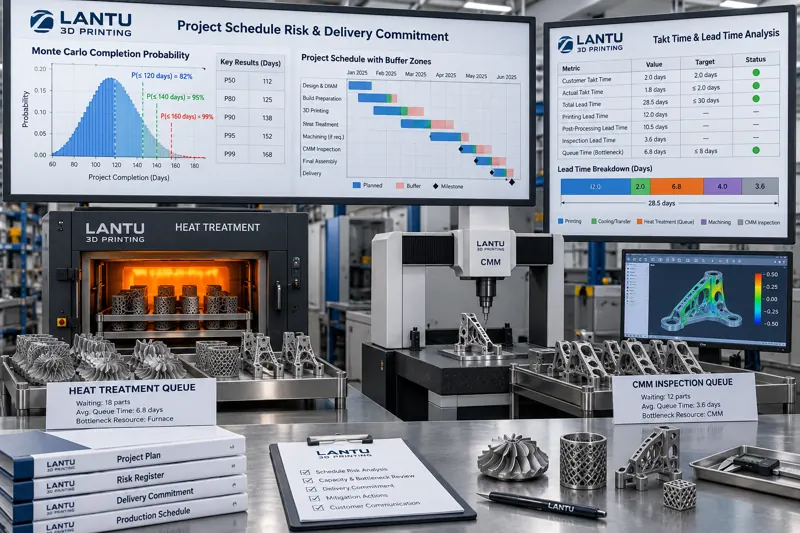
Quantitative Management of Schedule Risks in 3D Printing Projects: From Process-Time Distributions and Buffer Consumption to Delay Probability and Delivery Commitments
Delays in 3D printing orders often result from queuing, post-processing, and rework rather than printing itself. This article presents a practical quantitative approach: use distributions instead of averages for process times, identify shared-resource bottlenecks with queueing models, set and monitor project buffers through buffer consumption, and use Monte Carlo simulation to calculate delay probabilities and establish P85 delivery commitments while defining exception events and accountability boundaries.

news
Geometric Accuracy Inspection and Annual Calibration of 3D Printing Equipment: An Engineering Approach from Laser Interferometry to Error Compensation
Equipment that never fails is not necessarily always within its accuracy limits. This article examines the key geometric error sources in metal 3D printers—positioning accuracy, repeatability, backlash, perpendicularity, and build-platform leveling—and presents a tiered inspection approach using laser interferometers, ballbar systems, and standard test artifacts. It also outlines a five-step annual calibration process, workload-based interval planning, and criteria for four common misconceptions, turning machine accuracy into engineering data that can be assessed, compensated, and incorporated into order reviews.

news
In-Transit Monitoring for 3D-Printed Deliveries: Engineering Methods for Impact Thresholds, Temperature and Humidity Logging, and Damage Liability Determination
Parts pass factory inspection but are found cracked when the customer unboxes them, making liability difficult to determine—the root cause is the black-box nature of transportation. This article examines four real transport failure modes for 3D-printed parts—thin-wall resonance fracture, temperature/humidity cycling drift, residual stress release, and mutual damage from mixed packing. It provides impact and temperature/humidity thresholds by material and structure, three tiers of monitoring configurations based on 1%-3% of cargo value, and a five-stage evidence chain from factory release to unboxing, turning cargo-damage disputes into data comparisons.
news
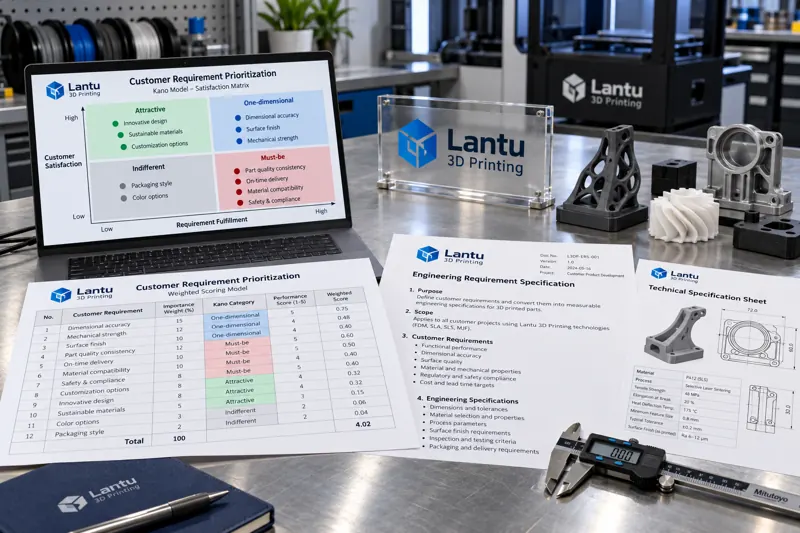
Quantitative Methods for Analyzing 3D Printing Customer Requirements: Kano Classification, Weighted Scoring, and Priority Ranking
Customer requirements are not simply a checklist; they must be prioritized. This article presents the Kano three-category model, a five-dimension weighted scoring matrix, and a requirement-prioritization mechanism, then explains how to convert ranking results into an acceptable technical specification so limited cost and lead-time budgets are invested where customers are truly willing to pay.

news
Maintenance of Mechanical Transmission and Motion Components in 3D Printing Equipment: Preserving Accuracy from Lead Screws and Guideways to Lubrication and Dust Protection
When layer misalignment and dimensional deviations persist after optical calibration, the mechanical transmission chain is often the cause. This article examines maintenance criteria for rolling, sliding, and flexible motion components: quantifying lead screw axial backlash, assessing guideway resistance fluctuations, mileage-based lubrication management, tiered powder protection, synchronous belt and servo following-error monitoring, and four-element documentation with standard verification parts after maintenance.

news
8D Root Cause Analysis for 3D Printing Customer Complaints: A Quantified Closed Loop from Failure Attribution to Corrective Action Verification
3D printing customer complaints often end with remanufacturing and apologies, allowing similar failures to recur. This article presents an 8D implementation path for additive manufacturing: quantified problem descriptions, interim containment and lot holds, the applicable scope of 5 Whys and fishbone diagrams, AM-specific process variation sources, process capability thresholds across consecutive lots, quantitative criteria for concessions and claims, and feeding cases back into FMEA to build organizational capability.
news
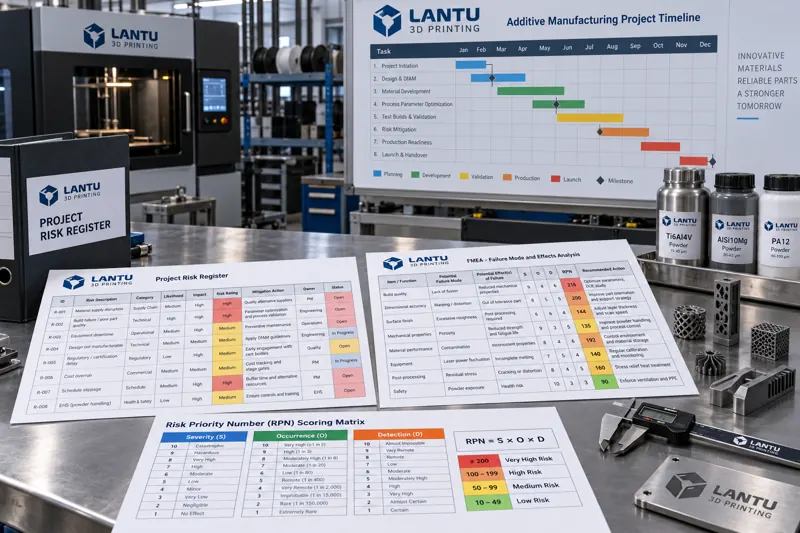
Quantitative Risk Management for 3D Printing Projects: Risk Registers, FMEA Scoring, and RPN Prioritization
Risk management in most 3D printing projects remains at the level of contingency slogans, lacking measurable and verifiable criteria. This article presents an engineering-oriented implementation path: create a risk register with structured fields, calculate RPN using Severity (S), Occurrence (O), and Detection (D) scores with scoring anchors, correct multiplication-model bias through severity thresholds, and link the register to four milestones—order review, first article inspection, low-volume ramp-up, and production release—to establish an auditable risk closed loop.
Start From Here
Have a model, drawing, or only an idea?
Submit your requirement and our engineers will recommend a better design and manufacturing path based on use, size, quantity, material, tolerance and lead time.