
Introduction: Requirements Are Not a Checklist, but a Matter of Priorities
In early discussions for 3D printing projects, the most common challenge is not that customers cannot articulate their needs, but that every statement they make is treated as an equally important requirement. A quotation may simultaneously list dimensional accuracy of ±0.05 mm, surface roughness of Ra 1.6, a five-day delivery period, a 15% unit-price reduction, and a change of material to titanium alloy. These items sit side by side, with no indication of how important each one is or of the cost of giving it up. As a result, the engineering team balances them according to its own interpretation, only for the customer to discover during acceptance that the item they cared about most was not given priority. The real threshold of requirements management is translating “what the customer said” into “what the customer is willing to pay for and what compromises they can accept.” This translation requires quantitative prioritization tools, not experience or on-the-spot judgment.
1. Why Requirement Prioritization Loses Focus
There are three typical sources of unfocused requirements. The first is distortion at the expression level: customers describe needs in terms of outcomes—must fit, must look refined, must be durable—while engineering receives them in parameter terms—tolerances, roughness, and fatigue life. Without a mapping table between the two, priorities are quietly flattened during conversion. The second is conflict at the stakeholder level: procurement focuses on unit price, design focuses on accuracy, and assembly focuses on fit. The same requirement carries entirely different weight for different departments, and whoever speaks last temporarily receives the highest priority. The third is the absence of constraints: every requirement exists within the triangular constraints of lead time, cost, and process feasibility. Discussing priorities without these constraints inevitably produces distortion. Under LPBF, improving surface roughness from Ra 6.3 to Ra 1.6 often requires additional shot peening, vibratory finishing, or even machining. Unit cost may increase by more than 30%, while lead time may extend by two to three days. If the customer's real priority is receiving an assembly-validation part within three days, the surface requirement should be downgraded to an optional item.
2. The Kano Model: First Divide Requirements into Three Categories
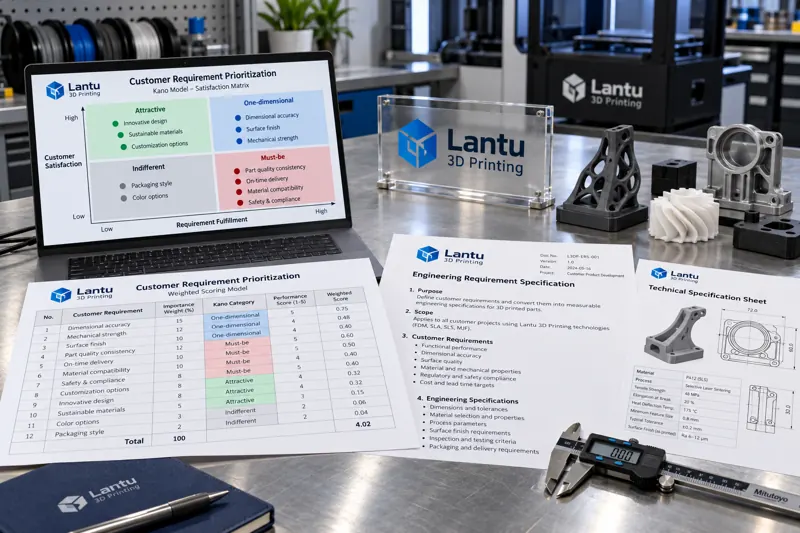
The Kano model qualitatively defines requirements using two dimensions: the horizontal axis represents the degree to which a requirement is fulfilled, while the vertical axis represents customer satisfaction. Based on three different curves, requirements are divided into three categories. Must-be requirements are items for which fulfillment earns no additional credit, but failure causes extreme dissatisfaction. Examples include assembly-hole dimensions on 3D-printed parts, tolerances on critical mating surfaces, and consistency between the specified material grade and certification. These requirements must be met unconditionally and should not enter the trade-off pool. Performance requirements are linear items for which better performance produces greater satisfaction, such as surface roughness, delivery lead time, and unit price. Satisfaction changes approximately linearly with the level of fulfillment, making these the main battlefield for prioritization. Excitement requirements are items that customers may not request but will appreciate if delivered, such as an accompanying CMM inspection report, an assembly or mold-fit validation video, or a reusable parameter package. These items have relatively low cost but high perceived value, making them useful differentiators. The purpose of classification is clear: must-be requirements cannot be traded away, performance requirements need scoring and prioritization, and excitement requirements provide low-cost added value.
3. Weighted Scoring Matrix: Scoring Performance Requirements
For requirements in the performance category, use weighted scoring for quantitative prioritization. A five-dimension approach is recommended, with each dimension scored from 1 to 5: customer value (the requirement's contribution to final assembly or functional performance), implementation difficulty (process complexity and yield risk; more difficult requirements receive lower scores), cost sensitivity (the increase in unit cost required to achieve the requirement), lead-time impact (the additional delivery days), and verifiability (whether acceptance can be conducted using quantitative methods; requirements that are harder to verify carry higher risk). Weighting factors should be set according to project type. For validation-part projects, recommended weights are 0.35 for customer value, 0.30 for lead time, 0.15 for cost, 0.10 for difficulty, and 0.10 for verifiability. For production-part projects, recommended weights are 0.30 for customer value, 0.30 for cost, 0.20 for verifiability, 0.10 for difficulty, and 0.10 for lead time. Calculate the weighted total score for each requirement and rank them in descending order. Define the top 30% as protected priorities, the middle 50% as optimization items, and the bottom 20% as negotiable items. Scoring must be completed jointly by customer and engineering representatives. Each side should score independently before averaging the results. Any item with a difference exceeding 1.5 points should be reviewed immediately; this process itself is a high-quality exercise in requirement clarification.
4. From Ranking Results to a Technical Specification
Once prioritization is complete, the results must be formalized in a technical specification. Otherwise, the conclusions will be diluted in subsequent communications. The specification should contain at least four sections. First, a requirement list and classification results, clearly identifying must-be, performance, and excitement requirements. Second, quantitative metrics and acceptance methods for key characteristics; for example, an Ø8 H7 hole inspected with a plug gauge, Ra 3.2 surface roughness verified against a comparison specimen or through three-point sampling with a roughness tester, and material tensile testing performed by furnace batch in accordance with GB/T standards. Third, concession-acceptance rules that define which indicators may deviate, the permissible deviation range, and the compensation method. Fourth, change-control provisions that establish rescoring and quotation-adjustment mechanisms after requirement changes. Once signed by both parties or confirmed by email, the specification becomes the sole basis for first-article inspection and production release. Experience shows that projects with quantified technical specifications typically improve first-article pass rates by 20% to 35%, while significantly reducing rework and the cost of dispute-related communication.
5. Implementation Checklist
Conduct every requirements review in the following sequence: first, list all original requests without deletion; next, perform Kano classification item by item; then apply five-dimension weighted scoring and ranking only to performance requirements; subsequently, document the ranking results in the technical specification and define acceptance methods; finally, identify two to three low-cost excitement requirements as value-adding items. Keep the review meeting within 60 minutes. The deliverables should be a prioritization table and a draft specification, not merely meeting minutes. It is especially important to remember that scoring is not a one-time exercise. When the process route changes—for example, from SLS to LPBF—when volume scales from five parts to 200 parts, or when the customer's mating assembly changes, the weighting factors should be recalculated and the prioritization results updated accordingly.
Conclusion
The core of customer requirement analysis is not collecting more requirements, but establishing a repeatable prioritization mechanism. Use the Kano model to classify requirements as must-be, performance, or excitement requirements; use five-dimension weighted scoring to establish the order of performance requirements; then formalize the conclusions in a technical specification with defined acceptance methods. Requirements are thereby transformed from verbal consensus into an engineering basis. For manufacturing scenarios such as 3D printing, which involve multiple processes, materials, and post-processing combinations, the value of quantitative prioritization is not only in reducing disputes, but also in directing limited cost and lead-time budgets toward the areas customers are genuinely willing to pay for.
Submit a model, drawing, image or written notes. Engineers will review material, process, finishing and delivery based on actual use.