
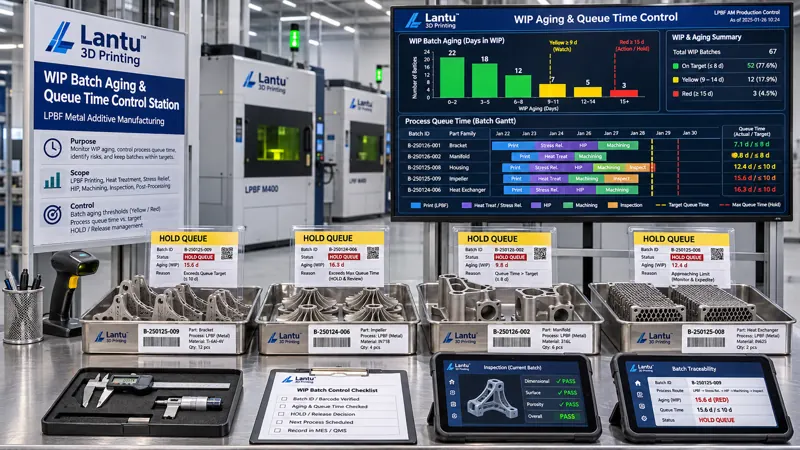
Introduction: The Schedule Is Not Wrong, but WIP Keeps Accumulating
Many 3D printing shops reach the same conclusion during postmortems: equipment did not stop, work orders were not omitted from the schedule, and powder was available, yet an order still required five to nine extra days from build removal to final delivery. The scheduling Gantt chart shows that every operation was assigned to a time window; on the shop floor, however, parts remain at depowdering stations, in front of heat-treatment furnaces, or in CMM inspection queues. The issue is not whether work was scheduled, but how long a WIP batch actually waited after scheduling and who determines whether it may continue flowing downstream. lantu3D classifies this issue as lifecycle management from design blueprint to physical delivery: the planning layer establishes the production sequence, while the execution layer must provide measurable WIP batch status data; otherwise, delivery commitments cannot be independently verified.
1. Why WIP Aging Must Be Defined Separately
WIP age is neither the number of days an order has been in production nor the machine time consumed. For metal LPBF parts, a build may be separated into multiple part numbers after removal from the machine, with each then passing through depowdering, support removal, heat treatment, wire EDM, blasting, inspection, and packaging. Different parts within the same batch may be held at different operations. It is recommended to use “part number + batch number + operation number” as the minimum status unit and record four timestamps: T_release (work-order release), T_start (actual operation start), T_finish (operation completion), and T_accept (downstream acceptance). Operation age A_op = current time − T_finish; batch age A_batch = current time − T_release; and queue time Q = T_start − T_finish (upstream). These three measures must be tracked separately to avoid mistaking “the machine printed for 18 hours” for “the part spent only a short time waiting.”
2. Establishing an Auditable Workstation Status Dictionary
The status dictionary should at minimum include the batch key, part number or tray number, current workstation, prior-operation completion code, next operation, material-readiness status code, quality status code, aging band, owner, and exception record number. Only four statuses are permitted: RUN (in process), QUEUE (qualified and waiting), HOLD (controlled suspension), and BLOCK (blocked pending disposition). QUEUE and HOLD must be strictly differentiated: the former may automatically enter a downstream reservation slot, while the latter requires a reason code, approver, expected release time, and reinspection requirements. Common reason codes include pending powder retest disposition, unavailable witness-coupon results, customer ECN impact analysis, inspection-resource failure, and borrowed tooling not returned. When status codes are entered at the production-reporting terminal, operator and terminal IDs must be retained. Free-text entries such as “temporary storage” or “awaiting notice” must not be used as substitutes.
3. Aging Thresholds and Overdue Escalation Rules
Thresholds should be frozen by process family rather than applying a plant-wide 48-hour limit. They may be established from the measured P50 and P90 queue times of conforming batches over the previous three months: the QUEUE warning threshold W = P90 × 1.2, and the HOLD limit H = 24 hours. Holds requiring third-party testing or customer approval may be extended to 72 hours, but the external reference number must be recorded. For example, if the P90 for support removal is 9 hours, W is approximately 11 hours; if the P90 for pre-heat-treatment queuing is 16 hours, W is approximately 19 hours; and if the P90 for CMM inspection queuing is 22 hours, W is approximately 26 hours. When aging exceeds W, the batch enters the yellow list and the team must confirm its disposition during the same shift. When it exceeds 1.5W, or when HOLD exceeds H, it enters the red list; planning, quality, and process engineering must jointly sign off on one of four outcomes: continue processing, outsource, isolate and reinspect, or scrap. Threshold versions must be reviewed quarterly as equipment capacity, product families, and inspection resources change. Old versions must not be overwritten; their effective dates and applicable order ranges must be retained.
4. Process Dwell Attribution Cannot Be Reduced to “Bottlenecks”
Shop-floor accumulation is often broadly attributed to insufficient capacity, leading directly to additional equipment purchases. An auditable approach divides each Q interval into six categories: upstream/downstream takt mismatch, batch preparation and changeover, unavailable material or tooling, unsigned quality evidence, pending customer changes, and resource failure. Each category must be linked to an event code and evidence: material shortages to material-readiness verification records, unsigned releases to inspection lots or report numbers, customer changes to ECN numbers, and failures to equipment alarm codes. Monthly reporting should calculate each category’s share of total queue time and separately track pure administrative waiting, defined as time during which conforming evidence exists but the batch has not moved. If pure administrative waiting exceeds 20%, the priority should be to improve the status dictionary and handover acknowledgements rather than add machines first.
5. Closed-Loop WIP Inventory and Hold Release
A reconciliation of system records and physical WIP should be performed once per day at shift handover, without moving every physical item to an inventory area. Use tray numbers or DPM scans to verify five items against the WIP list: workstation, status, aging band, and exception record number, in addition to the WIP item itself. Sample checks should confirm physical identification and the quantity of parts on each tray. Discrepancies are classified into four categories: incorrect location, incorrect status, incorrect quantity, and missing identification. Any discrepancy must generate a deviation record during the same shift; statuses must not be changed directly. A HOLD may only be released by the role that originally approved it, with entry of reinspection results, release time, first operation after release, and downstream recipient. If a process-parameter package revision, powder-lot change, or customer ECN becomes effective during the HOLD period, impact analysis must be rerun before release; the prior release decision may not be reused. Release records and original hold records must be retained as matched pairs to create a time chain auditable by customers.
6. Release Gates and Delivery Evidence
Set five D1 through D5 release gates before a WIP batch enters packaging and shipment. D1 verifies that all part numbers have exited RUN/QUEUE and that no exception records remain open. D2 verifies that A_batch does not exceed the total aging limit frozen for the product family; any exceedance requires a three-party sign-off conclusion. D3 verifies one-to-one correspondence in the quality evidence chain among powder lot, build number, heat-treatment furnace run, witness coupon, and final inspection report. D4 verifies that HOLD release records are complete and that the ECN impact-analysis version is current. D5 requires the delivery owner to sign the shipment-status checklist, which includes the batch key, total queue time, total hold duration, overdue-disposition conclusion, and threshold version number. The checklist is shipped with the goods or retained as specified by contract, allowing the question “Why did this batch wait three additional days?” to be answered with records rather than recollection.
7. Implementation Sequence and Common Pitfalls
A four-week implementation is recommended. In week one, establish only the status dictionary and four timestamps, without performance assessment. In week two, replay two weeks of historical production-reporting data to calibrate P90 values and W and H thresholds for each operation. In week three, launch yellow and red lists and shift-handover scan verification, migrating free-text exceptions into reason codes. In week four, make D1–D5 hard pre-shipment blocks and conduct a drill that traces the time chain backward from a serial number. Three pitfalls should be avoided: first, deriving one uniform WIP limit from the order due date while ignoring process-family differences; second, treating HOLD as an ordinary extension of QUEUE, allowing risks from pending customer approvals or incomplete inspections to be absorbed by automatic scheduling; and third, recording only “where it is now” without recording “when the prior operation finished and when downstream accepted it,” making Q and A_op impossible to calculate. Four recommended metrics are the percentage of QUEUE items exceeding W, the percentage of HOLD items exceeding H, the share of pure administrative waiting, and the first-pass rate for pre-shipment D-gate approval. Targets should be ≤5%, ≤2%, ≤20%, and ≥95%, respectively.
Conclusion
Delivery stability in low-volume 3D printing depends not only on whether schedules can keep equipment fully loaded, but also on whether the time from operation completion to downstream acceptance is measured, classified, and closed for each WIP batch. By using part number + batch number + operation number as the status unit; calculating batch age, operation age, and queue time through four timestamps; distinguishing waiting from controlled suspension through a four-status dictionary; and closing the evidence chain through threshold escalation, reason-code attribution, hold release, and D1–D5 gates, a shop can transform “WIP keeps piling up” into a set of engineering status measures that can be determined, reviewed, and provided to customers for verification. This is an indispensable management interface between the planning layer and the execution layer when moving from design blueprint to physical delivery.
Invia un modello, un disegno, un'immagine o note scritte. Gli ingegneri valuteranno materiale, processo, finitura e consegna in base all'uso effettivo.