
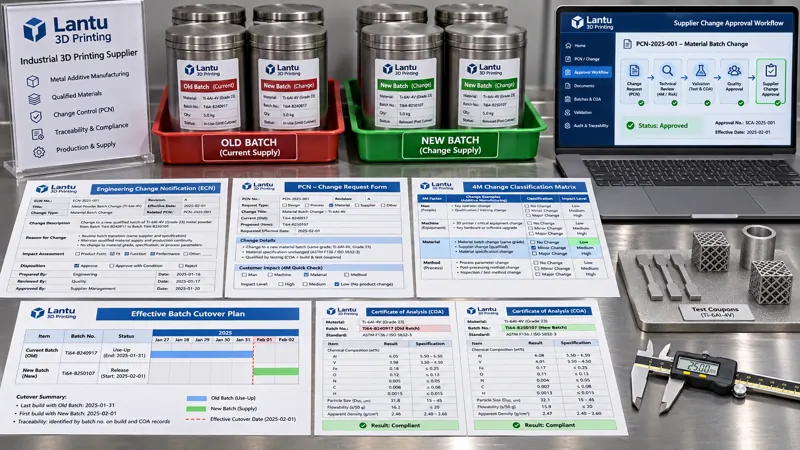
Introduction: Why a Single Supplier Change Notice Can Invalidate an Entire Lot of Parts
Materials and outsourced-process supply chains in 3D printing are highly interconnected. The particle-size distribution, oxygen content, and reclaimed-powder blend ratio of metal powder with the same grade; the melting point and flowability of PA12 powder with the same designation; and even the process provenance of the same model of protective lens, cleaning agent, or heat-treatment furnace can all drift when a supplier quietly changes its production location, equipment, formulation, or discontinues a product. For a platform such as lantu3D that manages the full lifecycle from drawings/design to physical delivery, the issue is not whether a notice was received, but whether that notice can be translated into a decision-ready, lot-segregated, traceable engineering event. If a supplier product change notification (PCN) remains only in a purchasing email while the shop floor continues using the old process card and inspection lots are still grouped under the old parameter revision, customer parts may show breaks in mechanical performance, dimensional stability, or compliance declarations despite appearing identical.
1. Define the Scope First: A PCN Is Not an Internal ECN or a Customer Change Order
A PCN concerns a change initiated by an external supplier and received and dispositioned by the manufacturer. An internal ECN (engineering change notice) generally addresses how models, work in process, inventory, tooling, and quotations are transitioned after a customer or internal drawing change. A customer requirement change addresses how acceptance specifications are revised. Supplier qualification and sourcing decisions address who to buy from and under what terms. A PCN, by contrast, answers: what an approved supplier is changing from its old state to its new state, from which effective lot onward, whether the change is accepted, whether change validation is required, and whether the customer must be notified. A usable PCN record must at minimum link the supplier code, material number, material revision, change category, before-and-after descriptions, reason, supplier internal change number, proposed effective lot or date, sample and COA/COC numbers, final purchase deadline for old material, contact person, and issue timestamp. A “change notice” without an effective-lot field cannot establish boundaries for inventory and work in process, and should be treated as information rather than a controlled engineering document.
2. Classify Changes by 4M1E Rather Than Requalifying or Releasing Everything by Default
It is recommended to separate changes into five categories using 4M1E: material changes (powder origin, atomization process, particle-size window, reclaimed-powder ratio, resin formulation, filament lot-numbering rules); equipment and tooling changes (supplier production equipment, sieving equipment, heat-treatment furnaces, mold cavity numbers); method changes (standards or parameter windows for cleaning, passivation, packaging, and test methods); personnel and site changes (relocation of critical processes, secondary subcontracting of outsourced processes, manufacturing-site transfers); and environmental/compliance changes (REACH/SVHC declarations, RoHS exemptions, or hazardous-waste disposal provider changes). For each category, first determine whether frozen CTQs and process windows are affected, then assign an A/B/C disposition level. Level A may affect safety, fatigue, regulated implant or aerospace characteristics; as a default, new lots are prohibited from production until sample testing, witness coupons, full CTQ inspection, and any required written customer approval are completed. Level B affects process stability but does not alter acceptance criteria; it requires comparative validation across at least three independent builds and tightened inspection of the first production lot. Level C involves documentation or packaging-label changes only; document consistency review and first-lot label verification are sufficient. The classification result must be recorded in the PCN ledger and linked to the material master-data revision.
3. Change Validation: Use Reviewable Data to Demonstrate “Old/New Equivalence” or the Need for a Revision Change
For metal powders, compare at minimum D10/D50/D90, Hall flow rate, apparent/tapped density, oxygen and nitrogen increases, and satellite-particle/hollow-particle content. Print standard test coupons using the same parameter package and measure density, tensile properties, and critical dimensions. For polymers such as PA12, compare melting/crystallization windows, viscosity or melt flow, moisture content, and standard specimen strength. Validation cannot consist only of confirming that supplier COA values fall within specification; performance must be reproduced on the manufacturer’s own equipment, using its own parameter package and post-processing route. Retained samples from the old lot should be used as controls: three samples in the old state and three in the new state, with critical characteristics evaluated using the same gauges, sampling orientation, and inspection-lot rules. A Level B change may be deemed equivalent only when the inter-build mean shift over three consecutive independent builds is less than one-third of the historical standard deviation, and no result falls within 10% of a CTQ tolerance boundary. If differences are significant, the matter is not simply a “notice acknowledged”; it triggers an internal ECN. Process cards, parameter-package revisions, inspection-lot rules, quotation and cost-review sheets, and referenced technical-agreement documents must be updated, with the new parameters explicitly assigned to a specific effective build number.
4. Lot Transition and Inventory: Convert “Starting with Which Bag” into Four Color-Coded States
The point at which PCNs most easily lose control is when old material, new material, work in process, and delivered parts are mixed under the same lot number. It is recommended that WMS/MES systems establish four statuses for every affected material: old lot released, old lot frozen pending use, new lot pending validation, and new lot released. Inventory should be counted bag by bag according to container seal number and lot number, recording gross/tare/net weight, storage location, inspection-report number, and PCN number. Work-in-process builds should be traceable through the production timestamp, old-lot identification, equipment number, and parameter-package hash. Parts produced in builds spanning a transition point must not be grouped in the same inspection lot; they must be split into old-material and new-material sublots, each with separate witness coupons. Whether old lots may be fully consumed must be determined jointly by the classification outcome, customer contract terms, and remaining quantity. Level A changes generally do not allow continued use of old lots without authorization. Level C changes may be consumed on a FIFO basis, but shipping documentation must identify the effective lot. Delivered lots are not automatically recalled because of a PCN, but a part serial number must allow tracing within 30 minutes to the supplier PCN number, old-lot COA, inspection-lot number, and report revision for customer audits or dispute retesting.
5. Customer and Contract Boundaries: When Written Approval Is Mandatory
Whether a customer must be notified does not depend on the apparent scale of the change, but on whether it affects frozen items in the technical agreement. If the agreement specifies material grade plus supplier plus country of origin, locked powder lots, a maximum reclaimed-powder blend ratio, a designated heat-treatment furnace, or a designated test method, any change to those fields requires written customer approval. If the agreement specifies only performance indicators and acceptance criteria, and A/B/C validation demonstrates that both old and new states meet those criteria, the change may be closed internally with lot records retained as evidence; however, shipping documentation must remain traceable. Purchasing terms should define PCN advance-notice periods in advance—typically 30 to 90 days, and no less than 120 days for discontinuation/EOL—as well as final-buy windows, obligations to provide samples and COAs, a default prohibition on secondary subcontracting, a prohibition against unilateral implementation of critical-characteristic changes, and responsibility for requalification, rework, and delivery losses caused by unnotified changes. This converts “the supplier changed lots without telling us” from a dispute into an enforceable contractual requirement.
6. Implementation Checklist and Common Failure Modes
Minimum ledger fields: PCN number, supplier code, material number, change category, 4M1E attribution, A/B/C level, effective lot/date, validation report number, internal ECN number, inventory disposition order number, customer approval number, obsolete-document record, first-lot tightened-inspection result, and closure date. Five control gates: D1 purchasing receipt and numbering; D2 joint engineering/quality classification; D3 validation and material-master revision freeze; D4 segregation of inventory, work in process, and inspection lots; D5 a 30-day review after first-lot release. Five common failure modes are: filing a PCN as a quotation email without entering it into controlled documentation; checking only the supplier COA rather than the internal process route; defining the effective lot as “starting next month,” resulting in mixed material in the same build; releasing material as an “equivalent grade” even though the customer technical agreement freezes the supplier origin; and allowing old parameter packages to remain callable from equipment after PCN closure. Randomly select one or two closed PCNs each week for a traceability drill, requiring any finished part to be traced within 30 minutes to the PCN number, old/new lot COAs, validation report, and approval records. The target first-pass success rate should be no less than 95%.
Conclusion
The engineering value of a supplier product change notification lies not in simply receiving it, but in converting an external change into a controlled object: one unique number, 4M1E attribution, A/B/C classification, equivalence validation, an effective lot and four-color inventory status, defined customer-approval boundaries, and an auditable evidence chain. This enables lantu3D to keep materials, processes, inspection, delivery, and commercial terms on one lifecycle chain, ensuring that external supplier changes do not compromise consistency from design to physical delivery.
Invia un modello, un disegno, un'immagine o note scritte. Gli ingegneri valuteranno materiale, processo, finitura e consegna in base all'uso effettivo.