
No model yet, material choice and wall thickness are explained from a practical angle.
Centro Conoscenze
Blueprint News
lantu3D verifica spessore, struttura, materiale, processo, quantità e finitura prima del preventivo.
01Guides
02Materiali
03Punto di vista cliente
Content should help customer decisions
lantu3D articles focus on materials, processes, cost, modeling and manufacturability so customers understand key decisions before submitting a request.
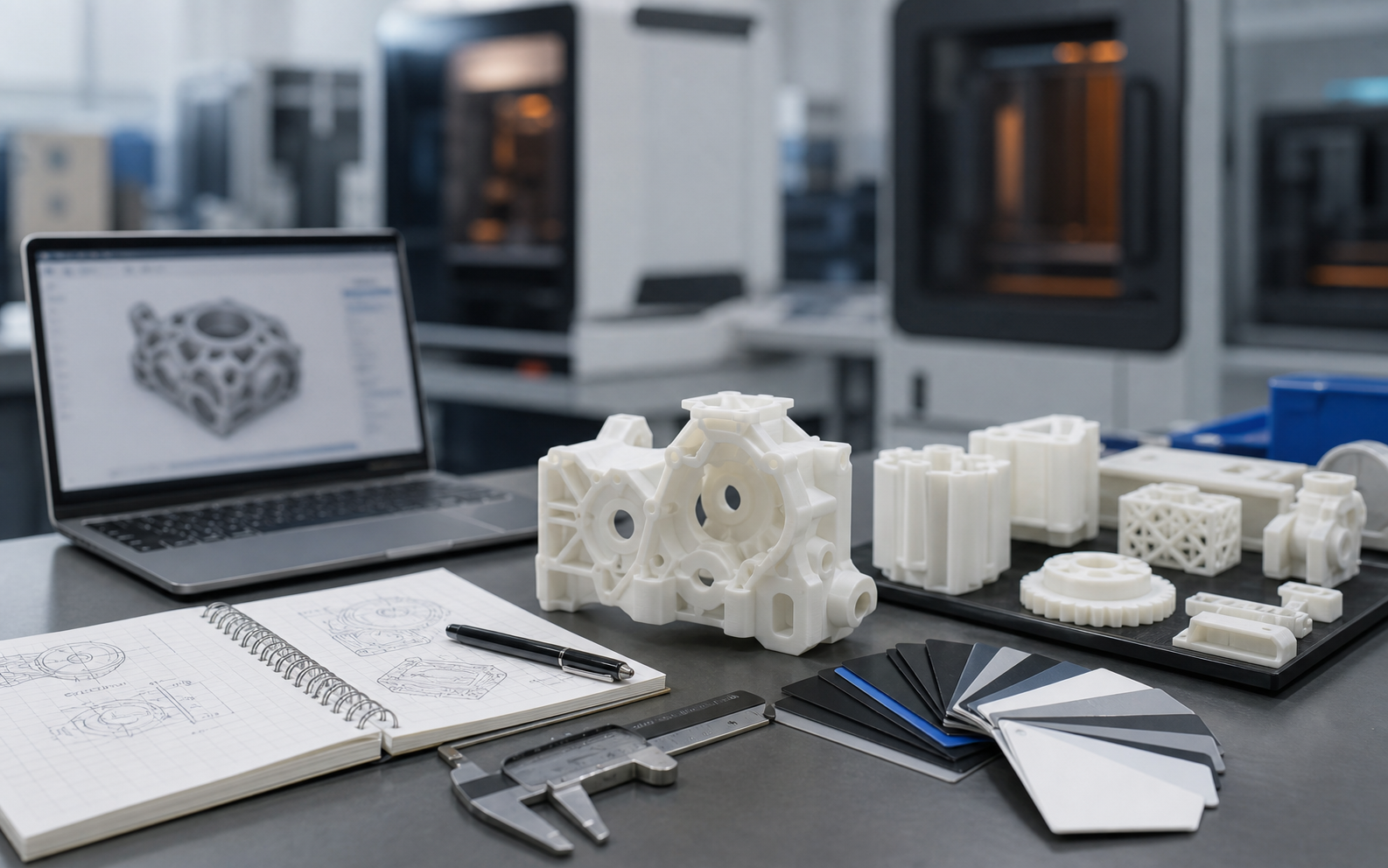
Prototype, fixture, custom part, small batch and cost-control topics for business users.
lantu3D is positioned as blueprint realization and lifecycle management, not just a print shop.
news
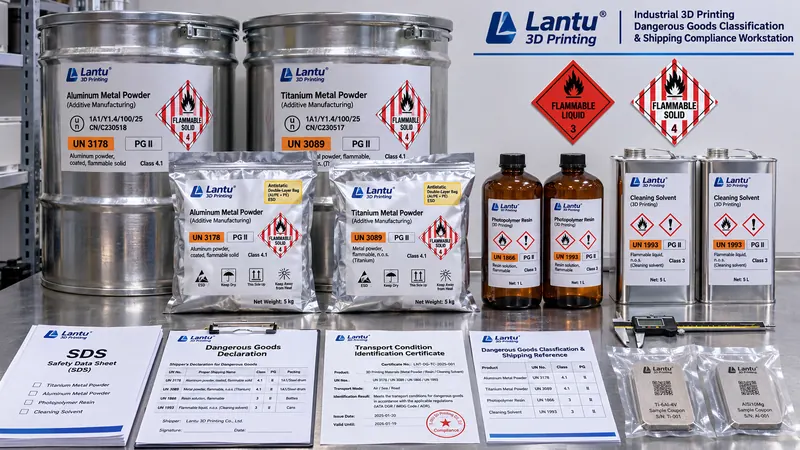
Hazard Classification and Transport Compliance for 3D-Printed Deliveries: A Determinable Method from Minimum Shipping Units and UN Numbers to Packing Groups and Test Reports
Directly applying a non-dangerous-goods conclusion for finished parts to accompanying metal powders, photopolymer resins, and cleaning agents is one of the most common causes of rejection in additive manufacturing deliveries. A single consignment may contain materials with entirely different physical states and classification rules. From a lifecycle perspective spanning design blueprints to physical delivery, this article breaks shipments down into minimum units of part number, batch number, and container; explains how to determine the boundaries of Class 3 flammable liquids and Class 4 flammable solids and water-reactive substances; and outlines the basis for selecting UN numbers and Packing Groups I/II/III, the minimum fields for SDS Section 14 and transport-condition test reports, the applicability of limited quantities and excepted quantities, as well as marking, documentation, and four release criteria. The numbers and thresholds cited are illustrative only; final conclusions must be based on current regulatory model provisions and reports issued by qualified assessment bodies.
news
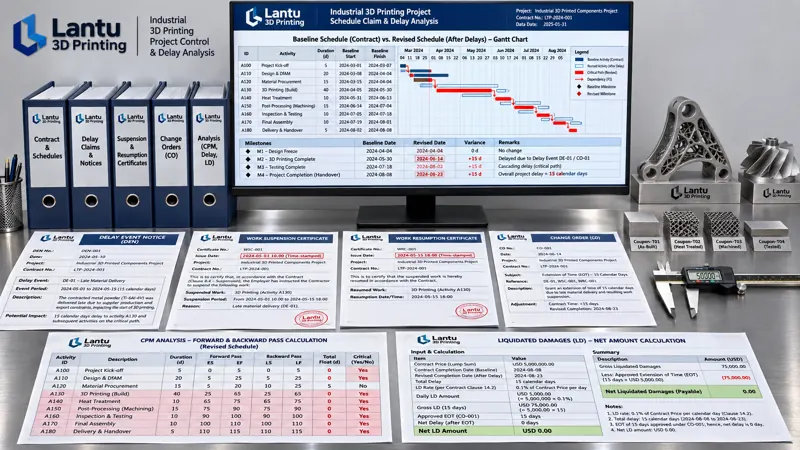
Quantifying Schedule and Cost Claims in 3D Printing Projects: An Engineering Method from Baseline Freezing to Critical-Path Delays and Counterclaims
Delivery disputes often remain stuck in chat logs and apologies because both parties lack an engineering method they can recalculate. This article presents a quantitative closed loop for 3D printing projects—from delay events to settlement statements—using an event responsibility matrix, frozen baseline WBS, 28-day schedule notices, CPM total-float calculation Δ=max(0,D−TF), three-state concurrent-delay assessment, cost breakdowns, and net settlement columns for liquidated damages and counterclaims, along with a six-document report package and 30-day implementation checklist.
news
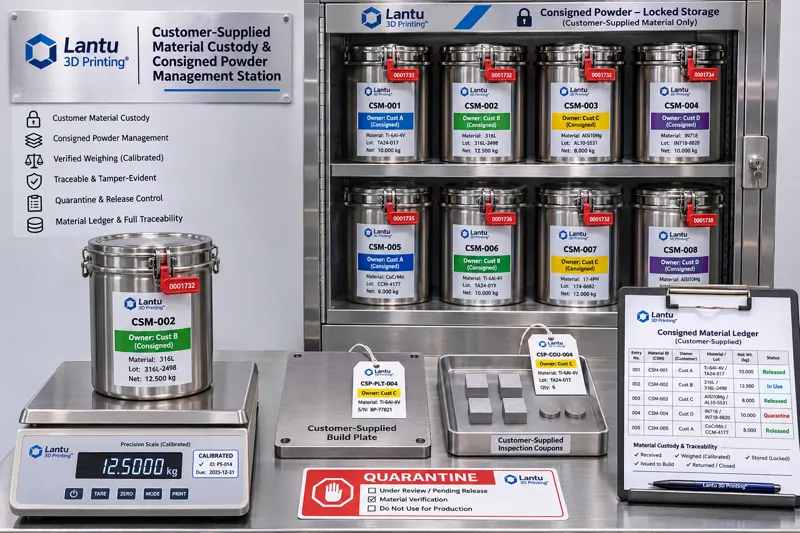
Customer-Supplied Materials and Asset Custody in 3D Printing: An Engineering Approach to Ownership Boundaries, Dedicated Use, Consumption Reconciliation, and Residual Material Returns
When customers provide powder, build plates, models, or dedicated tooling, the most overlooked issues are not print parameters but ownership, whether materials may be blended with in-house stock, how unused material is returned, and how losses are settled. Based on ISO 9001:2015 Clause 8.5.3 requirements for customer property, this article presents an ownership checklist for four categories of customer-supplied assets; numbered custody ledgers and incoming-inspection thresholds; three non-negotiable rules for dedicated material use and changeover clearance; and a material-balance example covering issued material, recovered powder, residual material, and built parts (closure deviation ≤1.5%; non-recoverable loss warning limit ≤2.0%). It also connects work orders, parameter-package hashes, inspection reports, and return acknowledgements into an evidence chain, ensuring delivery includes not only conforming parts but also an auditable asset reconciliation.
news
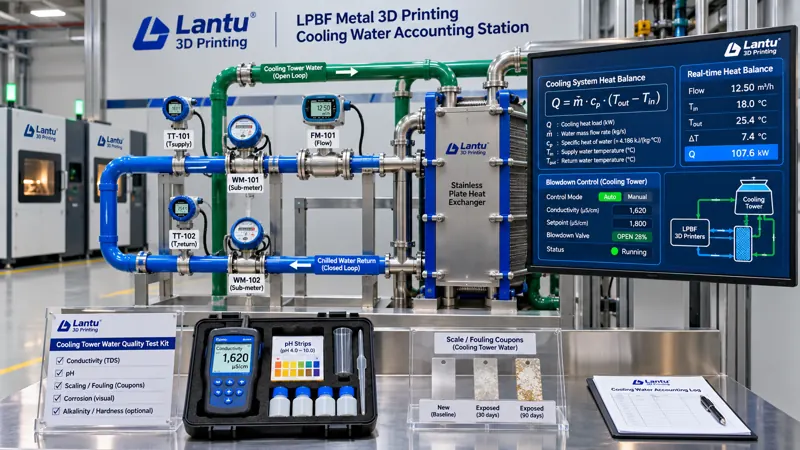
Engineering Accounting for Cooling Water in 3D Printing Shops
Electricity, gas, and carbon already have accounting methods in many workshops, but cooling water is often buried in the main water meter. This article defines cooling water as a fourth verifiable utility, covering metering maps, water balances, cycles of concentration, heat-transfer degradation, per-part water consumption, shared-build allocation, and release criteria.
news
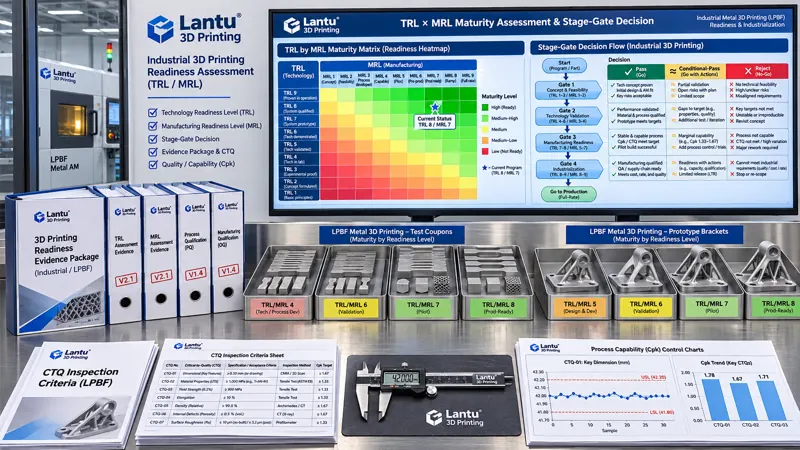
Readiness Assessment for Adopting 3D Printing: An Engineering Method from Dual-Axis TRL/MRL Ratings and Stage Gates to Adoption Thresholds
A successful print is often mistaken for a process ready for production. Three compliant laboratory parts may lead to batch variation, rising rework, and broken inspection records in low-volume delivery. The root cause is usually not the equipment or material, but the lack of readiness criteria that translate technical feasibility into repeatable, verifiable, scalable manufacturing. This article presents a sign-off-ready method comprising dual-axis TRL/MRL ratings, nine evidence packages, six stage gates, and three adoption thresholds.

news
Power Quality and Voltage Sag Mitigation in 3D Printing Workshops: An Engineering Method from Three-Tier Measurement Points and IEC 61000-4-30 Waveform Recording to Build Release Criteria
A single LPBF build can run for 20 to 80 hours, yet an 80 ms voltage sag can cause an entire build to be scrapped due to lack-of-fusion defects—while most workshops log it only as an intermittent equipment shutdown. This article distinguishes the utility-billing, facility-utility, and power-quality layers; defines a three-tier measurement architecture at the incoming supply, equipment feeder, and sensitive loads; introduces IEC 61000-4-30 Class A measurement, SEMI F47 immunity curves, and initial thresholds including 5% THDv and 2% three-phase unbalance; and links power-event timestamps to build layer numbers, expanded inspection findings, and an ALCOA+ data chain to establish auditable build-release decisions. Mitigation is prioritized through topology isolation, point-of-use compensation, and incoming-supply upgrades, with effectiveness verified using comparative standard-coupon data.
news
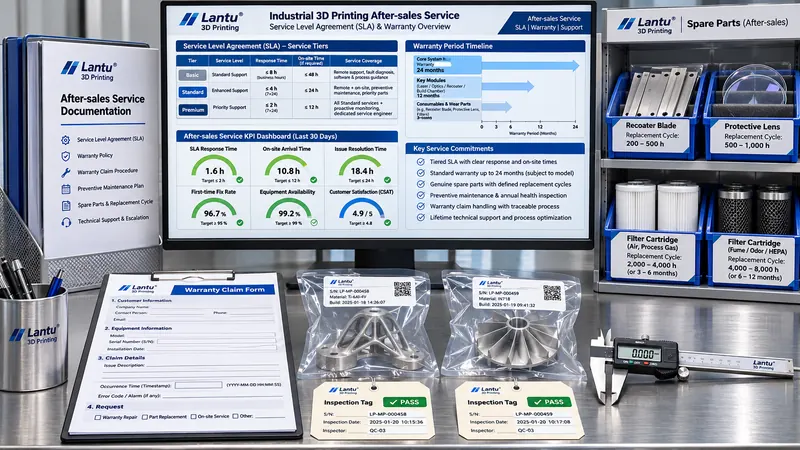
Post-Delivery Service Levels and Warranty Terms for 3D Printing: A Verifiable Method for Defining Warranty Commencement, Exclusions, SLA Timelines, and the Evidence Chain
Why do disputes over whether a 3D-printed part is still under warranty continue even after delivery has been signed for? This article translates after-sales service commitments into verifiable engineering terms: define T0 as the acceptance event and freeze eight fields, with a dual-limit warranty period; establish four categories of exclusions and a three-state determination process—supported, insufficient evidence, or excluded—to prevent forced attribution; map P1/P2/P3 service levels to work-order timestamps, suspension conditions, escalation, and fallback mechanisms; and provide methods for back-calculating minimum spare-parts inventory, setting thresholds for on-site dispatch, allocating costs using a responsibility-by-disposition matrix, and defining claim periods based on the discovery date and ALCOA+-based service records with four mandatory keys. This approach is intended for additive manufacturing delivery projects that need to incorporate service quality into a technical agreement and support independent third-party review.
news
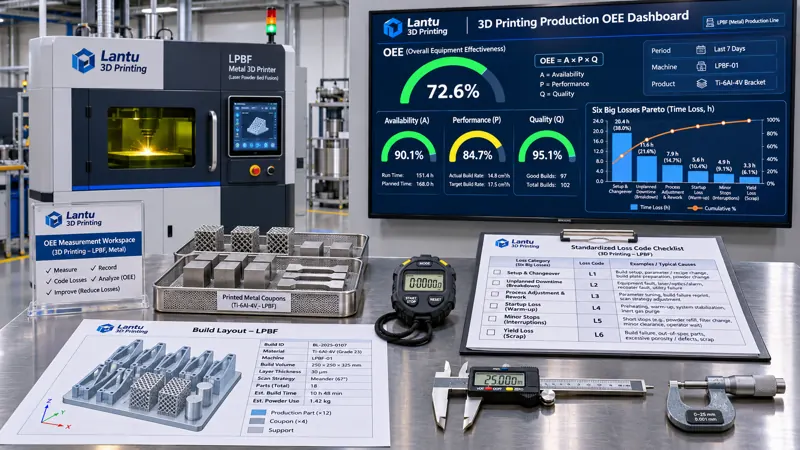
Calculating Overall Equipment Effectiveness (OEE) for 3D Printing: An Auditable Method from Loading Time and Six-Loss Minutes to First-Pass Yield
Many 3D printing shops treat powered-on hours as productive capacity, while classifying preheating, atmosphere purging, empty recoater travel, micro-stoppages, entire-build scrap, and inspection-report waiting time as planned downtime. As a result, apparent machine utilization may be 85% while actual OEE is only about 67%. This article defines additive-specific losses across availability, performance, and quality; explains how to recalculate theoretical cycle time from parameter sets; links acceptance decisions to CTQ reinspection and witness coupons; aligns four data sources by build ID; and uses a seven-day, 8,400-minute example to identify the real bottleneck through a unified six-loss minute table.

news
Product Chemical Substance Compliance for 3D-Printed Deliverables: From Homogeneous Material Breakdown and RoHS/REACH Limits to Material Declarations and Testing Evidence Chains
Simply forwarding a supplier certificate to a customer often cannot answer the actual concentration of every restricted substance in a delivered part. From lantu3D's lifecycle perspective spanning design drawings to physical delivery, this article explains homogeneous-material mapping, RoHS and REACH SVHC limit fields, exemptions and process-introduced substances, and a four-tier evidence chain of SDSs, full material declarations, and third-party test reports. It also provides control methods embedded in quotation, procurement, post-processing, and release, along with six quantitative indicators and a ten-minute release checklist.
news
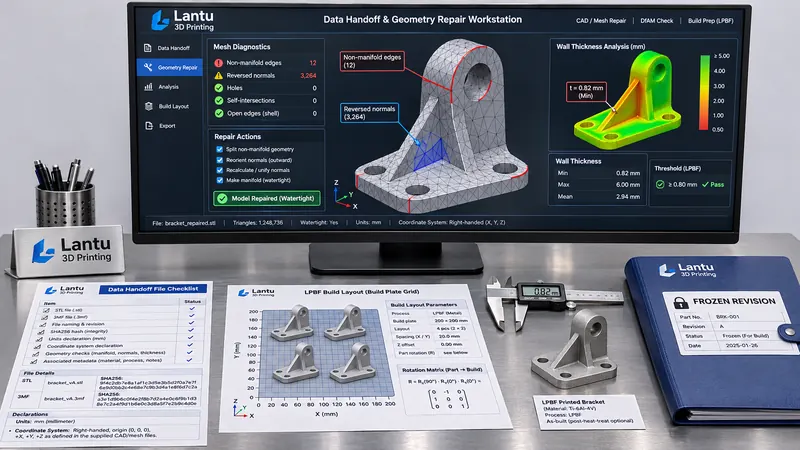
3D Printing Model Data Handover Packages: Engineering Methods from Geometry Repair and Unit/Coordinate Freezing to Build Release Gates
Different results from the same model on two machines often stem from incomplete data handover rather than machine capability. From lantu3D's lifecycle-management perspective, this article details six minimum handover fields, seven geometry repair checks, three unit and build-layout cross-checks, D1-D4 release gates, and an ALCOA+ evidence chain. It also provides a 10-minute checklist and quantitative targets of at least 95% first-build pass rate and no more than 2% data-related rework.
news
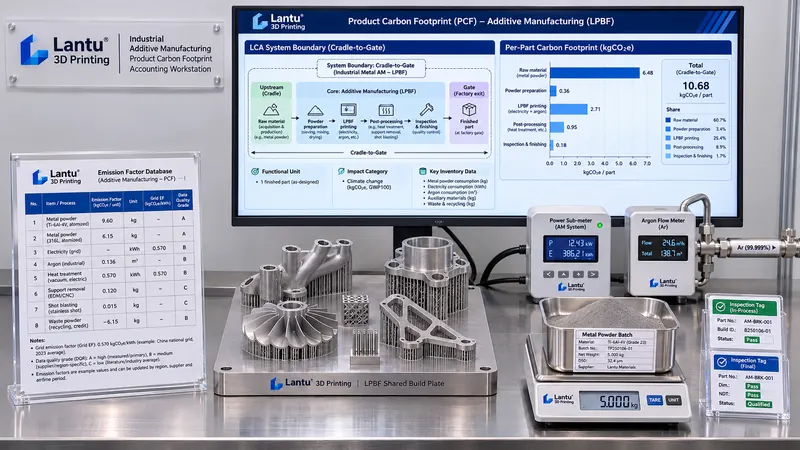
Calculating the Per-Part Carbon Footprint of 3D Printing: A Verifiable Method from Functional Units and System Boundaries to Shared-Build Allocation and Data Quality Ratings
The customer-requested figure of “kgCO2e per part” is not a green-manufacturing slogan; it is an engineering account traceable to original records. This article links functional units, cradle-to-gate boundaries, submetered electricity and shielding-gas activity data, weighted allocation for shared builds, emission-factor metadata and DQI data-quality ratings, four additive-specific amplification factors, uncertainty intervals, and an eight-item evidence trail into a verifiable per-part carbon-accounting procedure that feeds back into process decisions.
news
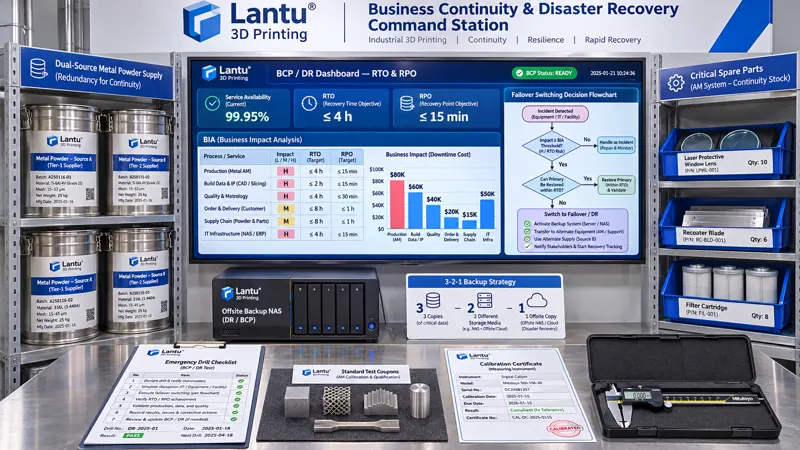
Business Continuity Management for 3D Printing Delivery: An Engineering Approach from BIA and RTO/RPO Targets to Dual Sourcing and Recovery Drills
Why can a single machine outage or powder supply disruption delay an entire batch of orders? Using the ISO 22301 framework, this article breaks 3D printing delivery into interruptible units, applies business impact analysis to quantify maximum tolerable downtime and loss curves, defines verifiable RTO/RPO targets by order tier, deploys dual-source powders, critical spares, validated backup capacity, and 3-2-1 version-controlled backups, and validates recovery through tabletop, component-switching, and end-to-end drills. The result is an on-time delivery capability supported by metrics and evidence that customers and auditors can verify.
Inizia da qui
Have a model, drawing, or only an idea?
Submit your requirement and our engineers will recommend a better design and manufacturing path based on use, size, quantity, material, tolerance and lead time.