
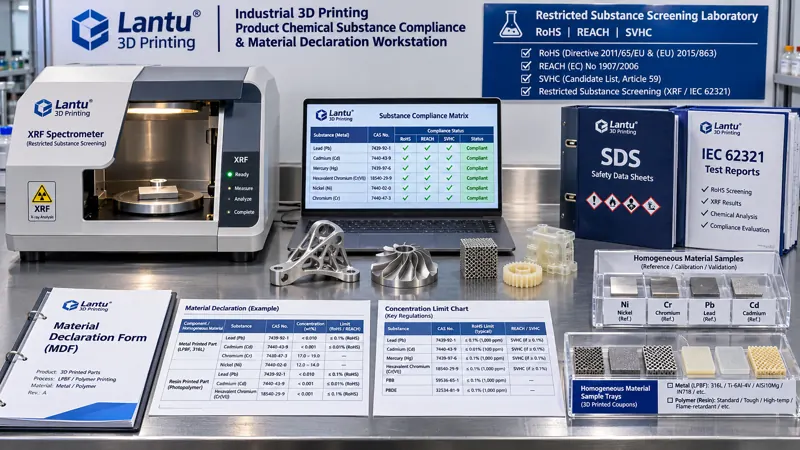
Introduction: A Material Certificate Cannot Answer “What Is in the Delivered Part?”
3D printing service providers often receive questions such as: Can you provide a RoHS declaration of conformity for this batch of nylon, metal, or resin parts shipped with the delivery? Do REACH substances of very high concern (SVHCs) exceed 0.1%? What are the concentrations of hexavalent chromium, cadmium, lead, and phthalates in the packaging and coatings for products exported to the EU? Many teams simply forward a material supplier's certificate of analysis or SDS, only to be told that the evidence is insufficient. The issue is not necessarily that the material is non-compliant; rather, a certificate demonstrates the batch properties of a container of powder or a spool of filament, not whether a finished part that has undergone powder spreading, sintering, cleaning, blasting, electroplating, bonding, and packaging still meets applicable limits for the composition and concentration of substances in every homogeneous material. lantu3D treats the journey from design drawing to physical delivery as a lifecycle chain. Substance compliance is not merely an attachment from the purchasing department, but engineering data that must be transmitted along the chain, verifiable, and version-controlled.
1. Break Down “Homogeneous Materials” into Determinable Boundaries
The assessment unit for RoHS and REACH is neither the complete assembly nor an individual component, but the homogeneous material: a material unit that cannot be further mechanically disjointed and has a uniform composition throughout. For a metal bracket produced by LPBF and surface-treated, the breakdown should include at least: the base metal (such as as-printed 316L or Ti6Al4V), surface plating or conversion coating, the alloy of inserted nuts, adhesive at bonding interfaces, marking ink, cushioning packaging foam, and barrier bags. Resin parts must also be separated into the photopolymer resin itself, cleaning residues, colored coatings, and post-curing layers. The principle is to create a mapping table from the bill of materials (BOM) to the homogeneous-material list. Each row should specify the material name, supplier, grade, batch number, mass proportion, location, mechanical separability, and referenced declaration number. If a coating is only a few micrometers thick and cannot be mechanically separated, it must still be declared as an independent homogeneous material rather than averaged into the substrate. Concentration limits are calculated based on homogeneous-material mass; averaging systematically underestimates risk.
2. Limits and Exemptions: Translate Regulatory Text into Fillable Fields
Common restricted-substance requirements must be converted into individual data fields rather than slogans. Under RoHS, lead, mercury, hexavalent chromium, polybrominated biphenyls, polybrominated diphenyl ethers, and cadmium are generally assessed against two homogeneous-material concentration thresholds: 0.1% and 0.01%. Phthalates have additional thresholds in certain plasticized materials. Under REACH, an SVHC concentration of 0.1% by article triggers communication or notification obligations, and because the Candidate List is updated approximately every six months, each declaration must be tied to a specific list version date. Engineering teams should establish a restricted-substance master data table containing, at minimum: substance name, CAS number, regulatory source, applicable material category, concentration limit, exemption reference and expiry date, test method standard (such as the IEC 62321 series for disassembly and determination of electrical and electronic products), and assessment unit (homogeneous material or entire article). Three common error areas require particular attention: first, exemptions, such as lead in specified alloys or high-temperature solder, which require the exemption number, scope, and expiration or review date; a generic statement of compliance is insufficient. Second, process-introduced substances: printing itself may not introduce cadmium, but post-processing electroplating solutions, passivation solutions, cleaning agents, release agents, adhesives, and inks may do so. Third, supplier changes: a change of batch or production line for the same grade requires renewed collection of declarations; attachments from a year ago cannot simply be reused.
3. Evidence Chain: SDSs, Supplier Declarations, and Test Reports Each Cover a Different Area
The three types of documents are not interchangeable. An SDS describes hazards and protective measures; its composition section often provides ranges or omits details as trade secrets, making it inadequate for concentration-compliance determinations. A supplier full material declaration or compliance declaration provides composition and limit commitments, but relies on the supplier's sampling and integrity. A third-party test report provides specific methods and measured values, but covers only the sampled locations of the submitted specimen. A verifiable approach is to establish a four-tier evidence chain: Level 1, material identity (purchase orders, grades, batch numbers, CoAs, incoming inspection records, and document hashes); Level 2, composition declaration (a full material declaration or IEC 63000-style material declaration including CAS numbers, concentration ranges, SVHC version, exemption references, signatory, and date); Level 3, process-introduction assessment (listing all post-processing auxiliaries and consumables, indicating whether each could introduce restricted substances, whether residue risk exists, and records of cleaning and curing verification); and Level 4, verification and release (XRF screening for rapid interpretation of elemental substances, and ICP-OES/MS or GC-MS for phthalates and brominated flame retardants requiring quantification; reports must specify sampling location, disassembly method, detection limit, measurement uncertainty, and decision rule). When test results are close to the limit, apply conservative decisions using the uncertainty band under ILAC-G8 / ISO 14253-1, rather than ignoring U and directly declaring compliance.
4. Integrate Substance Compliance into the 3D Printing Delivery Process
Compliance documentation should not be assembled only before shipment; it must be embedded at lifecycle milestones. During quotation and order review, first identify the sales region, customer-industry regulations (which differ for electrical and electronic products, medical devices, automotive products, toys, and food-contact applications), and required declaration types, then write restricted-substance requirements as assessable clauses in the technical agreement. During design, record material and surface-treatment codes in the BOM and model handover package to prevent declarations from remaining unchanged after a later coating substitution. During procurement and incoming inspection, collect declarations by batch and set validity periods and change triggers. Maximum powder reuse cycles should also be recorded, as the oxygen content and contamination history of recycled powder affect material identity. During production, link the auxiliary-material list, cleaning parameters, furnace witness coupons, and work orders; any substitute auxiliary material must follow a change-control order. During release, the quality gate verifies the declaration version, the homogeneous-material list covered by test reports, whether exemptions remain valid, and whether packaging materials have been declared separately. If any item is missing, release is placed on hold. The final delivery package includes a homogeneous-material mapping table, restricted-substance declaration of conformity, SVHC communication letter where triggered, test report index, exemption list, and version-controlled records. All documentation must retain an ALCOA+ audit trail and be preserved beyond the contractually required traceability period.
5. Quantitative Dashboard and First-Pass Checklist
Six metrics are recommended to manage this chain: homogeneous-material list coverage (declared rows ÷ required rows; target 100%), declaration validity rate (percentage not expired and matching the applicable version; target ≥98%), process auxiliary assessment coverage (target 100%), consistency rate between test reports and limit determinations, declaration update timeliness after change triggers (target ≤3 working days), and customer compliance documentation first-pass approval rate (target ≥95%). The ten-minute pre-release checklist is as follows: first, verify the sales region and regulatory version; second, verify that the BOM has been broken down to homogeneous materials without vague “other” entries; third, verify traceability of grade, batch number, and declaration number for every material row; fourth, verify that all post-processing auxiliaries have been assessed; fifth, verify the SVHC list version date and exemption validity; sixth, verify test sampling locations and disassembly methods; seventh, verify that uncertainty has been considered for results near limits; eighth, verify that packaging and marking materials have been separately declared; ninth, verify that change orders have been synchronized with declarations; and tenth, verify complete signatures, dates, and document hashes. If any item fails, a declaration of conformity must not be issued.
Conclusion: From “Forwarding Certificates” to a “Verifiable Substance Ledger”
The challenge of product chemical substance compliance is not memorizing a few limits. It is breaking down a printed finished product by homogeneous material, translating regulatory provisions into data fields, assigning SDSs, supplier declarations, and test reports to their appropriate roles, and ensuring that every material or process change triggers a declaration update. For platforms such as lantu3D that connect design, production, post-processing, and delivery, this approach extends “environmental protection” beyond workshop emissions and carbon narratives to the substance traceability of the physical item in the customer's hands. Its direct value is reducing export rejections and repeated customer documentation requests. Its indirect value is allowing compliance constraints to guide material selection, post-processing routes, and packaging options at the quotation stage, rather than discovering a missing link in the evidence chain just before shipment.
Invia un modello, un disegno, un'immagine o note scritte. Gli ingegneri valuteranno materiale, processo, finitura e consegna in base all'uso effettivo.