Introduction: Why Disputes Over Warranty Coverage Continue After Delivery Acceptance
The most common dispute after a 3D-printed part is delivered is not that the part itself cannot be produced, but that the service commitments are written too broadly. A contract clause stating “one-year warranty and lifetime service” quickly becomes a matter of competing interpretations in practice. The customer may argue that the part cracked three months after installation and should therefore be replaced free of charge. The supplier may respond that the customer supplied the model, the part underwent secondary machining before installation, and its loading exceeded the technical agreement, making the failure an excluded condition. Neither side can produce the fields needed for a determination: when the warranty period began, which version of the technical agreement governs, whether the failed part was retained, when the work order was created, or whether the response deadline was missed. The dispute then ends in a commercial concession. lantu3D treats delivery as one part of managing the entire lifecycle from blueprint design to physical delivery; service terms likewise need to be frozen, recorded, and reviewed in much the same way as process parameters. This article presents an implementable engineering method for translating “good service” into verifiable commencement points, tiers, thresholds, and evidence chains.
1. Warranty Commencement Point and Delivery Status Freeze
The warranty period should not begin on the production completion date or shipment date; it should be tied to an event that both parties can independently verify. T0 should preferably be defined as the point at which the part has passed inspection, been packaged as agreed, delivered to the agreed location, and signed for. Eight fields should then be frozen on the acceptance receipt: contract number and line-item number; part serial number or batch number; technical agreement and revision number; inspection report number and witness-coupon identifier; acceptance timestamp, including time zone; packaging condition and shock-indicator label status; delivered quantity; and the names or signatures of the receiving and delivering representatives. If the project uses a first-article sample, its sample identifier and sealing date should also be recorded on the same form. This prevents the “sample” and “production part” from later being interpreted under two different sets of rules for the same clause.
The term should be expressed as dual limits rather than as a single number of calendar months. For example: “12 months from T0, or 2,000 cumulative printed or service hours, whichever occurs first.” The source of the hour count should also be specified, such as an equipment-log export, reconciliation against the customer’s system, or a ledger jointly approved by both parties. The retention period for original records should be no shorter than the warranty period plus six months. The retention period for samples should match the warranty period, and the conditions triggering retesting should be stated: a third complaint involving the same failure mode, or a written objection by the customer to an inspection conclusion, automatically initiates sample retesting. Without this provision, it may become impossible after one year to retrieve the relevant powder batch number, volumetric energy density parameter package, and inspection records, regardless of how rigorous the contractual language is.
2. Tiered Criteria for Warranty Coverage and Exclusions
The greatest risk in exclusion clauses is an unclearly enumerated list of exceptions. The engineering approach is to first divide responsibility boundaries into four categories. For each category, define the evidence fields and use a three-state determination—supported by evidence, insufficient evidence, or excluded. Direct jumps to a final conclusion are not permitted. The first category covers input-model and design responsibility: customer-supplied wall thickness, fillets, supports, and print orientation that have not been confirmed through the supplier’s DFM review, or subsequent customer changes to the model revision. Supporting evidence includes the model hash, part_revision, change-order number, and DFM confirmation record. The second category covers secondary machining and post-processing: machining, welding, heat treatment, coating, adhesive bonding, or assembly torque operations performed by third parties. Evidence includes process-routing forms, subcontractor reports, assembly torque records, and surface topography photographs. The third category covers operation beyond the specified conditions: temperature, load amplitude, medium, or cycle count exceeding the windows declared in the technical agreement. Evidence includes operating-condition profiles, load spectra, medium-analysis reports, and operating logs. The fourth category covers normal wear and consumables: consumable items such as protective lenses, scrapers, filters, and seals that are consumed according to established intervals. Evidence consists of replacement ledgers and cumulative operating hours.
The purpose of the three-state determination is to prevent forced attribution. If fracture-surface or failed-part evidence points only to “inclusions on the material side” and no supporting review data are available for the same powder batch, the determination should be recorded as “insufficient evidence,” and supplementary sampling should begin rather than assigning responsibility immediately to either party. The failed part itself should be retained using bilateral protection, prohibition of mating surfaces, six-sided photography, and serial-number binding, and cross-referenced to the existing fracture-analysis, inspection-batch, and witness-coupon evidence chains. A warranty conclusion may be reached only after process records, inspection records, and service records are complete and reconciled.
3. Service Level Agreement Tiers and Response Timelines
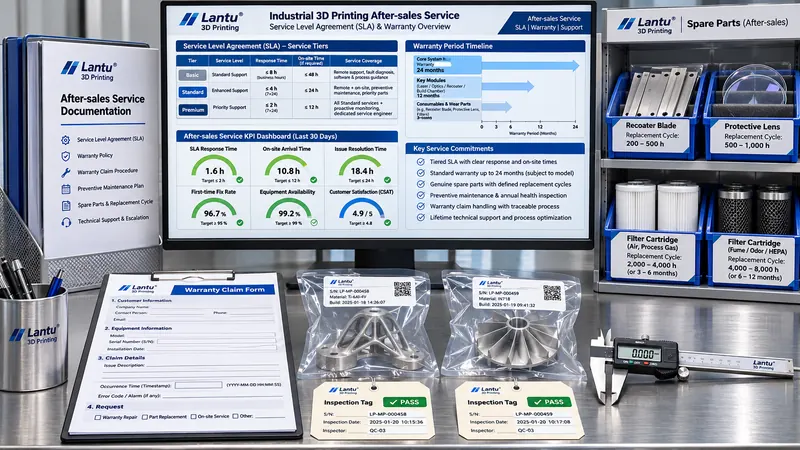
Service requests should be tiered according to their impact on the customer’s production line rather than subjective labels such as “urgent” or “routine.” P1 covers complete equipment downtime, safety risks, or suspected common-origin defects in a batch of parts and requires a response within two hours, a remote remediation plan within 24 hours, and either on-site support or dispatch of a replacement part within 72 hours. P2 covers degraded performance that does not prevent continued production and requires a response within eight hours and an analysis and corrective action within three business days. P3 covers document supplements, parameter consultation, and non-functional questions and requires a response within 24 hours and closure within five business days. Each tier must define what constitutes a “response.” It should mean that the work order has been accepted and assigned to a named owner, not merely that an automated email was sent; otherwise, the timeliness statistics have no practical meaning.
The SLA clock should consistently start from the work-order creation timestamp, including the time zone, with two types of suspension conditions. Time spent waiting for the customer to provide failure logs, samples, or access to the site should not count toward the SLA, but the suspension start and end times must be confirmed by both parties within the work order. Neither party may suspend the clock unilaterally. Escalation should use dual triggers: reaching 1.5 times the target duration for the applicable tier, or a second work order involving the same serial number and the same failure mode within 30 days. Either trigger automatically escalates the ticket one tier and notifies a more senior owner. A default fallback should also apply: if the assigned owner does not accept the ticket within the required threshold, the ticket is automatically reassigned to the backup role, with a complete audit trail. These rules should use the same identity and timestamp system as account permissions and operational audit logs, preventing service records and data-access records from becoming inconsistent.
4. Spare-Parts Commitments and Wear-Item Boundaries
Spares provisions should be defined through an itemized list and quantities rather than a promise to “supply promptly.” Wear items and critical parts should first be grouped by component family: protective window lenses and galvo-related consumables in the optical system; scrapers or powder-spreading blades, seals, and filters in the build system; timing belts and couplings in the motion system; and seals and filtration elements in the powder-delivery system. Each item should specify its recommended replacement interval or MTBF basis, applicable machine models, unit of measure, and whether it is supplied with the machine. Minimum spare-parts inventory should be back-calculated using “installed-base quantity × annual operating hours ÷ MTBF × service-coverage factor.” Replenishment trigger points and committed shipping times should also be defined—for example, dispatch of common items within 48 hours and specialized items within 10 business days—together with ownership and return deadlines for replacement parts supplied on an exchange basis.
One frequently disputed issue must also be addressed explicitly: whether replacing a spare part resets the warranty on the entire machine. Unless otherwise agreed in the contract, the default should be “no reset; only the replaced part receives a separate guarantee of whichever is longer, three months from the replacement date or the remaining warranty term.” This prevents a customer from using a single replacement to extend responsibility for the entire machine indefinitely, while also preventing the supplier from rejecting a newly installed part as “out of warranty.” The spare-parts batch number, issue note, replacement work order, and returned-part reference number must be mutually indexed to form a verifiable closed loop.
5. Cost Allocation for On-Site Service and Repair Determinations
On-site service is expensive and susceptible to misuse, so dispatch thresholds should be established first. A technician should be dispatched only when the issue cannot be reproduced remotely and requires specialized tooling or verification of the installation datum; when it involves interfaces across multiple assembled components; or when it is a P1 issue for which a replacement part cannot be dispatched first. Each dispatch order must include the estimated labor hours, list of tools to be carried, acceptance-signature template, and travel-cost boundaries, including which expenses are borne by each party and how time exceeding the agreed mileage allowance or waiting for customer site conditions is charged. The technician’s on-site output should not be the statement “it has been repaired,” but rather a completed record covering the observed failure, reproduction conditions, measured data, temporary measures, final conclusion, customer confirmation signature, and outstanding risks.
A repair determination should permit only three outcomes, each linked to a cost-allocation matrix. Repair means that, where the supplier is responsible, labor and parts are borne by the supplier, while customer responsibility is charged according to the quotation. Replacement requires the old part to be returned and retained, with costs allocated according to the responsible party. Concession for use requires the customer’s written acceptance of the deviation and an explicit statement that subsequent failures are not covered by the warranty. The cost matrix should be expanded along two dimensions—responsible party and disposition method—with each cell specifying who bears material, labor, logistics, and inspection costs. This avoids item-by-item disputes after the fact. Retesting of repaired parts must reference the original CTQ list and acceptance criteria and cannot rely on visual inspection alone.
6. Claim Periods, Service-Record Evidence Chain, and Performance Dashboard
The claim period should preferably run from the “date of discovery” rather than the date on which the failure occurred. However, the customer should be required to provide written notice within five business days after discovery. The minimum notice fields should include the serial number, contract number, discovery time, failure description, emergency measures already taken, site photographs or log references, and confirmation of whether the failed part has been retained. The discovery date is used because latent defects in additively manufactured parts—such as incomplete internal fusion or residual powder—often remain undetected until the component has been in service for some time. Prompt notice, meanwhile, helps ensure that evidence is not compromised by subsequent machining or handling. The supplier’s corresponding obligation is to issue an acceptance number and evidence checklist under the SLA after receiving notice, after which both parties should jointly freeze the evidence status.
Service records should be organized under ALCOA+: attributable, legible, contemporaneous, original, and accurate, supplemented by complete, consistent, enduring, and available records. Four primary keys must remain consistent throughout: serial number, work-order number, failure code, and log timestamp. Every response, dispatch, replacement, and retest must be linked to these four keys. The monthly dashboard should track at least six metrics: on-time response rate, first-time resolution rate, spare-parts fulfillment rate, on-site dispatch rate, recurrence count for the same failure mode, and SLA achievement rate. It should report P95 response time rather than an average alone, because a large volume of P3 tickets can dilute the average. Recommended targets are an on-time response rate of at least 95%, a first-time resolution rate of at least 85%, and a P95 response time no greater than 1.2 times the threshold for the applicable tier. Two consecutive months below target should trigger a review of the contractual terms and resourcing rather than a temporary increase in staffing.
Conclusion and Minimum Verification Checklist
The professionalism of after-sales service does not depend on how attractive its promises sound, but on whether both parties can retrieve the same set of fields when a dispute arises and reach the same conclusion using the same criteria. Eight matters—warranty commencement, three-state exclusion determinations, P1/P2/P3 response times, spare-parts lists and quantities, on-site dispatch thresholds, cost-allocation matrices, claim periods, and evidence chains—should be written into a technical-agreement appendix. Service then becomes a verifiable engineering issue rather than a matter of attitude. The minimum verification checklist is: ① a T0 acceptance form containing the eight required fields; ② a dual-limit warranty period and record-retention period; ③ four categories of exclusions, each with defined evidence fields; ④ three-state determinations with forced attribution prohibited; ⑤ a three-tier SLA covering commencement, suspension, escalation, and fallback; ⑥ a wear-item list, minimum-inventory back-calculation, and a no-reset provision for the overall machine warranty; ⑦ on-site dispatch thresholds and a “responsible party × disposition method” cost matrix; and ⑧ service records linked by four keys and a six-metric performance dashboard. By implementing these eight controls, every post-delivery service event can be reviewed and improved, allowing the organization to genuinely fulfill its end-to-end commitment from blueprint to physical product.
Invia un modello, un disegno, un'immagine o note scritte. Gli ingegneri valuteranno materiale, processo, finitura e consegna in base all'uso effettivo.