
No model yet, material choice and wall thickness are explained from a practical angle.
Centro Conoscenze
Blueprint News
lantu3D verifica spessore, struttura, materiale, processo, quantità e finitura prima del preventivo.
01Guides
02Materiali
03Punto di vista cliente
Content should help customer decisions
lantu3D articles focus on materials, processes, cost, modeling and manufacturability so customers understand key decisions before submitting a request.

Prototype, fixture, custom part, small batch and cost-control topics for business users.
lantu3D is positioned as blueprint realization and lifecycle management, not just a print shop.
news
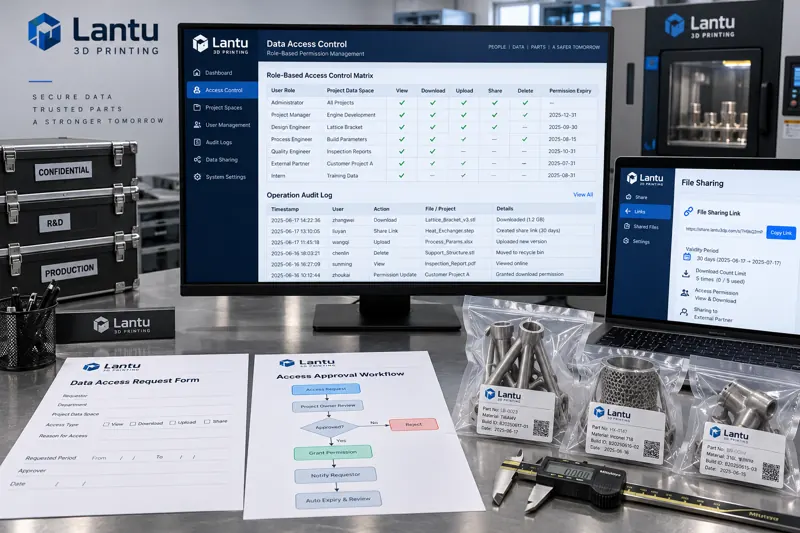
Account Permissions and Access Control for 3D Printing Companies: An Engineering Approach from Role Definition and Least Privilege to Audit Trails
Most data leaks at 3D printing companies are not caused by weak encryption, but by uncontrolled account permissions: permissions are not revoked after role changes, downloads require no approval, and access leaves no trace. This article provides a practical permission engineering framework: organize data objects by project, translate job positions into roles, deny by default and grant temporary access only as needed, separate download permissions from external sharing, manage the account lifecycle in three stages, and implement tamper-proof logs and automated alerts that can answer who did what to which object and when.
news
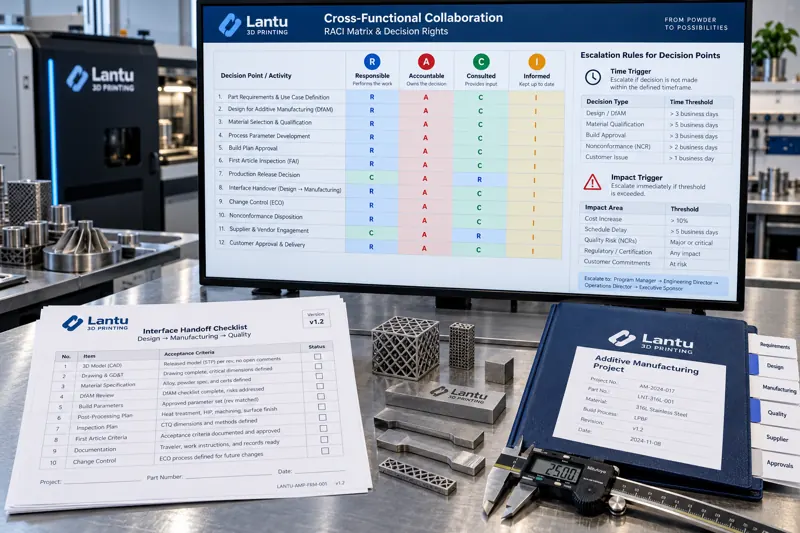
Designing Accountability and Decision Rights for Cross-Functional 3D Printing Collaboration: An Engineering Approach Using RACI Matrices, Interface Checklists, and Escalation Rules
Cross-functional collaboration failures are often not attitude problems, but the result of undefined decision rights. This article presents an actionable engineering approach: break collaboration items into delegable decision units and assign a single accountable owner to each one through a RACI matrix; use interface checklists to define interdepartmental deliverables as acceptance-ready items; resolve disputes through dual-trigger escalation rules based on time and impact, backed by default actions; and use decision, handover, and escalation records for monthly measurement and matrix revision.
news
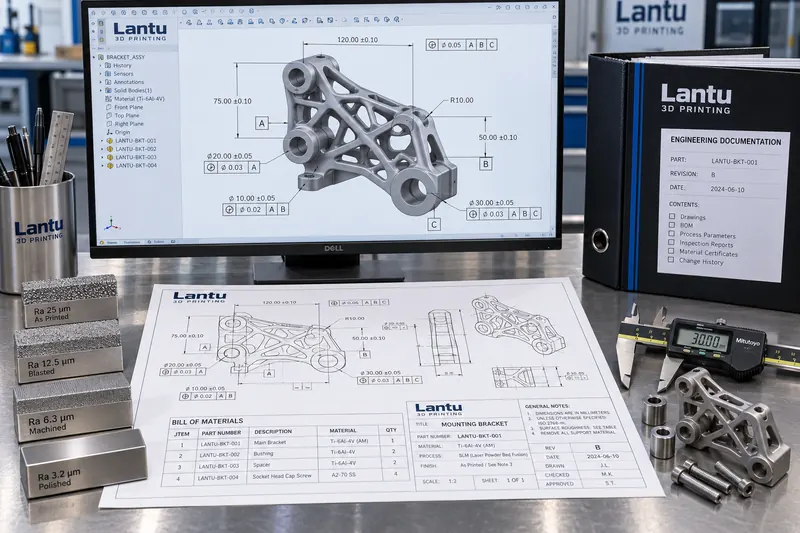
Standardizing Technical Documentation for 3D Printing: From Title Blocks and BOMs to Verifiable Technical Requirements
When the same model produces three different outcomes at three factories, the root cause is often unclear technical documentation rather than equipment. This article outlines the four additional questions additive manufacturing drawings must answer, the fields to standardize in title blocks, delivery-boundary declarations in BOMs, how to turn subjective requirements into verifiable clauses, and methods for version control and change traceability.
news
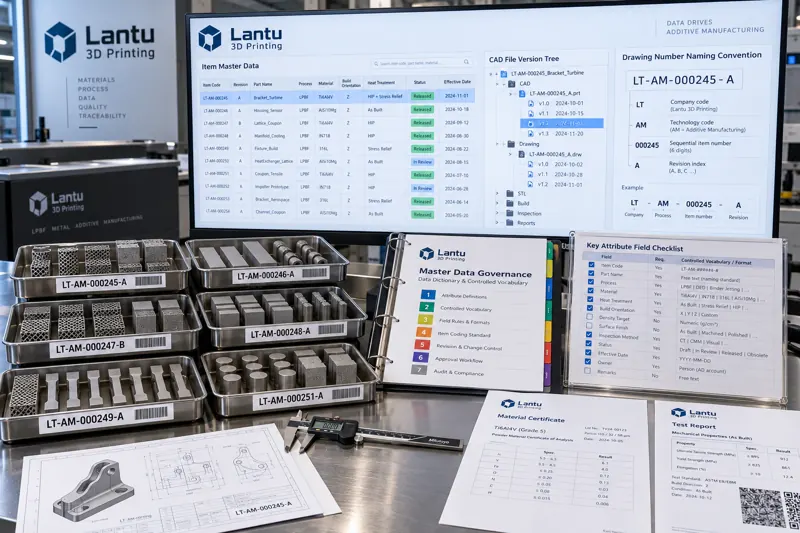
3D Printing Master Data Governance and One-Item-One-Code Traceability: From Coding Rules and Version Indexing to Data Dictionary Implementation
In high-mix, low-volume 3D printing workshops, the most common hidden loss is not downtime but multiple codes for one item: the same part has different identifiers in quotation, process, work-order, and inspection systems, while material batches and process parameters cannot be aligned. This article outlines four core master-data entities, a segmented one-item-one-code structure, criteria for version and drawing-number revisions, a four-step implementation path from code cleanup to system integration, and three measurable acceptance metrics.
news
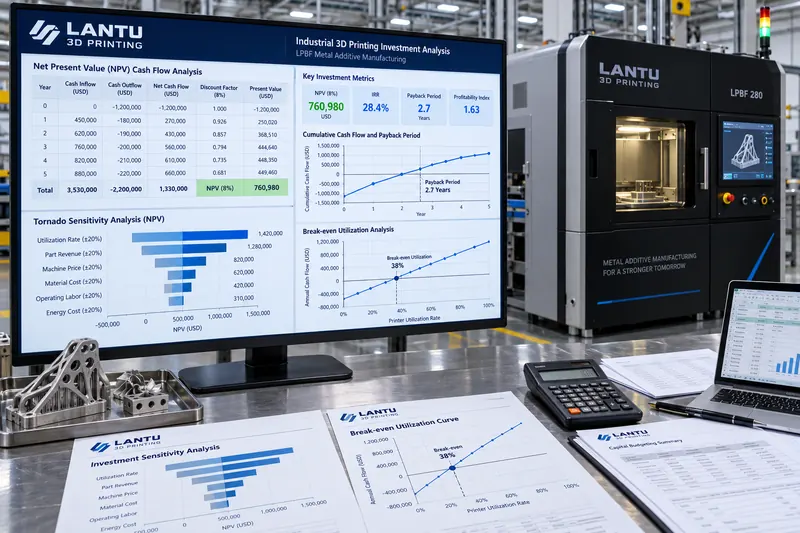
Capital Budgeting Methods for 3D Printing Equipment Investments: A Decision Framework from NPV and IRR to Sensitivity Analysis
Equipment investment decisions cannot rely on TCO alone. This article presents a capital budgeting framework for building 3D printing capacity: use discounted cash flow to account for the time value of money, apply NPV and IRR to establish clear thresholds, use three scenarios and sensitivity analysis to expose volatility in utilization, pricing, energy consumption, and material usage, and calculate break-even utilization and post-investment review milestones.
news
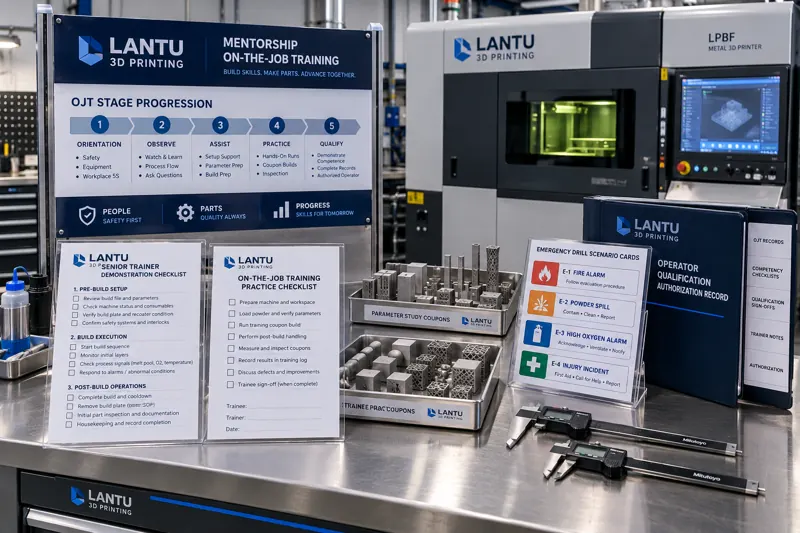
Mentorship and Knowledge Transfer for 3D Printing Talent Development: From Apprenticeship OJT and Internal Trainer Enablement to Job Qualification Authorization
Even well-designed training systems fail when mentorship is not engineered. This article presents a three-tier knowledge model, four-stage OJT plans and release criteria, internal trainer selection and enablement, tabletop and hands-on drills, and methods linking job authorization with reassessment to help additive manufacturing teams turn individual experience into repeatable capacity.

news
Characterization and Incoming Acceptance of Metal Powders for 3D Printing: Actionable Methods from Particle Size Distribution and Apparent Density to Hall Flow Rate
Two certificates of conformance may show identical D50 and oxygen values, yet deliver machine performance differing by several-fold. This article presents a measurable framework for incoming metal powder acceptance: D10/D90 distribution tails, apparent and tap density with Hausner ratio, Hall flow rate, quantification of satellite and hollow particles, and the relationship between BET surface area and oxygen pickup—plus an actionable inspection checklist with six mandatory and two spot-check items, as well as sample-retention rules.
news
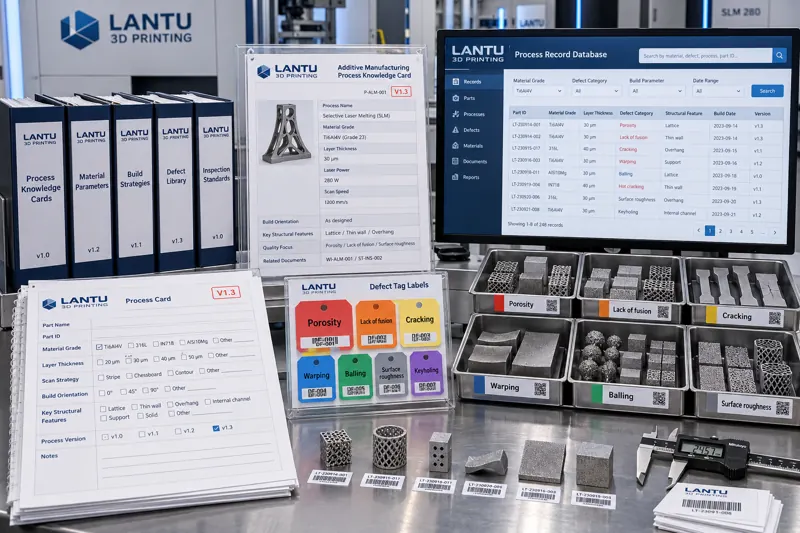
A Structured Approach to 3D Printing Process Knowledge: From Metadata Fields and Controlled Vocabularies to Searchable Process Cards
A knowledge base may be built, yet usable experience can still remain impossible to find—the most common failure mode in knowledge management for 3D printing companies. This article presents a practical structured approach: nine mandatory metadata fields, controlled vocabularies and synonym normalization, a five-part process card template, numbering and version-obsolescence rules, and three acceptance metrics—search hit rate, process card reuse rate, and repeat failure rate—to transform scattered process experience into engineering assets that can be searched, referenced, and version-controlled.
news
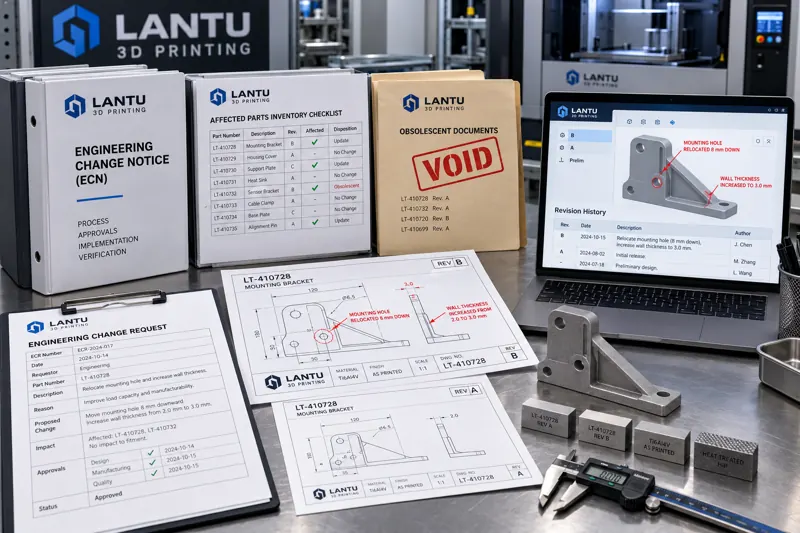
3D Printing Project Change Management: A Closed-Loop Method from Change Requests and Impact Analysis to Version Control
When change requests in 3D printing projects remain verbal, they often result in updated models without revised quotations, obsolete drawings circulating on the shop floor, and process parameters being adjusted casually. This article divides changes into geometric/technical specification changes, internal process changes, and deviations/concessions; provides required fields for a single-entry change request form; outlines five impact-analysis checklists covering technical, process, work-in-process, documentation, and commercial factors; and presents tiered authorization, first-article validation, and five common failure modes with corrective measures.
news
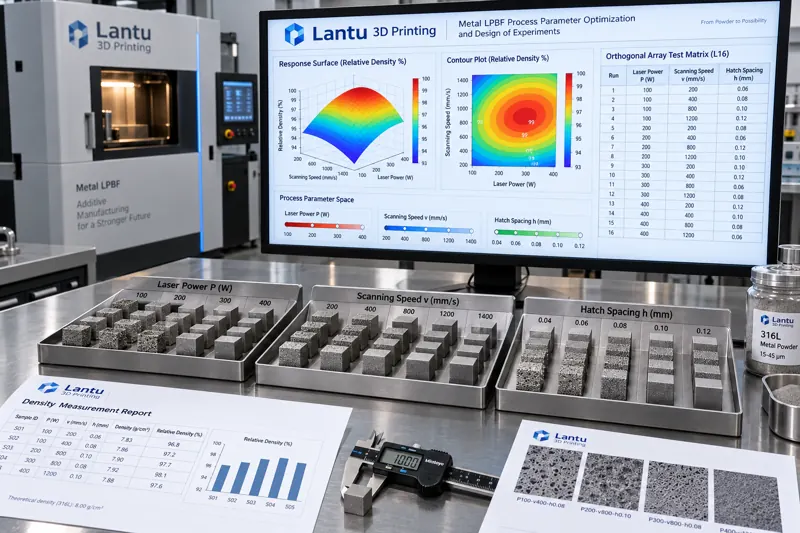
Design of Experiments for 3D Printing Process Development: An Engineering Path from Orthogonal Screening and Response Surface Modeling to Process Window Qualification
Multi-factor coupling makes one-factor-at-a-time parameter tuning ineffective. This article presents a three-tier experimental framework for 3D printing process development: orthogonal experiments screen and rank factors in nine runs; response surface methodology builds quadratic models with interaction effects in about 20 runs and resolves multi-objective trade-offs through desirability functions; overlay contour plots define releasable process windows with a 10% safety margin, supported by an execution checklist and three common pitfalls.
news
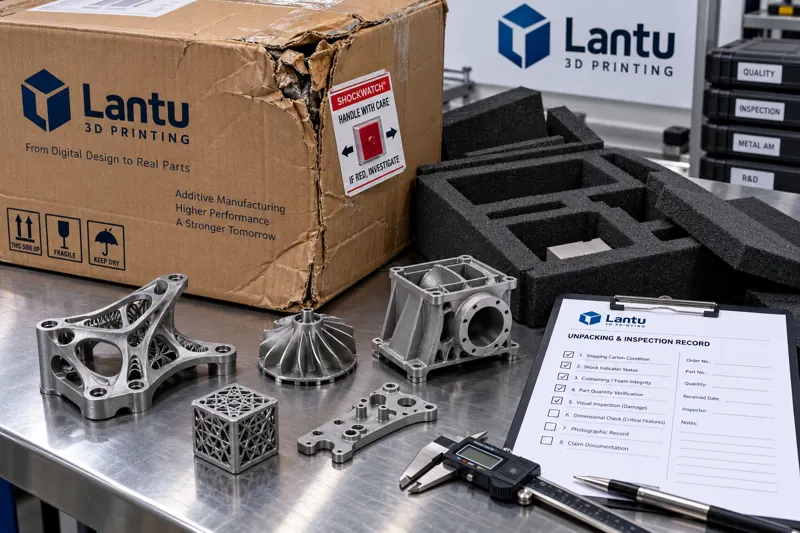
Engineering Handling of 3D-Printed Part Shipping Damage and Claims: From Unboxing Inspection and Evidence Chains to Liability Determination and Time-Limit Control
The root cause of shipping-damage disputes involving 3D-printed parts is often not the damage itself, but the absence of standardized unboxing procedures, evidence chains, and liability criteria. This article outlines damage classifications, a six-step unboxing protocol, five categories of evidence, liability criteria and burden-of-proof allocation, time-limit and loss-calculation methods, and a closed-loop approach for converting individual cases into packaging design rules.
news
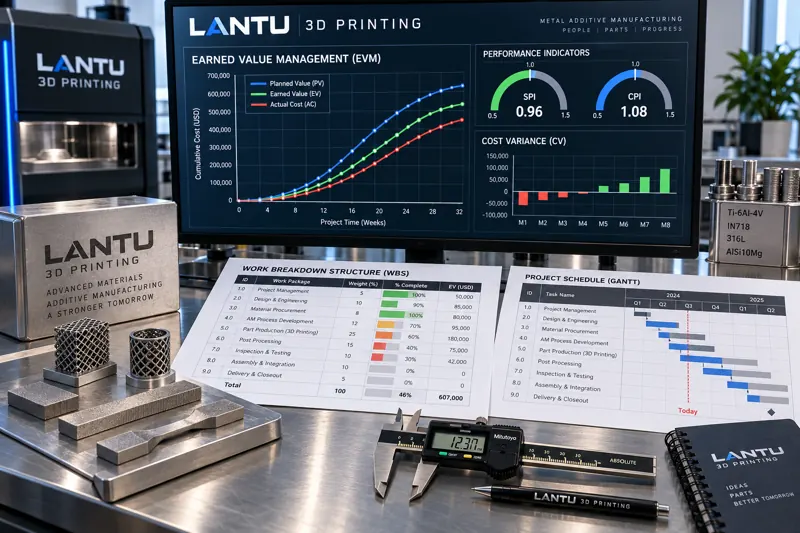
Quantified Schedule and Cost Management for 3D Printing Projects: Engineering Implementation of Earned Value Analysis, SPI/CPI, and Estimate at Completion
3D printing orders are often described as “80% complete,” yet layer progress is not synchronized with actual delivery status or cost incurrence, causing delays and cost overruns to occur at the same time. This article presents an engineering implementation path for Earned Value Management (EVM) in print shops: define PV using work-package weights, define EV using verifiable criteria, consolidate AC under a consistent accounting basis, derive SV/CV/SPI/CPI and forecast EAC and ETC, then link warning thresholds to specific management actions. The result is a measurable foundation for delivery and cost commitments.
Inizia da qui
Have a model, drawing, or only an idea?
Submit your requirement and our engineers will recommend a better design and manufacturing path based on use, size, quantity, material, tolerance and lead time.