
Introduction: Why One Outage Can Cause an Entire Batch of Orders to Miss Delivery Dates
The delivery chain in a metal 3D printing shop is highly interconnected. A laser module failure on one LPBF machine, a delayed shipment of PA12 powder, or a version mix-up in process parameter files can delay more than a dozen orders promised for the same week. Many companies already have contingency plans: contact the OEM when equipment fails, or add shifts to rush urgent orders. However, such plans answer the question, “Who should be contacted after an incident?” They do not answer, “How quickly must operations recover, to what state, and which orders should be protected first if recovery is not possible?” Business continuity management (BCM), with reference to the ISO 22301 framework, fills this gap. It breaks delivery capability into interruptible units, uses business impact analysis (BIA) to quantify interruption costs, works backward from recovery time objectives (RTOs) and recovery point objectives (RPOs) to determine redundancy investments, and verifies through drills that switchover can actually be completed within the target time. It is not an appendix to a risk register, but a measurable, auditable, and verifiable engineering control.
1. BIA: Breaking Down the Delivery Process into Interruptible Units and Quantifying Interruption Costs
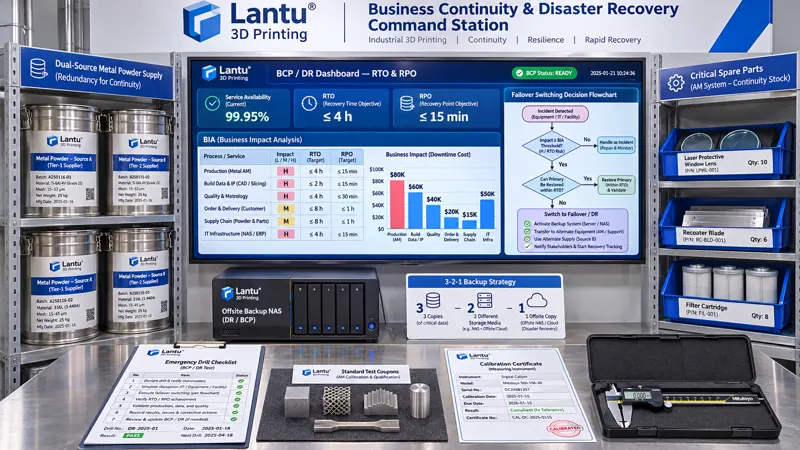
The first step in BIA is not listing risks, but listing delivery functions. A recommended breakdown consists of six stages: “model receipt and process review → powder/resin preparation → printing/building → support removal and post-processing → inspection release → packaging and shipment.” For each stage, record three fields: the time after interruption at which impacts become unacceptable, or maximum tolerable downtime (MTD); upstream dependencies, such as machine model, material batch, tooling, parameter files, and inspection equipment; and direct losses after 1 hour, 4 hours, and 24 hours of interruption, including rework labor, contractual penalties, expedited freight, and customer production-line downtime claims. For example, the MTD for the printing/building stage is often set at 8–24 hours, while the MTD for inspection release may be only 4 hours if it depends on a single CMM, because blocked release causes all completed parts to remain on hold. When the MTD and loss curve for each stage are plotted in the same table, recovery priorities become clear: restore the bottleneck stage first, rather than repairing the most expensive machine first. The output of this step is a numbered function list and classification table. Every subsequent redundancy investment must be traceable to an MTD in that table, preventing situations where spare parts are purchased but critical stages remain unprotected.
2. RTO/RPO: Working Backward from Customer Commitments to Define Verifiable Recovery Metrics
RTO is the latest time by which a function must be restored, while RPO is the tolerable data-loss window. Both must be shorter than the MTD for the relevant functional stage and include a safety margin. A three-tier order classification is recommended: Class A orders, involving customer production-line downtime risk or contracts with penalty clauses, require RTO ≤ 4 hours and RPO ≤ 15 minutes; Class B orders, for standard production parts, require RTO ≤ 24 hours and RPO ≤ 4 hours; and Class C orders, for prototypes and non-time-sensitive parts, require RTO ≤ 72 hours and RPO ≤ 24 hours. Targets must be expressed in verifiable terms. For example: “At any time, the print parameter package and latest calibration records for Class A orders can be rolled back to a version no more than 15 minutes old,” rather than “data loss should be minimized.” RPO determines backup frequency and traceability granularity. A 15-minute RPO requires process parameters, machine logs, and inspection records to have timestamps and incremental snapshots; manually copying files at the end of each workday is insufficient. A 4-hour RPO can use scheduled archiving plus change orders, while a 24-hour RPO can rely on daily off-site backups. The criteria should also include post-recovery status confirmation: after machine recovery, standard test coupons must be used to verify geometric accuracy and energy-density-related conditions, including positioning accuracy, measured laser power, and oxygen level, with retained evidence. A machine running again does not mean the function has been restored.
3. Redundancy Design: Three Switchover Paths for Supply Disruptions, Machine Outages, and Outsourcing Failures
Only after BIA and RTO have been defined does redundancy have a sound basis for investment. Three paths correspond to three categories of single points of failure. Material supply disruption: establish dual sources for metal powders and engineering polymers used in Class A orders. Dual sourcing does not simply mean finding a second supplier; it requires the two powder batches to have D50 particle size distribution, Hall flow rate, apparent density, and oxygen content within the same process window. Blending ratios and first-article validation must be completed in advance to create a “switchable batch list.” Maintain safety stock for critical grades according to MTD, for example, enough to cover a 4-hour RTO plus one replenishment lead time. Machine outage: identify wear parts with the greatest downtime impact, such as protective lenses, recoater blades, filter elements, seals, and vacuum pump oil; set minimum spare quantities based on MTBF and procurement lead time. At the same time, register qualified external capacity capable of handling the same process, clearly defining the partner’s machine models, printable materials, inspection capabilities, and confidentiality boundaries. This turns “finding a supplier at short notice” into “using validated backup capacity.” Outsourcing/system failure: use 3-2-1 backups for model files, process cards, and inspection reports—three copies, on two types of media, with one copy off-site—and prepare offline delivery packages for Class A orders so production can continue under controlled versions even when the MES or file server is unavailable. Each path must specify trigger conditions, decision-makers, switchover action lists, and return-to-primary conditions. Switchover costs, including requalification labor, material losses, and freight, should be estimated in advance as inputs to the BIA loss curve rather than discovered afterward.
4. Data and File Recoverability: Version Control Is a Prerequisite for Continuity
The most common failure in recovery drills is not that equipment cannot be restarted, but that “it has been restored, yet no one is confident enough to use it.” The parameter package version may be unclear, calibration certificates may have expired, or inspection records may not match physical batches. Continuity must therefore be built on version control. Each delivery unit should be linked to four controlled objects: the 3D model, including version number and hash; the process parameter package, including frozen values for laser power, scan speed, layer thickness, and overlap rate; machine-status evidence, including the latest calibration or interim verification record; and inspection release records. Backup objects must include metadata, not just the files themselves: who changed which field and when, which change order applies, and whether obsolete versions have been marked. For Class A orders, create an immutable snapshot after every critical change. During recovery, verify in four steps: model hash → parameter package version → calibration validity → inspection record. If any step fails, the batch is deemed unrecovered and must not be released. This elevates RPO from “the files were not lost” to “the process has been restored to a verifiable and releasable state,” which is also one of the areas most frequently questioned during audits and customer second-party assessments.
5. Recovery Drills: Three-Level Verification from Tabletop Exercises to Actual Switchover
A BCP without drills is only a document. A three-level progression is recommended. Tabletop exercises, conducted quarterly, require personnel in each role to describe their actions and expected duration for interruption scenarios, confirming whether the RTO is achievable and whether decision-making roles have coverage gaps. Component switchover drills, conducted semiannually, involve actual execution of a first-article build using blended dual-source powder, a standard test-coupon check after replacement of a spare part, and restoration of a parameter package from off-site backup followed by hash comparison. Record actual time and deviations. End-to-end drills, conducted annually, simulate an outage at the building stage, transfer a Class A order to backup equipment or validated external capacity, and complete the full closed loop from switchover decision and material/file handover through first-article release and customer notification. Each drill should produce four quantitative results: actual recovery time, actual data-loss window, scrap and rework labor caused by the switchover, and responsibility and corrective-action deadlines for nonconformities. Pass/fail criteria must be strict: if actual recovery time exceeds the RTO, the drill fails. It must not be closed with vague language such as “largely recovered.” Unmet items should enter CAPA and trigger the next round of drills, creating a closed loop of “set targets → verify → correct → re-verify.”
6. KPI Dashboard and Continuous Improvement
Continuity management requires a small set of metrics that can be tracked over time: drill pass rate, calculated as passing drills divided by total drills, with a target of ≥90%; mean time to recovery (MTTR), broken down by interruption type; spare-parts availability, calculated as actual inventory of critical spares divided by defined minimum inventory; dual-source switchable-batch coverage, calculated as backup batches that have completed process validation divided by material grades used for Class A orders; and backup restoration success rate, defined as the proportion passing hash and metadata verification on the first attempt using the four-step check. These indicators should share the same identification system as CAPA in the quality system, MTBF records in equipment management, and safety-stock data in warehousing, rather than being maintained in separate disconnected spreadsheets. Every six months, use actual interruption events and drill deviations to revise the BIA MTD and loss curves. When the business mix changes or customer production-line takt times change, recovery priorities should change accordingly. By including these items as management review inputs, business continuity will not remain a last-minute documentation exercise before a certification audit.
Conclusion
The vulnerability of 3D printing delivery comes from process-chain coupling, not from the unreliability of a single machine. A practical sequence is to first use BIA to break delivery into interruptible units and quantify MTD and losses; then use RTO/RPO to translate customer commitments into verifiable recovery metrics; next deploy dual sourcing, spare parts, backup capacity, and 3-2-1 backups according to those metrics; and finally use three-level drills to verify that switchover truly meets targets and that the recovered state is genuinely releasable. For integrated platforms such as lantu3D, which connect drawings and design through to physical delivery, the value of this approach is not merely reducing machine downtime. It makes “on-time delivery” an engineering capability with measurable indicators and an evidence chain that customers and auditors can verify, rather than a promise dependent on ad hoc coordination.
Invia un modello, un disegno, un'immagine o note scritte. Gli ingegneri valuteranno materiale, processo, finitura e consegna in base all'uso effettivo.