
No model yet, material choice and wall thickness are explained from a practical angle.
Centro Conoscenze
Blueprint News
lantu3D verifica spessore, struttura, materiale, processo, quantità e finitura prima del preventivo.
01Guides
02Materiali
03Punto di vista cliente
Content should help customer decisions
lantu3D articles focus on materials, processes, cost, modeling and manufacturability so customers understand key decisions before submitting a request.
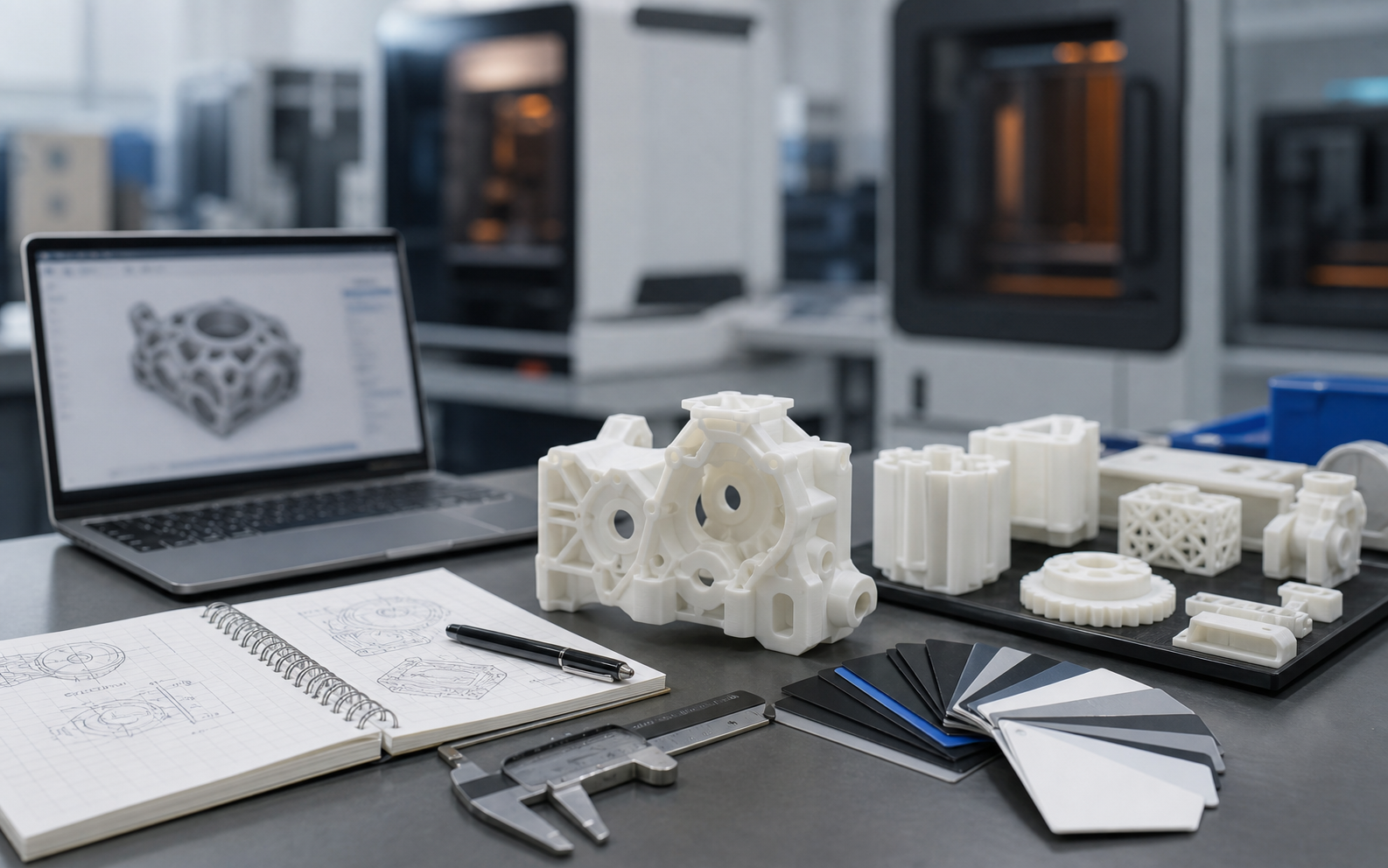
Prototype, fixture, custom part, small batch and cost-control topics for business users.
lantu3D is positioned as blueprint realization and lifecycle management, not just a print shop.

news
Fractography of Failed 3D-Printed Parts: An Engineering Method from Macroscopic Morphology and SEM/EDS Evidence to Crack-Origin Attribution
After a 3D-printed part fails in service, compliant process records and test-coupon data often cannot answer why it fractured or where cracking began. This article distinguishes fractography from defect prevention, metallographic characterization, and 8D processes. It presents fracture-surface protection and sampling, macroscopic three-zone interpretation, SEM/EDS criteria for dimples, cleavage, fatigue striations, lack-of-fusion defects, and keyhole signatures, as well as a four-factor attribution matrix covering material, process, design, and service conditions. The approach translates findings into verifiable parameters such as layer number and coordinates, energy density, fillet radius, and oxygen content to establish an auditable evidence chain.
news
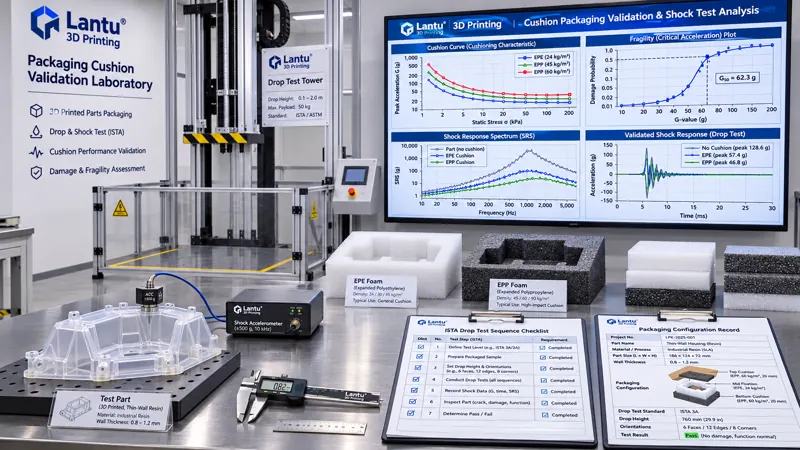
Fragility Calibration and Cushion Packaging Validation for Precision 3D-Printed Parts: A Determinable Method from Drop Height and Cushion Curves to ISTA and ASTM D4169
Thin-walled, lattice, and post-processed 3D-printed parts can fail during delivery from a single drop impact lasting only milliseconds. Simply adding thicker foam may instead transmit acceleration directly to the weakest section. This article converts fragility G-values, drop height, static stress, and cushioning thickness into calculable, reviewable engineering criteria, covering cushion-curve selection, ISTA 2A and ASTM D4169 drop-sequence validation, and calibration and release records accounting for print orientation and post-processing condition.

news
Tribological Validation of 3D-Printed Parts: Release Criteria from Duty Profiles and Sampling Orientation to Wear Rate and Coating Adhesion
Once printed parts enter tribological pairs such as sliders, sealing faces, and guideways, acceptable dimensions and strength cannot predict service life. This article defines duty profiles, PV values, sampling orientation, surface condition, steady-state friction coefficient, and specific wear rate as controlled fields. It provides three-stress-level testing, coating adhesion criteria, Weibull life-extrapolation limits, and five failure modes, upgrading wear validation from wear-track photographs to auditable release evidence.
news
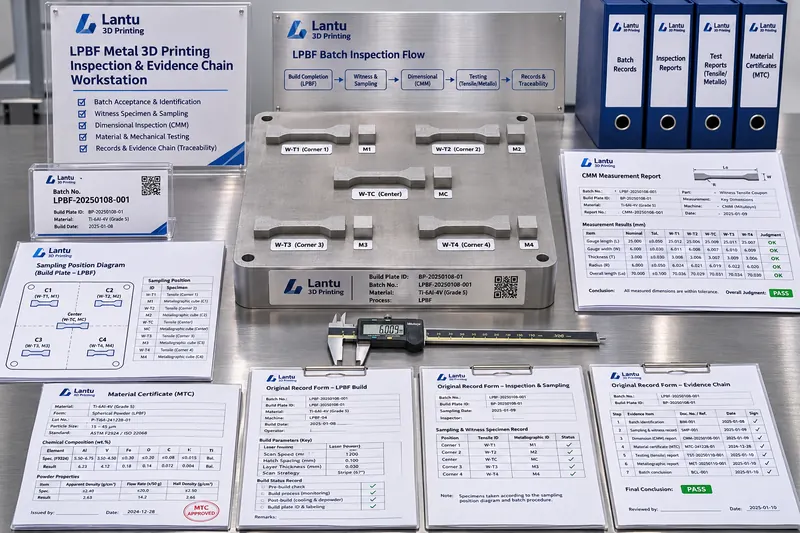
3D Printing Inspection Lot and Witness Specimen Management: An Evidence-Chain Method from Lotting Rules and Sampling Orientation to Original Records and Retained-Sample Retesting
Release disputes in low-volume 3D printing often arise from unclear inspection-lot boundaries, witness specimens built in a different run from delivered parts, editable original records, or batches remaining marked as accepted after nonconforming parts are removed. This article presents a four-factor lotting rule based on material lot, machine, parameter version, and build chamber; records sampling orientations for build witness tensile bars and metallographic blocks; applies ALCOA+ original-record principles and report-template version control; and defines segregation, concession, retention periods, and retest triggers to turn quality conclusions into reproducible, traceable, and retestable engineering evidence.
news
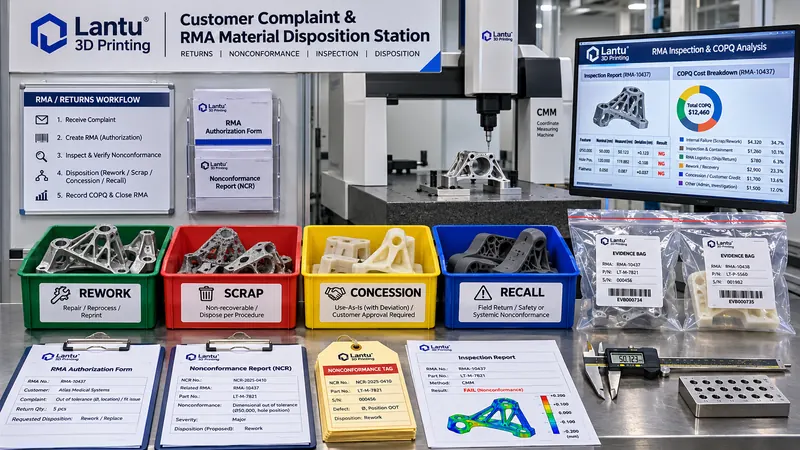
Managing Returns and Recalls for 3D Printing Customer Complaints: An Engineering Closed Loop from RMA Classification and Defect Escape to COPQ Allocation
Simply reshipping a part and issuing an 8D report often overlooks real losses such as downtime, reinspection, concessions, and lost orders. Using customized 3D-printed parts as an example, this article defines the boundaries of returns, replacements, rework, concessions, and recalls; presents A/B/C complaint classifications and RPN thresholds; outlines a seven-node RMA handling chain; details four COPQ categories, defect escape metrics, and recall triggers; and provides a 30-day implementation checklist to help lifecycle delivery operations use after-sales data to improve design, processes, and inspection plans.
news
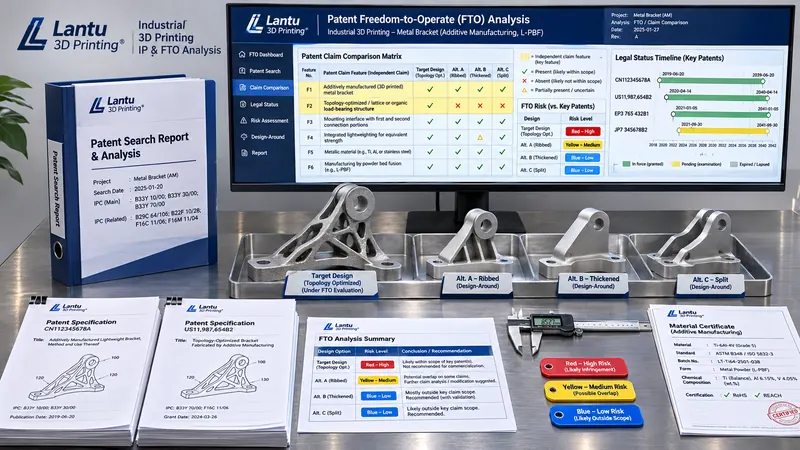
Freedom-to-Operate (FTO) Analysis for 3D Printing Projects: An Engineering Approach to Search Scope, Claim Mapping, Design-Arounds, and Licensing Decisions
3D printing projects often confuse technical feasibility with delivery compliance. This article uses patent freedom-to-operate (FTO) analysis as its central thread, breaking down search scope, feature-by-feature claim mapping, red-yellow-blue risk classification, design-arounds, validity analysis, and licensing calculations. It also proposes four gates—pre-quotation, design freeze, change control, and production release—to turn IP assessment into searchable, reviewable, traceable engineering data.
news
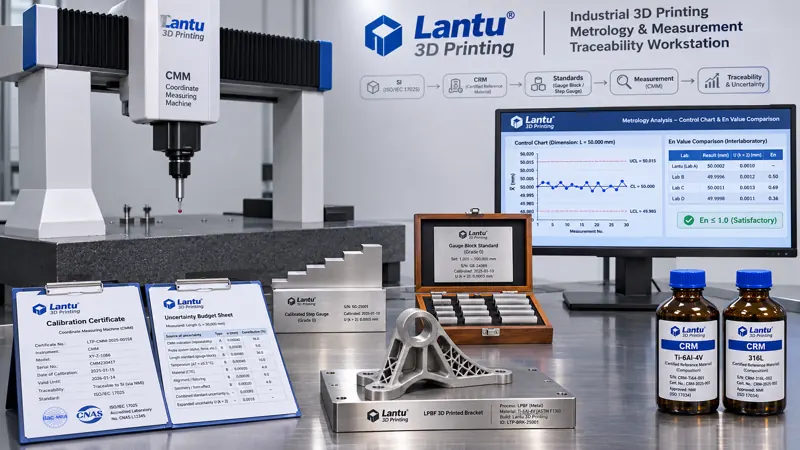
Metrological Traceability of 3D Printing Inspection Data: Engineering Methods for Calibration Certificate Verification, Reference Materials, Measurement Uncertainty, and Interlaboratory Comparison
When two laboratories report 8.019 mm and 8.028 mm for the same part, conformity cannot be decided even within a ±0.025 mm tolerance band. This article breaks the metrological traceability chain into four levels and presents five calibration certificate checks, certified reference materials and intermediate-check control charts, a GUM uncertainty example, En and z-score criteria for interlaboratory comparison, and an ALCOA+ inspection-record chain—turning 3D printing acceptance decisions from “we believe it passes” into conclusions any third party can recalculate.
news
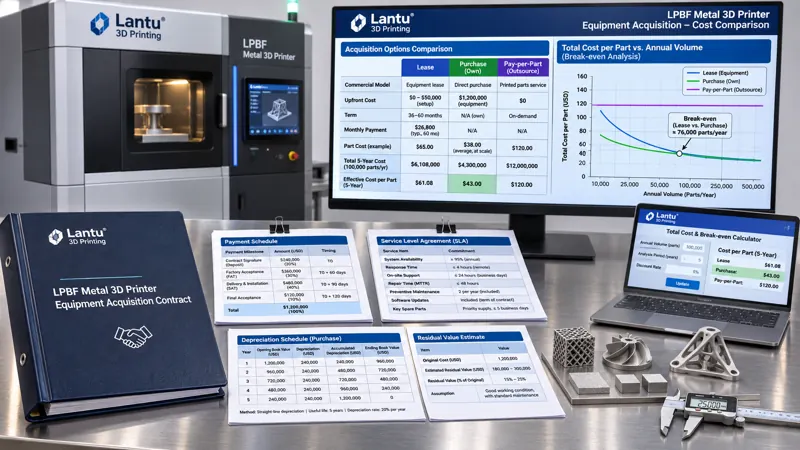
Choosing Contract Structures for Acquiring 3D Printing Equipment: Cost Thresholds and Risk Allocation from Purchase and Leasing to Per-Part Pricing
Equipment investment decisions should not rely solely on TCO and payback period. This article breaks capacity acquisition into four contract structures—direct purchase, operating lease, finance lease, and per-part pricing—using a consistent model to calculate per-part cost curves and identify a utilization threshold of approximately 62%. It also clarifies the allocation of six risks—technology obsolescence, downtime, capacity, process data, residual value, and compliance—and translates them into a negotiable contract checklist.
news
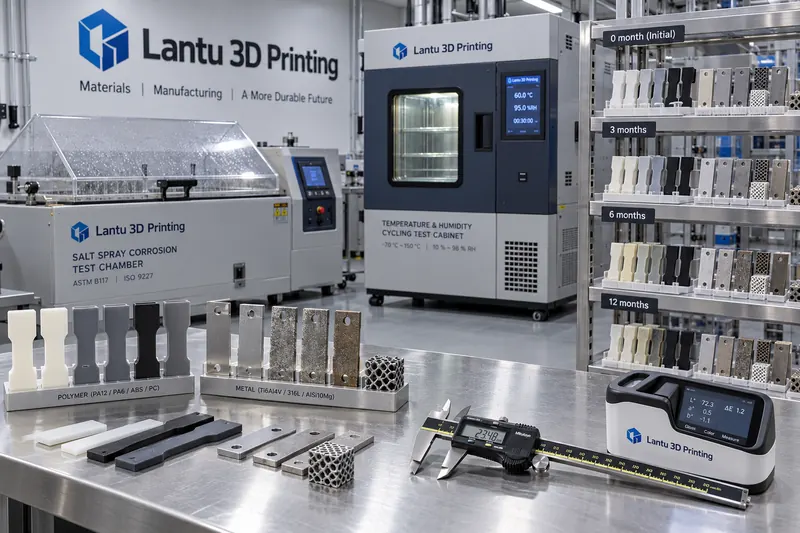
Environmental Aging and Durability Validation of 3D-Printed Parts: Engineering Methods from Salt Spray and Damp Heat to Thermal Cycling and UV Accelerated Testing
3D-printed parts that pass factory inspection may develop coating blistering, resin yellowing, moisture-induced nylon swelling, or metal pitting after six months in service. This article presents a complete methodology covering service-environment profile definition, applicability limits of four basic aging tests, combined-stress accelerated test design, specimen preparation with controlled orientation and surface condition, and Weibull statistical interpretation.
news
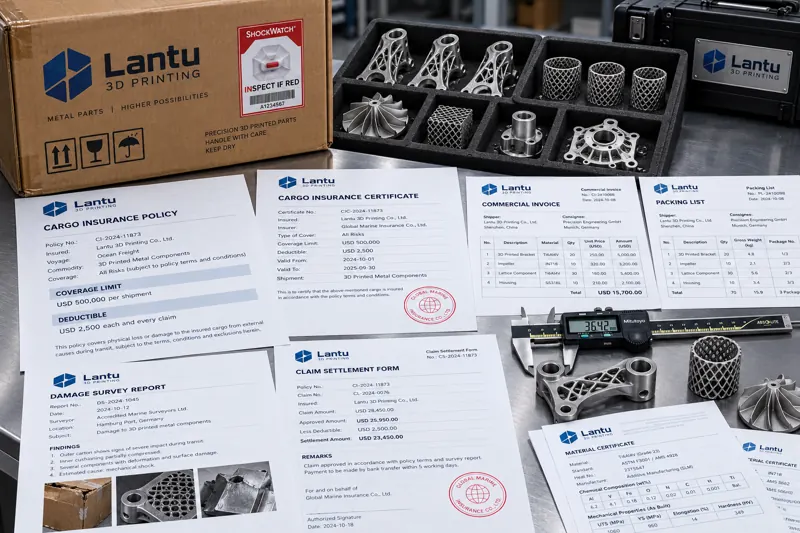
Freight Insurance and Claims Management for Precision 3D-Printed Parts: An Engineering Approach from Coverage Selection to Subrogation
When high-value 3D-printed parts are damaged in transit, compensation often falls far short of the actual loss. This article distinguishes cargo insurance from carrier liability insurance, explains how to complete key policy details such as insured value, deductibles, and packaging declarations, outlines the claims process from notification and inspection to evidence organization and loss quantification, clarifies obligations under subrogation, and provides an actionable pre-shipment risk checklist.
news
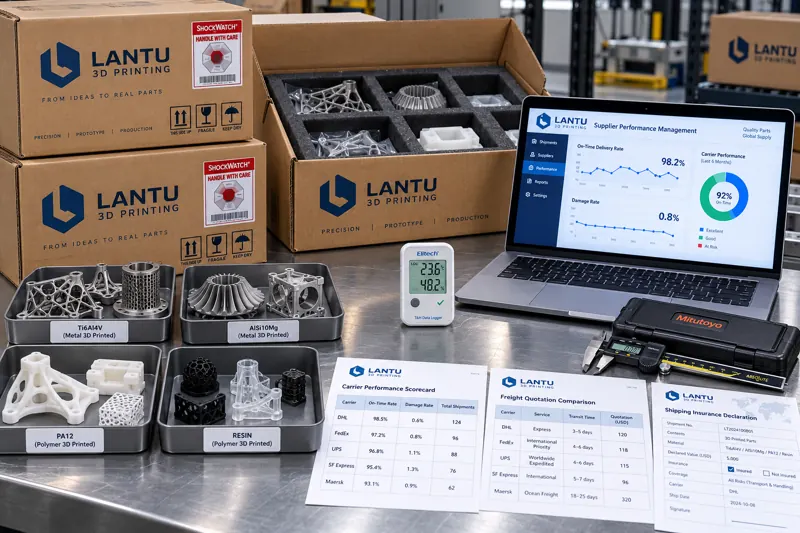
Carrier Management for 3D Printing Deliveries: An Engineering Approach from Qualification and Performance Evaluation to Freight Terms and Damage-Claim Closed Loops
Damage in 3D printing deliveries often stems not from packaging design but from carrier handling. This article presents a practical carrier-management framework: define transport nonconformities as functional damage, cosmetic damage, delivery-time deviation, and missing records; classify deliveries into A/B/C risk tiers with differentiated carrier requirements; build quarterly scores from traceable damage rates, on-time performance, record completeness, and claims cooperation; compare per-part landed cost including freight, surcharges, insurance, monitoring-device amortization, and consequential damage costs; and establish clear terms for insurance limits, claim timing, and burden of proof, then drive continuous improvement through route-plus-packaging classification.
news
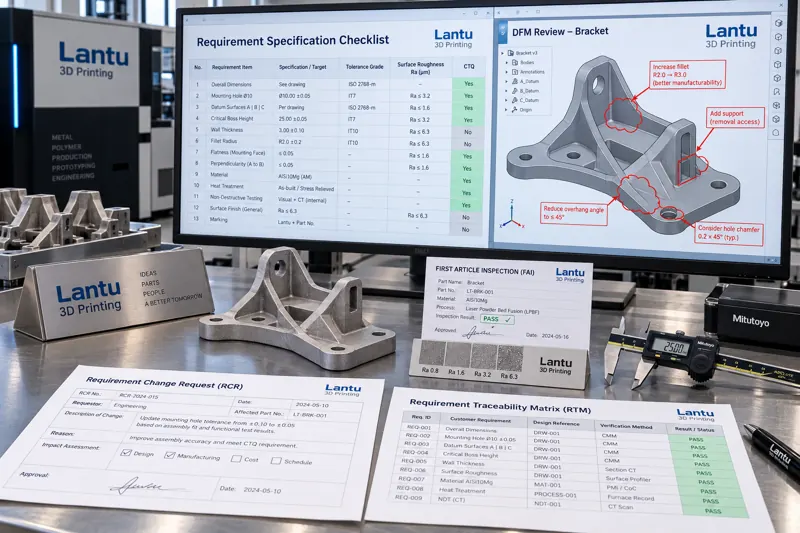
3D Printing Customer Requirements Engineering: From Specifications and CTQ Identification to Sample Approval and Technical Agreements
Most rework in additive manufacturing projects stems from misunderstood requirements rather than printing itself. This article presents a complete method for translating vague requests into verifiable specifications, including CTQ identification and grading, sample approval and first-article sealing, version control for requirement changes, and executable acceptance criteria in technical agreements.
Inizia da qui
Have a model, drawing, or only an idea?
Submit your requirement and our engineers will recommend a better design and manufacturing path based on use, size, quantity, material, tolerance and lead time.