Introduction: Post-Processing Determines the Delivery Quality After a Part Is Printed
In 3D printing projects, many teams focus on equipment, materials, and unit pricing, while underestimating the impact of post-processing on the final deliverable. If an SLA resin appearance part is only washed and lightly cured, it may yellow, warp, or feel tacky after two weeks. If an SLS nylon structural part is not depowdered thoroughly, residual powder can remain in threaded holes, snap-fit grooves, and cooling channels, exposing problems only during assembly. Even if a metal SLM part is successfully built, it still needs support removal, heat treatment, machining, and nondestructive testing before it can be used in real operating conditions. In project evaluation, lantu3D typically treats post-processing as a key engineering stage from blueprint to physical delivery, rather than as an accessory step after printing.
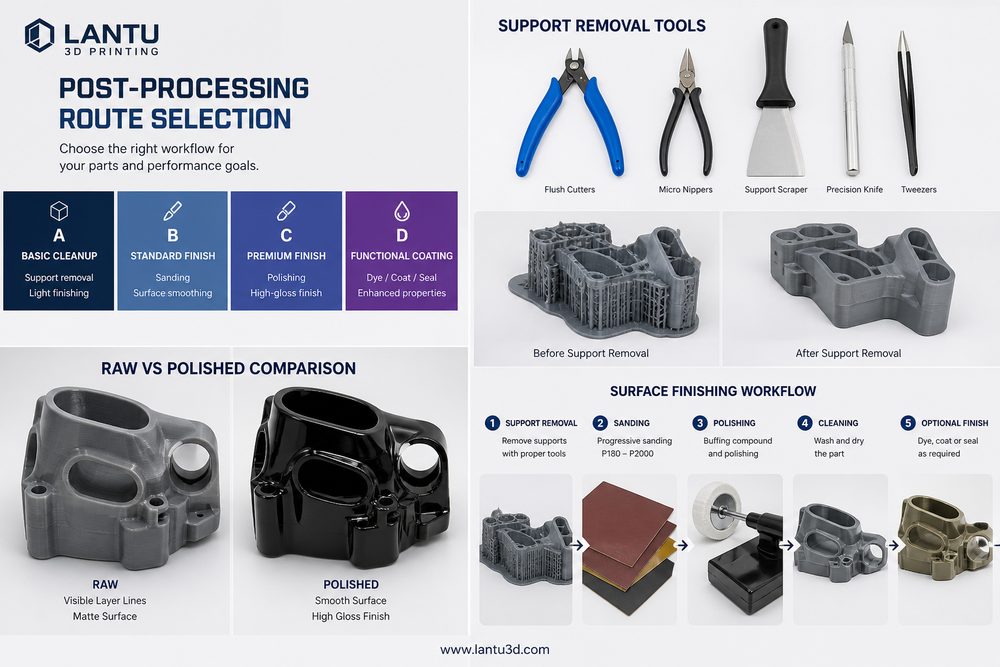
1. Define the Post-Processing Level Based on the End Goal
The choice of post-processing depends first on the part's intended use. A display sample for appearance verification should emphasize uniform surface finish, stable color, and intact edges. An assembly validation part should focus more on hole positions, snap-fits, threads, and mating surface dimensions. A functional test part must consider strength, temperature resistance, fatigue, sealing, and long-term aging. Before placing an order, it is recommended to classify post-processing into three levels: Class A for presentation quality, requiring consistent coating, polishing, or texture; Class B for assembly verification, requiring remeasurement of critical dimensions and, if necessary, CNC finishing; and Class C for functional delivery, requiring heat treatment, impregnation, blasting, surface strengthening, or inspection reports. This classification helps avoid using expensive processes on low-risk areas and prevents critical functional surfaces from being overlooked.
2. Core Post-Processing Differences Between Processes
SLA and DLP photopolymer parts usually require alcohol cleaning, secondary UV curing, support mark trimming, sanding, and coating. If the wall thickness is less than 1.2 mm or the part has a slender cantilever, overlong curing increases brittleness, while insufficient curing affects surface stability. The main priorities for SLS nylon parts are depowdering, bead blasting, dyeing, and checking holes and grooves; narrow channels below 0.8 mm should be evaluated in advance for depowdering risk. FDM parts show more visible layer lines and can be finished by sanding, chemical smoothing, painting, or coating, but dimensional accuracy will change as material is removed. SLM metal parts commonly require support cutting, stress-relief heat treatment, blasting, machining, anodizing, or passivation, and critical load-bearing parts should also undergo CT scanning, dye penetrant testing, or coordinate measuring.
3. Choose a Workflow Using a Cost and Risk Matrix
More post-processing is not always better. For a consumer electronics housing prototype used only for structural review, SLS nylon with bead blasting and light dyeing may be enough. If it is used for an investor pitch, resin printing, fine finishing, primer, topcoat, and clear coat are required, and the lead time will increase by 2 to 4 days. If a drone bracket must pass load testing, a nylon part may need impregnation or glass-fiber reinforced material instead of simply pursuing a smoother surface. Project managers are advised to build a matrix using five dimensions: appearance requirements, dimensional requirements, mechanical requirements, environmental requirements, and production volume. Each dimension can be scored from 1 to 5. If the total score is below 10, basic post-processing is sufficient; if it is 10 to 18, local reinforcement should be selected; if it exceeds 18, post-processing and inspection should be written into the delivery specification.
4. Bring Post-Processing Into the Design Stage
Design stage planning should reserve allowances for post-processing. Painting typically adds a film thickness of 20 to 80 μm, plating layers may reach 5 to 25 μm, sanding removes local material, and heat treatment may introduce minor deformation. For assembly holes, guide rails, snap-fits, and sealing surfaces, it is recommended to define three sets of data: printed dimensions, tolerance compensation, and final dimensions after post-processing. Support contact areas should be placed away from appearance surfaces and mating surfaces whenever possible. Painted parts should be designed with hanging points or masked areas. Metal parts that require machining should reserve 0.3 to 1.0 mm of machining allowance. Moving these constraints upstream reduces rework and communication costs.
5. Quality Inspection and Delivery Records
After post-processing is complete, an inspection checklist should be established: whether there are support scars, cracks, bubbles, or color differences; whether critical dimensions have been remeasured; whether threads, holes, grooves, and snap-fits have been test assembled; whether the surface treatment is evenly covered; and whether packaging prevents friction during transport. For batch projects, it is recommended to retain material batch numbers, equipment IDs, post-processing parameters, inspection photos, and records of abnormal handling. In this way, even if a customer reports a problem later, it can be quickly traced to the design, printing, post-processing, or shipping stage.
Conclusion
The essence of choosing a post-processing workflow is engineering decision-making: finding the right balance among appearance, dimensions, performance, cost, and lead time. lantu3D emphasizes planning post-processing from the design review stage and incorporating it into lifecycle management, rather than waiting until a part is printed and then making ad hoc corrections. Only in this way can 3D printing evolve from making a sample into a stable, repeatable, and deliverable manufacturing solution.
Submit a model, drawing, image or written notes. Engineers will review material, process, finishing and delivery based on actual use.