
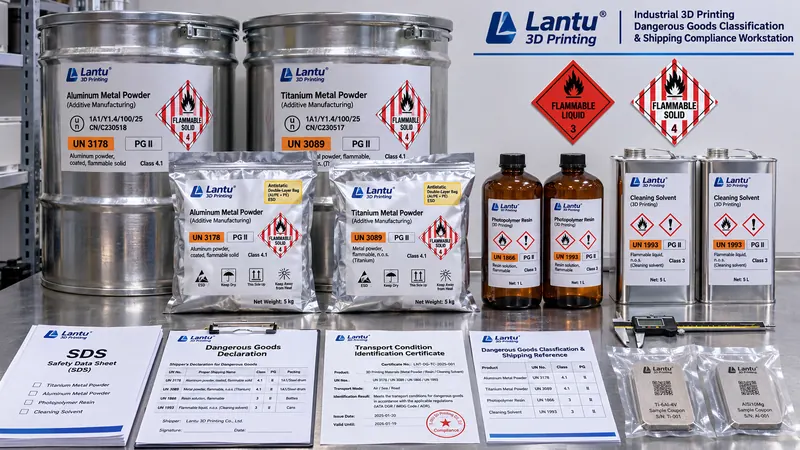
Introduction: A Drum of Powder Rejected at the Shipping Dock
A batch of titanium alloy brackets had completed printing, heat treatment, and full-dimensional inspection. The shipment also included a bag of unused TC4 powder and a drum of isopropyl alcohol for cleaning, enabling customer revalidation and on-site maintenance. When accepting the shipment, the carrier asked only one question: where are the hazardous-property classification test reports for these three items? Without classification conclusions, the entire consignment could not be loaded. The issue was not the parts themselves—dense metal components generally do not constitute dangerous goods—but the fact that the same delivery package contained three materials with entirely different physical states and classification rules. lantu3D extends its service coverage from design blueprints through physical delivery; therefore, pre-shipment classification is not a final logistics formality, but an engineering criterion that must be frozen during delivery-package design.
1. Why Additive Manufacturing Goods Are Particularly Prone to Misclassification
Traditional manufacturing typically ships finished products whose reactions have already been completed, whereas additive manufacturing often ships raw materials, semi-finished products, process consumables, and test specimens at the same time: metal powders, photopolymer resins, cleaning agents, uncured waste liquids, furnace coupons, repair brazing materials, and coating materials. Their hazardous properties do not depend on the order description, but on physical state, particle size, surface coating, flash point, and water-reactivity. Aluminum powder of the same grade may be assessed as general cargo when coarse particles have been passivated and coated, while uncoated fine powder may fall under Division 4.3, substances which, in contact with water, emit flammable gases. Likewise, a photopolymer resin whose closed-cup flash point drops from 62 °C to 48 °C after a formulation change moves from non-hazardous status into Class 3 flammable liquids. An even more common error is to directly apply the non-hazardous conclusion for a finished part to accompanying powder, or to treat the statement “transported as non-restricted goods” in SDS Section 14 as a test report—the former provides composition information, while the latter is the classification conclusion recognized by the transport channel.
2. Break Down to Minimum Shipping Units, Then Classify by Composition
A practical approach is to break a delivery list down to three levels: part number, batch number, and container. Four questions must be answered for each item: is its physical state solid, liquid, or powder; is its closed-cup flash point below 60 °C; does it emit flammable gas or self-heat when in contact with water; and can its dust form an explosive cloud? For metal powders, particle size and coating condition are critical. When D50 decreases from approximately 45 μm to 15 μm, specific surface area rises significantly and minimum ignition energy decreases; a batch previously managed as non-hazardous may require reassessment. Fine titanium-, aluminum-, and magnesium-based powders in particular require separate determination of the boundaries between Divisions 4.1, 4.2, and 4.3. Common corresponding entries include UN 3089, UN 1396, and UN 2546, among others; specific entries must follow the current version applicable to the relevant transport mode, including the UN Recommendations on the Transport of Dangerous Goods: Model Regulations, JT/T 617 for road transport, the IATA DGR for air transport, and the IMDG Code for sea transport. Photopolymer resins and acrylate cleaning agents commonly fall under Class 3 and are assessed under entries such as UN 1993 or UN 1219 to determine their packing group. Nylon PA12 powder, cured resin parts, and formed and thoroughly cleaned 316L/TC4 components can generally be assessed as non-hazardous, but must still be supported by SDS Sections 2, 9, and 14 and by a test report. The UN numbers and thresholds in this article are interpretation examples only and do not replace a Transport Conditions Test Report issued by a qualified assessment organization.
3. Minimum Fields for Classification Reports and the Evidence Chain
An evidence chain accepted simultaneously by carriers, freight forwarders, and destination ports should include at least five elements: an SDS prepared in accordance with the GB 30000 series or GHS classification approach, with Section 14 stating the correct shipping name, hazard class, UN number, packing group, marine pollutant status, and special provisions; transport condition test reports for each transport mode, as air and sea reports cannot substitute for one another and most carriers require reports issued within the previous 12 months; a declaration of consistency between the sample and actual goods, including batch number, D10/D50/D90 particle-size distribution, coating process, and measured flash point; instructions for using UN specification packaging and its performance-test results; and a frozen record stating the formulation version, particle-size range, packaging configuration, and transport mode on which the assessment was based. If any item changes—such as the powder batch, blend ratio, inner-bag material, or transport mode changing from road to air—the assessment conclusion becomes invalid and must be redetermined; an old report cannot be reused. This is the purpose of making classification an engineering criterion rather than a one-time document: the report must be traceable to a specific material batch and packaging configuration, not merely to a generic “company product.”
4. Determinable Selection of Packing Groups, Limited Quantities, and Excepted Quantities
Once the class is determined, Packing Group PG I/II/III directly determines the required performance-test severity. Corresponding drop-test heights are approximately 1.8 m, 1.2 m, and 0.8 m, respectively, along with a 3 m/24 h stacking test and applicable leakproofness or hydraulic-pressure tests. Containers must bear legible UN specification markings and batch traceability numbers. Metal powders are recommended to use antistatic double-layer inner bags, inert-atmosphere sealing, and reliable grounding. Outer packages should be steel drums or UN specification fiberboard boxes validated for the applicable PG, while individual net mass and residual dust must also be controlled. Liquid resins and cleaning agents should retain 5%–10% expansion space and use absorbent cushioning to prevent leakage caused by temperature variations. Where individual quantities are very small, consult the Limited Quantities (LQ) provisions of Chapter 3.4 and Excepted Quantities (EQ) provisions of Chapter 3.5 of the Model Regulations for the code and per-package limit corresponding to the relevant UN number, such as 1 kg, 5 kg, or 5 L, and apply the required marking. Never assume that “no declaration is required below 5 kg.” LQ and EQ differ in the scope of their exemptions, packaging requirements, and documentation obligations; air transport is generally more restrictive than road transport and may prohibit certain exemptions entirely. The sole criterion is whether the packaging plan can be matched item by item in the test report to the UN number, PG, individual net mass, and marking format.
5. Documentation, Marking, and Carrier Handover Fields
Before handover, place six fields on a checkable shipping checklist: the correct shipping name and UN number, including technical names in parentheses where required; hazard-class and subsidiary-risk labels; packing group and number of packages/net mass; UN specification packaging marking and performance-test document number; LQ/EQ marking or a full dangerous-goods declaration; and SDS and test-report version numbers and validity dates. Air shipments additionally require a Dangerous Goods Declaration (DGD) and acceptance checklist. Sea shipments must be completed in accordance with IMDG stowage and segregation requirements, while road shipments must be checked against JT/T 617 requirements for vehicles, placards, and onboard documentation. Markings must be placed on visible outer-package surfaces and must not coexist with obsolete labels. Residual old diamond labels on reused return boxes are a frequent reason for on-site rejection due to non-compliant marking. All documents should be retained with the delivery package and linked to inspection records, powder batch numbers, and model versions, creating one continuous record chain from blueprint to physical product. When a dispute arises, what can be retrieved is not memory, but a set of version-controlled data fields.
6. Five Common Failure Modes and Release Criteria
The first failure mode is “classifying by order rather than material,” whereby an entire shipment is exempted from assessment simply because the finished product is non-hazardous. The second is “classifying by grade rather than state,” ignoring changes in particle size, coating, and flash point. The third is “classifying by an old report rather than the current batch,” disconnecting the test report from the actual material batch. The fourth is “classifying for one transport mode but using another,” such as using a road-transport conclusion for an air-shipment declaration. The fifth is “classified but unmarked,” where packaging, labels, and documents are inconsistent. Based on these risks, four release criteria are established: every minimum shipping unit has a corresponding classification conclusion; the formulation, particle size, packaging, and transport mode underlying that conclusion are consistent with the actual goods; packaging and marking can each be traced back to that conclusion; and document versions remain valid and are available with the shipment. Goods may be handed over to the carrier only when all four criteria are satisfied. If any criterion is missing, the shipment must be returned for completion; uncertain goods must not be shipped merely because of schedule pressure.
Conclusion: Write Classification Conclusions into the Delivery Package
Hazardous-property classification may appear to be the final step before shipment, but it is actually part of delivery-package design. Breaking goods down by part number and container, determining class based on composition and state, freezing the basis through test reports, making packing groups and markings traceable item by item, and applying the four release criteria can prevent high-cost events such as shipment rejection, port inspections, and last-minute document amendments before goods leave the warehouse. For a full-lifecycle platform that provides materials, printing, post-processing, and delivery, the value of this approach extends beyond compliance: each delivery carries a set of engineering data that can be reviewed, traced, and reused. When the same material and packaging are used again, the process does not need to start from scratch.
Submit a model, drawing, image or written notes. Engineers will review material, process, finishing and delivery based on actual use.