Introduction: Why Delivery Disputes Always End Up as “Expediting and Apologies”
In 3D printing projects, the greatest drain on trust is often not a technical challenge, but a delivery dispute. A customer model arrives three days late, an engineering change is added midway, and a designated third-party inspection is queued for a week; the final delivery is seven working days late. Yet both parties can only argue from chat records: the customer believes “you were slow to begin with,” while the service provider says “you changed the requirements.” Most companies do not lack goodwill; they lack an engineering method that can translate delay events into numbers that can be entered into formulas, recalculated by both parties, and included in a settlement statement. Schedule and cost claims are not litigation tactics; they are part of project baseline management. They answer: which delays fall on the critical path, how many days should be extended, what compensable costs result, and which losses must be borne internally.
I. Define Responsibility Boundaries First: Four Claimable Events and Four Self-Borne Events
The first threshold for a claim is not calculating money, but determining responsibility. It is recommended that a event responsibility matrix be frozen as a contract appendix, classifying common interruptions into four types of claimable events: ① customer-side input delays, including model files, technical agreements, customer-supplied materials, or sample approval not provided on time; ② customer-initiated changes, including ECNs, geometry revisions, material-grade changes, or stricter acceptance criteria; ③ waiting for customer-designated actions, including third-party testing, airworthiness or medical certification, customer-site witnessing, or queues at designated outsourced heat-treatment providers; and ④ force majeure and contractually specified external interruptions, including power restrictions, logistics lockdowns, and statutory inspections. Conversely, four categories of self-borne responsibility must be clearly stated: unplanned equipment downtime and failures of consumable parts such as protective lenses or recoater blades; process parameter tuning and first-article rework; scheduling errors and displacement caused by rush orders; and default by the service provider’s subcontractors. The key question is simple: who controls this event? If the boundary is not written into the contract, all subsequent quantification may be overturned during settlement negotiations.
II. Baseline Schedule: Without a Frozen WBS, There Is No Claim
The reference point for a claim is the baseline schedule, not a verbal delivery promise made by sales. At project kickoff, a version-controlled six-stage WBS should be frozen: model review and data validation (10%), material preparation and powder/build-plate readiness (10%), additive build (35%), post-processing such as support removal and heat treatment (15%), machining and inspection release (20%), and finishing, packaging, and shipment (10%). Each stage should specify planned duration, predecessor dependencies, milestone ID, and critical-path status. The baseline must be confirmed in writing by both parties. Any change must follow an ECN process and generate a new version number, such as BL-2026-014-R2. A common practical failure is “changing while working, with no R0 throughout the project.” At settlement, neither the original critical path nor the actual impact of an event can then be established. The baseline freeze date, R0 Gantt chart, and bilateral sign-off page are all indispensable.
III. Schedule Notices: Convert Events into Time-Stamped Evidence
A schedule notice should be issued on the day a claimable event occurs; do not wait until settlement. The minimum field set includes: event ID, such as E-2026-014-03; occurrence and resolution timestamps, accurate to the hour; responsible party; affected WBS stage and milestone ID; build number or work-order number in process at the time; evidence list, including emails, change orders, customer-supplied material receipts, testing queue confirmations, and six-angle site photographs; and signatories from both parties. The contract should specify the time limit for notice of intent to claim. A common industry practice is to submit notice of intent within 28 days of the event and a complete quantified report within 42 days; late submission constitutes waiver. This is not unduly strict, because after three weeks even equipment logs and powder batch records may have been overwritten. The notice itself does not discuss monetary amounts; it fixes only “when, due to whom, and which stage was stopped.” Amounts are calculated in Sections V and VI. Every input must come from traceable records; retroactive completion is prohibited.
IV. Quantifying Critical-Path Delay: Only Delays Pushing the Critical Path Merit an Extension
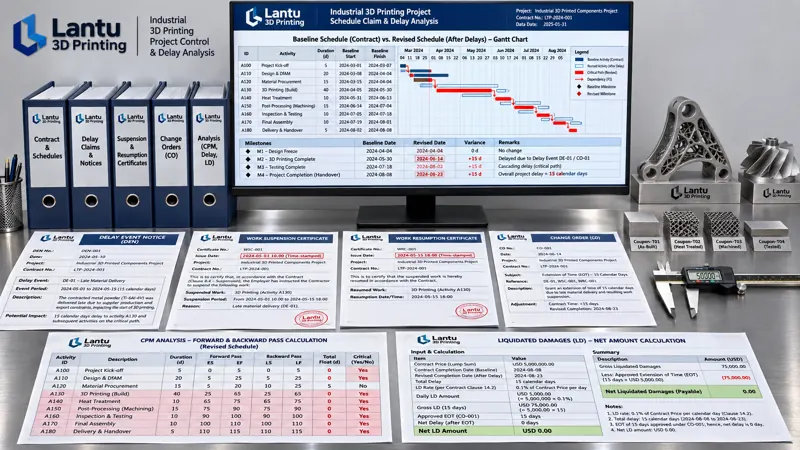
The core criterion comes from the Critical Path Method (CPM): a delay generates a schedule extension only after it consumes the activity’s total float (TF) and affects the critical path. Let D be the event impact duration and TF be the total float of the affected activity. The extension days are Δ = max(0, D − TF). If the activity is not on the critical path and D ≤ TF, then Δ = 0; the event is recorded but not claimed. For example, if a customer ECN stops the build stage, which is on the critical path with TF=0, for 3.5 days and also requires 1.5 days of repeat first-article testing, then Δ = 5.0 days. If the same event occurs in the “finishing and packaging” stage, where TF=4 days and D=2 days, then Δ = 0 because the shipment milestone is not pushed. The calculation package must include R0 and R2 Gantt charts, forward-pass and backward-pass calculation sheets for each affected path, and the actual recovery time after the event is resolved. When multiple events overlap within the same activity, calculate by the union of time intervals; do not double-count. This is the area most vulnerable to inflation. The output should contain three columns: event ID, Δ days, and revised milestone date.
V. Concurrent Delays: Allocation Rules When Both Parties’ Causes Overlap in the Same Period
Real projects rarely involve clean, one-sided delays. A customer model may arrive two days late while the service provider experiences a 1.5-day shutdown caused by laser protective-lens contamination, with the time windows overlapping. The rules should be frozen before calculation: ① do not count the same period twice; use the union of calendar intervals to determine net delay; ② identify the primary cause that occurred first and could independently cause delay, and assign responsibility for that window accordingly; ③ where no primary cause can be identified, allocate according to the contractually agreed ratio, commonly 50/50 or based on each party’s share of downtime hours, and state the allocation basis and sensitivity analysis in the report, including the impact of a ±10% ratio change; and ④ overlapping periods caused by the service provider are never compensable in cost, even where a partial schedule extension may be available. Use a three-state decision table: extension with compensation / extension without compensation / no extension and no compensation, marking each event accordingly. The greatest mistake in concurrent delay is for each party to report its own days and then add them together; that effectively sells the same calendar period twice.
VI. Cost Claims and Counterclaims: Convert Days into Settleable Amounts
A schedule extension does not automatically result in payment. Compensable costs are limited to items actually incurred because of the event and incapable of being absorbed through rescheduling: daily equipment and workstation occupancy rates, calculated as machine-hour rate multiplied by net extension days; extended storage and custody of work-in-process and customer-supplied materials; labor for revalidation of frozen parameters and repeat first-article inspection; secondary queue charges for customer-designated third-party testing; and financing costs calculated at the contractual interest rate. Explicitly exclude expected profit, service-provider efficiency losses, machine time that can be absorbed through combined builds, and routine management expenses with no causal connection to the event. The standard formula is C = Σ(daily rateᵢ × compensable daysᵢ) + one-time reinspection fees, with every item linked to a supporting document number. The other side should include a cap on liquidated damages (LD) and a counterclaim mechanism. If the service provider is the primary cause of delay, it bears liability under common contractual terms, such as 0.5% per week capped at 5% of the contract value, and the customer may also submit counterclaims for shutdown losses. The report must therefore present both “amount due to us” and “amount payable by us,” with the net amount entered into the settlement statement. Freeze the monetary basis, currency, tax rate, and document index in advance to avoid debating whether a particular labor hour is eligible during settlement.
VII. The Six-Document Claim Package and a 30-Day Implementation Checklist
A complete report needs only six deliverables: ① version-controlled baseline WBS and R0/R2 Gantt charts; ② the event responsibility matrix and schedule-notice summary, including proof of timeliness; ③ CPM forward-pass/backward-pass calculation sheets and detailed Δ-day calculations; ④ the three-state concurrent-delay assessment and allocation basis; ⑤ cost-item calculation sheets and supporting-document index, plus the net LD/counterclaim amount in two columns; and ⑥ bilateral sign-off and dispute recalculation rules, under which either party may recalculate using the same templates within 10 working days, with third-party schedule assessment required only where the variance exceeds 5%. Implement in five steps: in Week 1, include the responsibility matrix and notice template in contract appendices; in Week 2, supplement all active projects with frozen R0 baselines; in Week 3, connect equipment logs, customer-supplied material receipts, and testing confirmations to the notice evidence list; in Week 4, conduct a desktop recalculation exercise using one historical disputed project; thereafter, review three KPIs quarterly: notice timeliness rate, Δ recalculation consistency rate, and net settlement cycle time. The eight self-checks are: whether the baseline is signed by both parties, whether events are notified within 28 days, whether each Δ includes TF, whether overlaps use interval unions, whether concurrent delays use the three-state assessment, whether costs are supported by documents, whether LD/counterclaims are presented in two columns, and whether recalculation rules are written into the contract.
Conclusion
The engineering core of schedule and cost claims is translating “who delayed whom” into an equation that both parties can recalculate: freeze the baseline → issue a notice on the day of the event → calculate only the Δ that pushes the critical path → use interval unions for overlaps and three states for concurrent delays → convert days into documented cost items → place them alongside LD and counterclaims to obtain a net amount. This approach does not create conflict; on the contrary, when the responsibility matrix, total float, and daily rates are defined before work begins, most disputes are naturally resolved at the notice stage. For platforms such as lantu3D that manage projects from design drawings through physical delivery, this method transforms delivery commitments from sales language into a version-controlled, evidence-based, settleable engineering contract.
Submit a model, drawing, image or written notes. Engineers will review material, process, finishing and delivery based on actual use.