Introduction: Talent capability sets the floor for 3D printing delivery
In 3D printing services, customers usually only see the quote, sample, and delivery date, but what truly determines delivery stability is a full set of role capabilities covering model review, process decisions, post-processing control, and acceptance communication. Even with the same machine and the same PA12 nylon or photopolymer resin, differences in an operator’s understanding of wall thickness, build orientation, support density, depowdering time, and curing windows can lead to dimensional deviation, surface defects, assembly interference, or rework. lantu3D focuses on full lifecycle management from design to physical delivery, so talent training should not stop at “being able to run the machine”; it must form a reproducible engineering decision-making system.
1. Role capability map: breaking experience into trainable modules
The first step in a training system is to define a role capability map. Model review staff need to master minimum wall thickness, hole compensation, chamfers and fillets, part splitting and joining, and file version control. Process engineers need to understand the material windows of SLA, SLS, MJF, SLM, FDM, and other technologies; for example, resin parts often use a layer height of 0.05-0.1 mm, functional SLS nylon parts commonly use 0.1-0.15 mm, and metal SLM parts also require attention to support heat conduction and subsequent heat treatment. Post-processing staff must know support removal, sanding, bead blasting, dyeing, painting, UV curing, and depowdering standards. Quality inspectors need to be familiar with calipers, plug gauges, thread gauges, coordinate measuring machines, or 3D scanners and their appropriate use cases. Project managers, meanwhile, must connect requirement freeze points, change records, delivery risks, and customer confirmation milestones.
2. Modeling standards training: teaching new hires to identify risks first
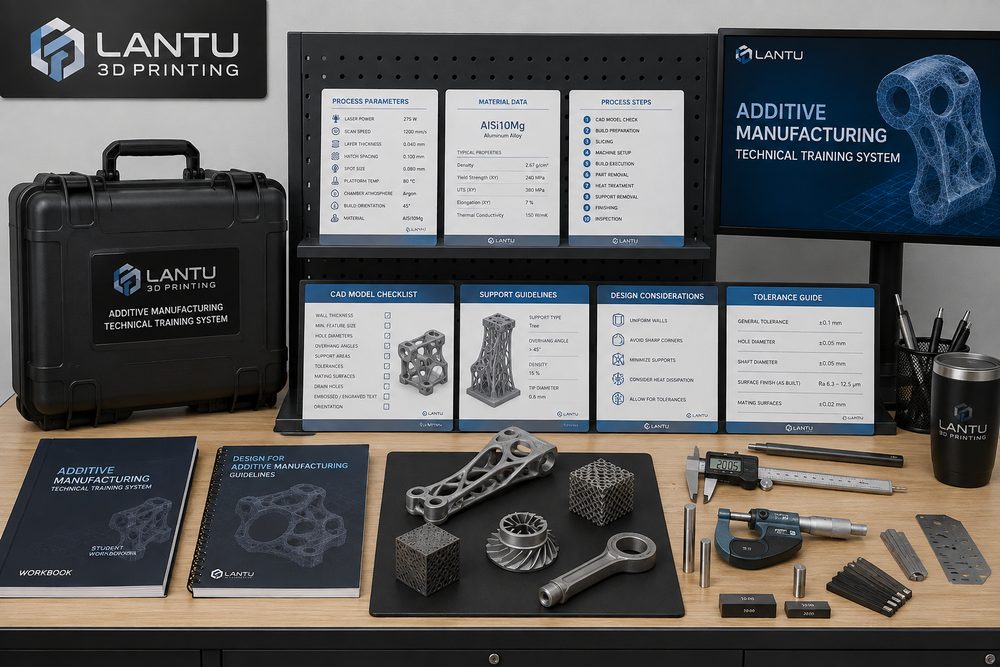
Many reworks are not print failures but manufacturing risks that existed in the model from the start. Training should include a model review checklist: decorative thin-wall parts are generally recommended to have a wall thickness of no less than 0.8-1.2 mm, while load-bearing functional parts usually require more than 2.0 mm along with reinforcing ribs. Blind holes and deep grooves should be checked for powder removal accessibility, and enclosed cavities that cannot be depowdered in SLS must include powder-release holes. For assembled parts, 0.15-0.4 mm of clearance should be reserved according to the process, and extra allowance should be added for surface coatings after painting or plating. Each new hire should practice identifying risk points on 20-30 real historical models and compare those annotations with final delivery results, so they can move from “looking at a model” to “predicting the physical part.”
3. Process parameter training: using a case library instead of verbal experience
The biggest mistake in process training is teaching only conclusions. A more effective approach is to build a parameter case library that records material batch, build orientation, layer height, support strategy, post-processing method, and inspection results. For example, even when both are display parts, SLA resin can produce a finer surface, but large thin panels may warp during post-curing. Likewise, for snap-fit structures, SLS PA12 offers better toughness than ordinary brittle resin, but its grainy surface and dimensional shrinkage must be explained in advance. The case library should include both successful examples and failure postmortems, with defect photos, root-cause judgments, corrective actions, and revalidation results recorded at a minimum. In this way, when new staff face similar projects, they do not choose a process by intuition; they make engineering decisions based on traceable data.
4. Post-processing and quality inspection training: turning “looks good” into acceptance criteria
Post-processing training should turn subjective aesthetics into executable standards. Whether support marks are allowed to remain after support removal, whether sandblasting roughness affects mating surfaces, whether dyed parts show batch color variation, and whether transparent resin requires multi-stage polishing and clear-coat protection should all be defined in the work instructions. The quality inspection stage also needs grading: appearance samples focus on surface quality, color consistency, and obvious deformation; assembly samples focus on hole positions, snap fits, and mating clearances; functional parts focus on load direction, thread strength, and temperature or chemical resistance. For critical dimensions, first-article 100% inspection, in-process sampling, and final-piece verification can be used, with sampling rates set between 5% and 20% depending on batch size and risk level.
5. How to implement training: exams, mentorship, and a closed-loop review process
Truly effective training requires a closed loop. The first stage is standards learning, in which new hires must become familiar with material manuals, process capability boundaries, and quoting input requirements. The second stage is shadow projects, where a mentor guides the trainee through model review and process recommendations. The third stage is independent handling of low-risk orders, with delivery acceptance results used for scoring. The fourth stage is review of complex projects, where trainees learn how to handle customer changes, delay risks, and quality disputes. Each month, 5-10 typical projects can be selected for review meetings, and the questions of “why it failed,” “how it was detected,” and “how to prevent it next time” should be added to the knowledge base. In the long run, this system turns experience into organizational capability instead of leaving it in the minds of individual engineers.
Conclusion: the goal of training is stable delivery, not isolated skills
The core of 3D printing talent training is not to produce one person who can operate a machine, but to build collaborative capabilities across design review, process selection, production execution, post-processing, inspection, and customer communication. For a lifecycle management and fulfillment platform like lantu3D, the more standardized the training system, the more controllable the project risk and the more consistent the delivery experience for customers. Companies can start with four tools—role capability maps, model review case libraries, parameter recording sheets, and acceptance checklists—and turn complex experience into process assets that are learnable, verifiable, and continuously optimizable.
Submit a model, drawing, image or written notes. Engineers will review material, process, finishing and delivery based on actual use.