Introduction: There are often a dozen critical questions behind a simple “Can you print this for me?”
In 3D printing projects, customers often start the conversation with a simple “I have a model, can you print it?” However, engineering delivery requires many more questions to be answered: Is this part for display, assembly verification, or long-term load-bearing use? Does it need heat resistance, toughness, flame retardancy, or transparency? Are the dimensional tolerance requirements ±0.1 mm, ±0.3 mm, or only close in appearance? Does post-processing include painting, dyeing, threaded inserts, or surface polishing? If this information is not clarified before quoting, price changes, delivery delays, or acceptance disputes are very likely later on. lantu3D emphasizes full life-cycle management from blueprint to physical part, and requirement analysis is the first gate in turning an idea into a deliverable solution.
1. The use case is the starting point of requirement analysis
The same model may require a completely different process route depending on the application. For a housing used at a trade show, the focus is on a fine surface, consistent color, and visual completeness, so SLA resin with sanding and painting may be more suitable. For a functional test clip or snap-fit part, the focus is toughness, fatigue resistance, and assembly feel, so SLS PA12 or MJF nylon is usually a safer choice than brittle resin. For a fixture used in a high-temperature environment, the material’s heat deflection temperature must be evaluated; ordinary resin may only offer a 50–70°C operating window, while heat-resistant resin or nylon composites can provide a larger safety margin. Therefore, the first step in requirement analysis is not asking “what material do you want,” but “what task will this part perform, and in what environment?”
2. Turn vague requests into measurable specifications
Customers often say “make it stronger,” “make it more accurate,” or “make the surface better.” These expressions must be converted into measurable specifications. Strength can be broken down into tensile strength, bending strength, impact resistance, or thread torque. Accuracy can be split into key dimensions, tolerance ranges, and measurement methods. Surface quality can be defined by layer-line level, color, gloss, tactile feel, and allowable defects. For assembly parts, it is recommended to mark the critical mating areas in the requirement sheet and define the clearance, for example leaving 0.2–0.4 mm for sliding fits, while interference fits need trial assembly based on material elasticity and post-processing thickness. Only when the criteria are measurable can quoting, production, and acceptance share the same basis.
3. Quantity, schedule, and budget define the boundaries of the solution
3D printing is suitable not only for rapid prototyping but also for small-batch production, yet the optimal solution changes with quantity. For 1–3 concept samples, delivery time and appearance should be prioritized. For 10–50 functional parts, batch consistency, build orientation strategy, and sampling inspection standards become important. Once the quantity exceeds 100, it is necessary to compare the overall cost of 3D printing, silicone molding, CNC machining, or injection-molding trials. Budget limits are equally important. If the customer only needs internal validation, high-end painting may not be necessary. If the part is for sales display, however, investment in surface finishing may increase its value. The role of requirement analysis is to establish transparent trade-offs among function, time, cost, and risk, rather than simply providing the lowest price.
4. From requirements to an engineering plan: lantu3D’s breakdown method
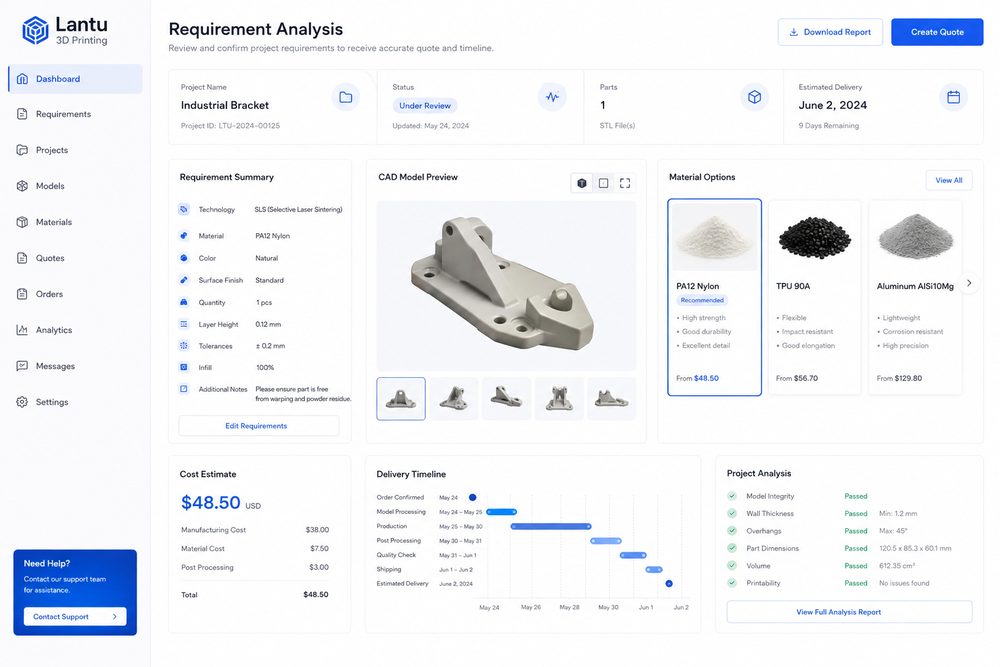
A deliverable solution usually includes six types of information: model status, material and process, post-processing method, delivery quantity, inspection criteria, and risk warnings. Model status should specify the file format, version, and whether repair or modification is required. Material and process should explain the reason for selection as well as alternative options. Post-processing should list support marks, sanding scope, color standards, and protective packaging. Inspection criteria should clearly define key dimensions, appearance grade, and sampling rate. Risk warnings should proactively explain issues such as thin walls, sharp corners, enclosed cavities, long overhangs, heat deformation, or color variation. Writing these items into the plan can significantly reduce communication costs caused by “we didn’t make that clear at the time.”
5. Acceptance criteria must be confirmed before placing the order
Many delivery disputes occur at the end of a project, but the root cause lies in the early requirement stage. For appearance parts, it is recommended to confirm with reference photos, color swatches, or surface-grade descriptions. For assembly parts, define the sample test-fit process and the allowed number of rework attempts. For batch parts, establish a first-article approval process so mass production only begins after the first piece is approved. For critical functional parts, simple load tests, heat-resistance tests, or simulated use-case testing can be added when necessary. The earlier acceptance criteria are confirmed, the easier future changes are to manage. If the customer’s requirements change during production, a change record should be used to reassess price, lead time, and quality risks.
Conclusion: Requirement analysis is an engineering tool for reducing project risk
Customer requirement analysis is not a sales tactic; it is an engineering tool for 3D printing project management. It breaks vague ideas into use cases, performance targets, material and process choices, production volume, budget limits, and acceptance standards, giving every step actionable criteria. For lantu3D, the earlier the requirements are clarified, the earlier risks can be identified at the quoting stage, the less rework is needed during production, and the higher customer satisfaction will be at delivery. Customers can also better understand price differences and technical trade-offs through a transparent plan, and get a physical result that truly fits the intended scenario more quickly.
Submit a model, drawing, image or written notes. Engineers will review material, process, finishing and delivery based on actual use.