Introduction: Why the Same Model Can Receive Different Quotes
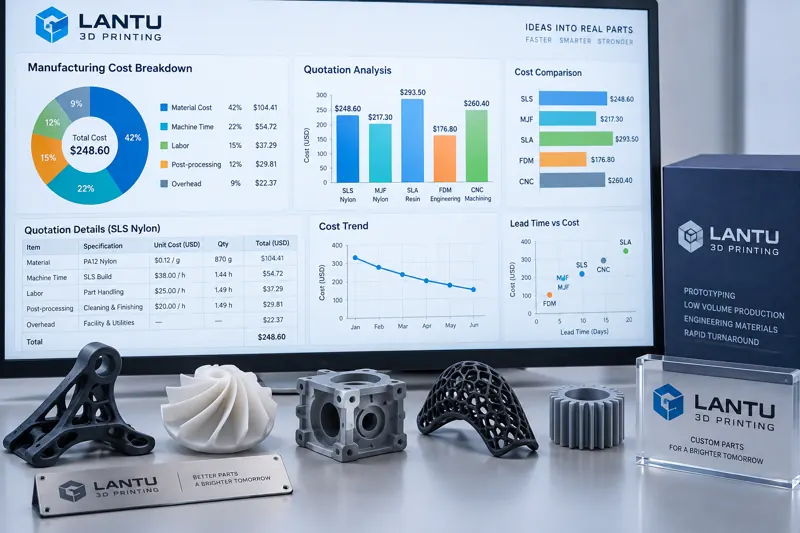
When enterprise clients request 3D printing quotes, they often find that the same STL file can receive prices that differ by 30% or even by more than a factor of two. On the surface, this looks like price competition, but behind it are differences in material grade, machine capability, nesting method, post-processing standards, inspection requirements, delivery commitments, and communication costs. If you choose only the lowest price, you may pay more in size accuracy, strength, appearance, or delivery time.
The goal of transparent quoting is not to make every project the cheapest possible, but to help customers clearly see where the money goes, where the risks are, and which requirements will significantly increase costs. lantu3D, as a management and execution platform from design blueprint to physical delivery, treats quoting as part of engineering decision-making: first clarify the intended use and acceptance criteria, then match materials, process, and delivery method, rather than pricing only by volume multiplied by a unit rate.
1. Material Costs: More Than Just a Price Per Gram
Material cost is the easiest part of a quote to understand, and also the easiest to misunderstand. The procurement cost differences between photopolymer resin, SLS nylon, metal powder, and carbon-fiber-reinforced materials are obvious, but the final quotation also includes material waste, support consumption, powder refresh rate, failed reprints, and batch management. Taking SLS nylon as an example, the customer sees the part weight, but the supplier must also account for full-chamber powder occupation, the proportion of reused powder, and sieving losses.
Material grade also affects price. Standard display resin is suitable for visual verification, but high-toughness, heat-resistant, or biocompatible resins require stricter storage and curing management. In metal printing, titanium alloy, stainless steel, and aluminum alloy differ not only in powder price, but also in protective atmosphere requirements, heat treatment, and inspection requirements. Therefore, when requesting a quote, customers should specify the operating environment, such as whether the part will bear load, the maximum temperature, whether it will contact skin, and whether flame resistance or food-contact compliance is required.
2. Machine Time: Printing Is Not Free Waiting After Pressing a Button
Machine time usually includes preparation, printing, cooling, part removal, and machine cleanup. As the height of a part increases, printing time may rise significantly; if multiple small parts can be nested efficiently, unit cost may decrease. For FDM and photopolymer equipment, time cost is related to layer height, supports, and exposure area. SLS also depends on full-chamber nesting efficiency, while metal SLM is affected by scan path, layer thickness, and protective gas consumption.
Rush orders change machine scheduling. Under normal lead times, suppliers can combine multiple projects into a single nesting plan and improve equipment utilization; if a customer requests delivery within 24 hours, it may require a dedicated machine run, overtime post-processing, or a change in production schedule, all of which will appear in the quotation. Transparent quoting should distinguish standard lead time, expedited lead time, and non-compressible steps to avoid promises that seem fast but cannot be delivered reliably.
3. Model Preparation and Engineering Support: Hidden Costs Often Determine Success
Many quote differences come from model preparation. The file provided by the customer may contain non-manifold geometry, insufficient wall thickness, normal direction errors, assembly interference, or unclear scale units. A simple platform may print directly from the file and leave the failure risk to the customer, while an engineering-oriented service will inspect wall thickness, hole diameter, support surfaces, deformation risk, and post-processing accessibility before production, and then provide revision suggestions.
This work requires experience. For example, if a housing part has a local wall thickness of only 0.6 mm, SLA can form it, but it may break easily during transport or assembly; if the opening direction of an SLS snap-fit is not appropriate, it may still jam after powder removal; if a metal part does not account for heat-treatment deformation, key hole positions may exceed tolerance. Although engineering review increases early communication time, it reduces failed reprints and project delays, making it a cost item that enterprise clients should pay attention to.
4. Post-Processing and Inspection: The Clearer the Acceptance Criteria, the More Reliable the Quote
Post-processing includes support removal, sanding, bead blasting, dyeing, painting, electroplating, heat treatment, machining, and assembly. Different post-processing steps have a major impact on labor, equipment, and yield. A display part requiring Class-A cosmetic painting and an internal verification part that only needs deburring cannot possibly have the same cost. If the customer does not specify visible surfaces, color, texture, and mating surfaces in advance, disputes are likely to arise after delivery.
Inspection must also be defined during the quotation stage. Standard samples may only require caliper spot checks, functional parts may require a critical-dimension report, and precision parts may require CMM, optical measurement, or material certification. The more inspection items there are, the higher the quotation, but in return the delivery becomes traceable. Enterprise clients can list key dimensions, allowable tolerances, mating objects, and acceptance quantity in the inquiry sheet so suppliers can quote against the same standard.
5. How to Build an Enterprise-Level Inquiry Template
To obtain comparable quotes, enterprise clients should provide seven types of information: 3D file format, part purpose, material preference or performance requirements, quantity and batch size, appearance and post-processing standards, critical dimensions and tolerances, and expected lead time. If confidentiality is required, an NDA should also be signed in advance and data usage boundaries should be clearly defined. This allows suppliers to determine whether the job is a rapid sample, a functional validation part, a trade show display piece, or a small-batch end-use part.
When requesting a quote, customers should also ask the supplier to define delivery boundaries, such as whether model repair is included, whether taxes and shipping are included, how failed reprints are handled, whether color consistency is guaranteed, whether dimensional reports are charged separately, and whether rush service is feasible. Transparent quoting is not one-way disclosure of costs, but a way for both sides to clearly define requirements and responsibilities. In this way, procurement, R&D, and suppliers can communicate around the same goal.
Conclusion
3D printing quotes are made up of materials, machine time, engineering support, post-processing, inspection, and delivery risk. Once enterprise clients understand these factors, they can move from “comparing the lowest unit price” to “comparing total delivery value.” A clear inquiry template, explicit acceptance criteria, and traceable project records can significantly reduce rework, delays, and communication costs. lantu3D hopes to help customers turn the quoting process into a reliable manufacturing decision rather than a one-time price guess.
Submit a model, drawing, image or written notes. Engineers will review material, process, finishing and delivery based on actual use.