Introduction: Digital supply chains are turning 3D printing from prototyping into reliable delivery
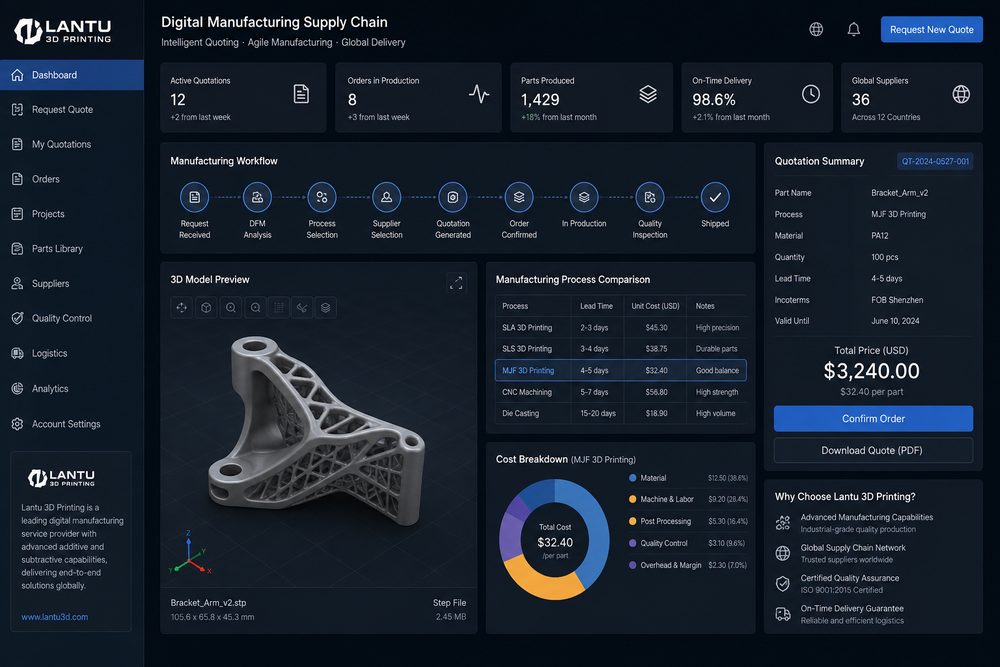
The pain points in 3D printing projects are not limited to the printing stage. They are spread across requirement confirmation, model repair, material selection, cost estimation, scheduling, quality inspection, post-processing, and logistics delivery. When each step depends on manual messages, projects can easily run into version confusion, inconsistent quoting standards, inaccurate delivery commitments, and missing quality records. The goal of a digital supply chain is to turn the journey from design file to finished part into a data-driven process that can be tracked, reviewed, and improved.
1. Models and requirements are the source data of the supply chain
A STL or STEP file alone is not enough to support an accurate quote. The platform also needs to collect the intended use, quantity, material preferences, precision requirements, surface finish, color, assembly relationships, and delivery timeline. After the model is uploaded, it should automatically record volume, bounding-box dimensions, wall-thickness risks, non-manifold edges, thin-wall areas, and support requirements. Only when this information is structured can later pricing and process recommendations move beyond individual engineer experience.
2. Digital quoting requires a breakdown of cost structure
3D printing quotes usually include material consumption, machine time, labor, post-processing, inspection, packaging, shipping, and a risk buffer. A digital system can generate an initial quote based on material density, print time, build-plate utilization, and post-processing complexity, then allow engineers to adjust it for special requirements. For batch orders, the system should also separate the cost of first-piece validation from the cost of repeat production, so customers do not assume that sample pricing can be applied directly to mass production.
3. Supply chain coordination improves delivery certainty
Once an order enters production, the platform should log the machine, material batch, print orientation, layer height, post-processing method, and inspection results. If a machine goes into maintenance or material stock runs short, the system can quickly switch to an alternative process or flag a delivery risk. For composite projects that require CNC machining, spraying, dyeing, or assembly, a digital work order can clearly define the owner, inputs and outputs, and acceptance criteria for each step.
4. Customer service evolves from status updates to decision support
What customers really need is not just “your order is in production,” but clarity on where the risks are and what the next best choice should be. A digital supply chain can present model repair suggestions, material alternatives, cost differences, estimated lead times, and quality records. When customers need to balance strength, appearance, and turnaround time, the platform can offer evidence-based guidance instead of a single price.
Conclusion
The core of digital transformation is not adding more spreadsheets; it is removing information gaps. By connecting design, manufacturing, inspection, and delivery data end to end, lantu3D upgrades 3D printing services into a project-lifecycle execution platform, helping customers achieve a more stable and transparent manufacturing experience.
Submit a model, drawing, image or written notes. Engineers will review material, process, finishing and delivery based on actual use.