Introduction: Delivery quality doesn't end at the production site
After a 3D-printed part has been printed, post-processed, and inspected, the quality risks are not over. Vibration, drops, compression, humidity changes, and temperature swings during shipping can still cause brittle resin parts to crack, precision models to warp, thin-walled structures to wear, or surface coatings to get scratched. For a full-process manufacturing platform like lantu3D, packaging and transportation are the final stage of engineering control from physical production to customer acceptance, and they must be considered together with design, materials, post-processing, and quality inspection standards.
1. Start by classifying parts by risk before choosing a packaging strategy
Different 3D-printed parts need different packaging priorities. SLA resin parts offer fine detail but are relatively fragile; slender columns, thin shells, and transparent parts need protection against bending and scratching. SLS nylon parts are more impact-resistant, but their porous surfaces easily attract powder and dust, and dyed parts must also be protected from rubbing and color transfer. Metal printed parts are strong but heavy, so if they are not secured properly during transport, they can damage other components. Before packaging, it is best to evaluate risk across five factors: brittleness, weight, surface requirements, dimensional accuracy, and assembly relationships. That assessment should determine the inner lining, isolation method, and outer carton specification.
2. Inner packaging: fixing parts is more important than simply filling space
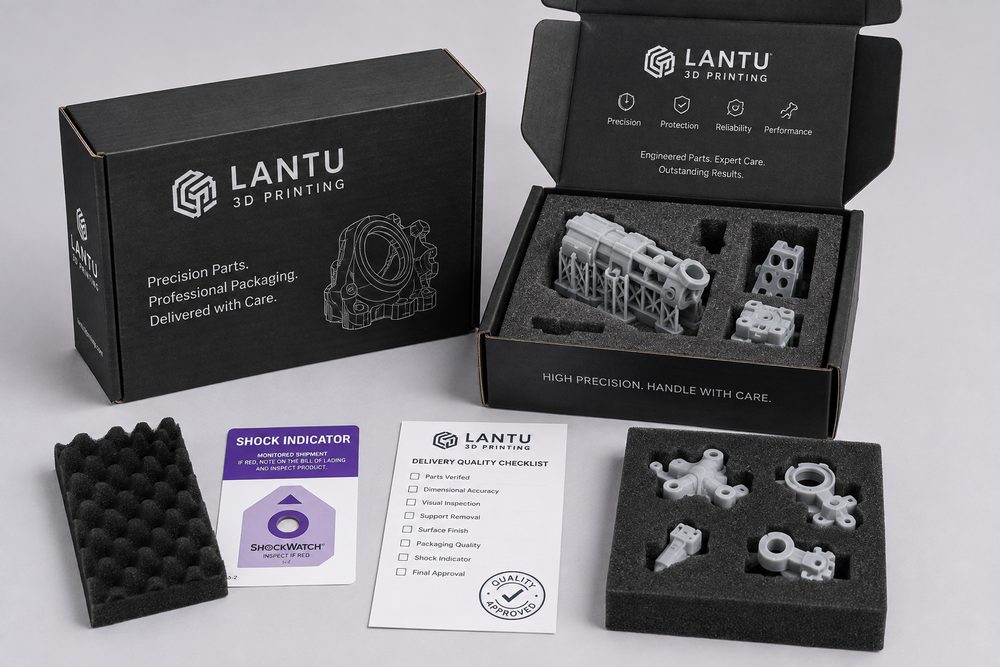
A common mistake is to fill the box with large amounts of foam or bubble wrap without actually preventing movement. Precision parts should use custom foam inserts, EPE dividers, or molded pulp trays so that critical surfaces are suspended or kept away from load-bearing points. For resin parts with sharp edges, thin walls, or visible support-removal marks, each part can be wrapped first in lint-free paper or a PE bag before being placed into the foam insert. When multiple parts are shipped in the same box, hard parts should never touch directly. Instead, separate them by model number, pack them in labeled bags, and assign serial numbers to reduce sorting errors after delivery.
3. Outer packaging: set the protection level according to the shipping environment
Courier shipments typically go through sorting drops, stacking pressure, and vehicle vibration. The outer carton should be a five-layer or seven-layer corrugated box depending on weight. Heavy parts should have a load-bearing tray at the bottom, and long parts should not be supported only at both ends. For high-value models, add drop-indicator labels, upward orientation marks, and moisture-barrier bags. For cross-region transport or sea freight, the effect of humidity on nylon parts, cardboard boxes, and coatings must be considered. If the model exceeds 600 mm in size or includes multiple assembled sections, it is recommended to package it in separate modules and provide an assembly-number diagram to reduce the risk of damage from a single box.
4. Labeling and tracking: help customers complete inspection quickly
Packaging is not only for protection; it also carries information. Each order should be labeled on the outer carton and inner bags with the order number, part number, quantity, material, color, handling notes, and opening sequence. For models with left-hand and right-hand parts, directional requirements, or assembly relationships, labels should match the packing list so customers do not mistakenly think items are missing. lantu3D recommends photographing the packed shipment before dispatch and linking the tracking number, packing photos, and inspection records to the order batch. If shipping damage occurs, this makes it much easier to determine whether the issue came from a production defect, insufficient packaging, or a logistics problem.
5. Incoming inspection and complaint handling: build a reviewable evidence chain
After receiving the shipment, customers should inspect the outer carton condition, part count, appearance, critical dimensions, and assembly sequence. If damage is found, they should keep the outer carton, inner packaging, photos of the damaged area, and a video of the unboxing. When a service provider receives a complaint, it should not immediately blame logistics or customer handling. Instead, it should review the part risk assessment, packaging design, packing photos, and carrier route. If the same structure repeatedly suffers shipping damage, the design should be optimized in reverse: add temporary reinforcement ribs, adjust the split location, change the material, or increase the packaging protection level.
Conclusion: packaging and transportation are part of delivery engineering
Reliable 3D-printing delivery quality comes from continuous control across production, inspection, packaging, and logistics. With risk-based classification, fixed inner packaging, outer cartons matched to the transport environment, clear labeling, and a complaint evidence chain, brittle resin parts and precision models can arrive at the customer in a much more stable condition. For business customers, this traceable delivery system reduces project risk far more effectively than simply chasing the lowest shipping cost.
Submit a model, drawing, image or written notes. Engineers will review material, process, finishing and delivery based on actual use.