
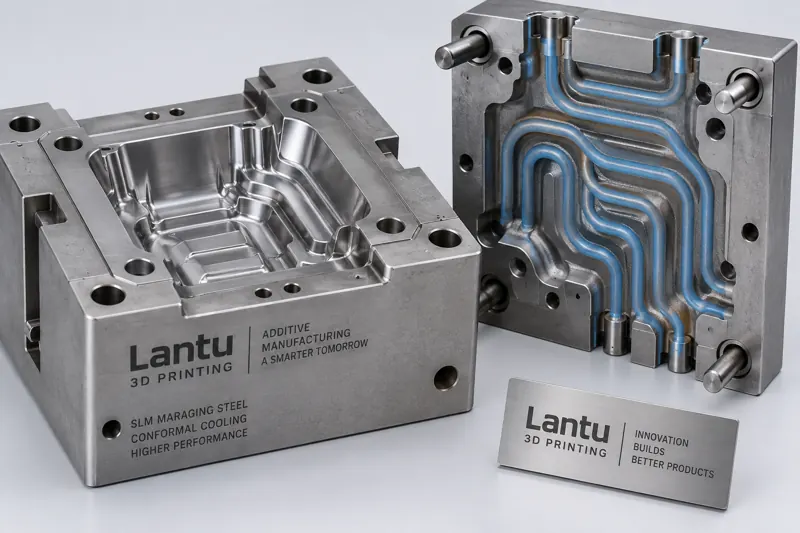
Introduction: Why Traditional Mold Cooling Is Being Replaced by Conformal Channels
In injection molding and die casting production, mold cooling time usually accounts for 50%–70% of the entire molding cycle. Traditional straight cooling channels are limited by CNC machining capabilities and are often far from the cavity surface, resulting in large local temperature differences, product warpage, and longer cycles. Conformal cooling arranges cooling channels along the contour of the cavity, keeping the distance between the mold wall and the coolant uniform, thereby significantly shortening cooling time and improving dimensional consistency. With metal 3D printing (SLM), complex conformal cooling channels can be integrally formed. This is a typical application scenario for lantu3D’s full lifecycle service from design to delivery in the mold sector.
1. Core Principles of Conformal Cooling Channel Design
For conformal cooling channels, denser is not always better. Several engineering principles should be followed: First, the distance from the channel center to the cavity surface, known as standoff, is generally controlled at 3–6 mm. If it is too small, lack of fusion may occur during printing; if too large, cooling efficiency decreases. Second, the channel cross-section is usually circular or conformal with variable sections, and a diameter of 6–10 mm is recommended to balance flow resistance and heat transfer area. Third, sudden cross-sectional changes in the channel should be avoided to prevent turbulence, and inlet and outlet ports should be arranged away from gates and high-temperature zones. With CFD thermal simulation, the temperature field can be predicted before printing, reducing the cavity temperature difference from ±15°C in traditional solutions to within ±3°C.
2. Material and Process Parameter Selection
Conformal cooling molds place dual requirements on materials: they must have good printability while maintaining hardness and thermal conductivity under subsequent injection molding conditions. Common materials include mold steel 18Ni300, a maraging steel with as-printed hardness of about 30–36 HRC and aged hardness up to 50–54 HRC, and H13, a hot-work tool steel that requires preheating to 170–200°C to reduce cracking risk. For the SLM process, a layer thickness of 0.03–0.05 mm, laser power of 200–370 W, and scanning speed of 800–1200 mm/s are recommended, along with island scanning and appropriate rotation angles to suppress thermal stress accumulation. Before printing, the powder should be tested for oxygen content and particle size distribution to ensure flowability and density.
3. Post-Processing and Stress-Relief Processes
After printing, mold inserts must undergo heat treatment to eliminate residual stress. 18Ni300 is typically aged at 480–520°C for 6–8 hours; H13 requires stress-relief annealing followed by secondary tempering. CNC finishing of reference surfaces, wire cutting of parting surfaces, and polishing of the cavity are then performed. The interior of conformal cooling channels is difficult to mechanically polish, so electrochemical polishing or low-pressure Abrasive Flow Machining can be used to clean slag from the inner walls and reduce flow resistance. Process parameters should be recorded at every step to establish a traceable quality file.
4. Inspection Acceptance and Delivery Boundaries
Before delivery, channel patency and dimensional accuracy must be verified. Endoscopic inspection is used to check whether the inner walls of conformal cooling channels are continuous and free of spheroidized inclusions. Industrial CT or coordinate measuring machines (CMM) are used to verify critical dimensions. The dimensional accuracy of SLM molds can usually be controlled within ±0.05–0.1 mm. Trial mold verification should also be conducted to compare cooling curves between traditional and conformal solutions, quantifying the cycle reduction ratio and warpage improvement. During delivery, lantu3D provides closed-loop reports from first article inspection to batch stability tracking, clearly defining delivery boundaries and acceptance standards to avoid later disputes.
5. Engineering Value and Implementation Recommendations
Practical data show that well-designed conformal cooling molds can reduce cooling time by 20%–40%, shorten the molding cycle by 15%–30%, and significantly improve product warpage and internal stress. For implementation, it is recommended to first conduct small-batch validation with a single-cavity insert before expanding to multi-cavity molds. Thermal simulation, printing parameters, and post-processing records should be integrated into the same data chain to achieve traceability from design to printing to delivery. For enterprises pursuing stable mass production and rapid iteration, conformal cooling molds are a high-value entry point for 3D printing into traditional manufacturing.
Conclusion
3D printing process optimization for conformal cooling molds is a systematic project spanning cooling channel design, material processes, post-processing, and inspection acceptance. Only by solidifying the process window for each step can design freedom truly be transformed into deliverable and repeatable engineering value. With full lifecycle management capabilities, lantu3D helps enterprises reduce trial-and-error costs and shorten delivery cycles during the digital upgrade of mold manufacturing.
Submit a model, drawing, image or written notes. Engineers will review material, process, finishing and delivery based on actual use.