The Importance and Challenges of Cost Accounting
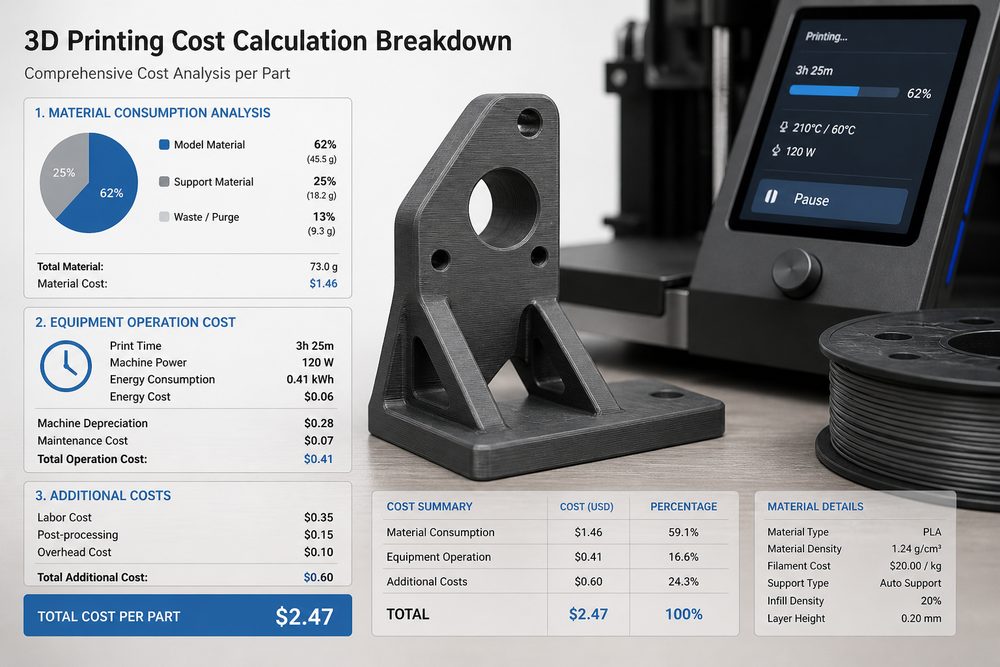
Cost accounting is the foundational work for 3D printing service companies to achieve scientific pricing and precise profit management. Traditional manufacturing cost accounting methods are difficult to fully adapt to the characteristics of 3D printing services, mainly in that process diversity leads to complex cost structures, the small-batch, multi-variety production model makes cost allocation difficult, and customized services introduce uncertainty in cost forecasting. Establishing a scientific cost accounting system is of great significance for enhancing the market competitiveness of 3D printing service companies.
Analysis of Cost Composition
The cost composition of 3D printing services mainly includes two categories: direct costs and indirect costs. Direct costs refer to costs that can be directly assigned to a specific order or project, including material costs, equipment depreciation, labor costs, and so on. Material cost is the main component of direct costs, including base materials, support materials, post-processing consumables, etc. Material utilization rates vary significantly across different processes: FDM process material utilization is usually 80-90%, SLA process can reach over 95%, while SLS process is close to 100%.
Equipment depreciation is another important direct cost. Taking the EOS M290 metal 3D printer as an example, the equipment purchase cost is about 2 million yuan. Calculated on a 10-year depreciation basis, the daily depreciation cost is about 548 yuan. Considering factors such as equipment uptime and maintenance, the actual depreciation cost needs to be adjusted according to equipment utilization. Labor costs include the salaries of various personnel directly involved in production, such as operators, technicians, and quality inspectors, and must be allocated to specific orders according to working hours.
Indirect costs refer to costs that cannot be directly assigned to a specific order, including factory rent, utilities, management expenses, marketing expenses, and so on. Reasonable allocation of indirect costs is a difficult point in cost accounting, requiring the establishment of scientific allocation bases and methods.
Design of the Accounting Model
Activity-Based Costing (ABC) is the recommended method for cost accounting in 3D printing services. Through steps such as identifying activities, accumulating costs, determining cost drivers, and calculating allocation rates, this method enables precise cost allocation. Taking a certain SLA 3D printing service company as an example, its activity centers include: pre-processing activities (model inspection, slicing layout), printing activities, post-processing activities (cleaning, curing, support removal), quality inspection activities, and packaging/shipping activities. Each activity center establishes clear cost drivers, such as machine hours for printing activities and processing time for post-processing activities.
Taking a typical order as an example to illustrate the cost accounting process: a customer orders 10 ABS parts, each with a volume of 50 cm³, printed using FDM, with a layer height of 0.2 mm and a 30% infill rate. Material cost calculation: material usage per part is about 65 cm³ (including supports), material unit price is 0.8 yuan/cm³, material cost = 65 × 0.8 × 10 = 520 yuan. Machine hour cost: printing time per part is 4 hours, equipment hourly cost is 100 yuan, machine hour cost = 4 × 100 × 10 = 4000 yuan. Post-processing cost: post-processing time per part is 30 minutes, hourly cost is 60 yuan, post-processing cost = 0.5 × 60 × 10 = 300 yuan. Indirect cost allocation: allocated according to direct labor hours, allocation rate is 150%, indirect cost = (4000 + 300) × 150% = 6450 yuan. Total cost = 520 + 4000 + 300 + 6450 = 11270 yuan, cost per part is 1127 yuan.
Cost Control Strategies
In terms of material cost control, optimizing printing parameters to improve material utilization is the main approach. A company, through systematic optimization of FDM printing parameters, increased average material utilization from 75% to 88%, saving about 120,000 yuan in material costs annually. Establishing a material inventory management system and implementing FIFO management reduces losses from material expiration. Building strategic partnerships with suppliers and lowering procurement costs through bulk purchasing and price agreements are also effective measures.
In terms of equipment cost control, improving equipment utilization is key. Through order consolidation and intelligent scheduling, a company increased average equipment utilization from 60% to 82%, significantly reducing the equipment cost allocation per unit product. Establishing a preventive maintenance system reduces equipment downtime due to failures; one company reduced equipment failure rates by 45% and maintenance costs by 30% through preventive maintenance.
In terms of labor cost control, process optimization reduces manual intervention, such as adopting automated support removal equipment and intelligent slicing software. After introducing automated post-processing equipment, one company reduced post-processing labor costs by 60% and improved efficiency threefold. At the same time, skills training improves staff operating efficiency; one company reduced the average debugging time of operators by 40% through systematic training.
Pricing Decision Support
Cost accounting data provides foundational support for pricing decisions. In cost-plus pricing, reasonable profit margins and market competition factors must be considered on top of the cost base. A company's pricing model is: price = cost × (1 + profit margin) × market adjustment coefficient, where the profit margin varies between 15% and 40% depending on order size, customer relationship, market competition, and other factors, and the market adjustment coefficient is adjusted between 0.8 and 1.2 according to off-season/peak-season conditions, capacity utilization, and other factors.
The implementation of differentiated pricing strategies requires precise cost data support. For urgent orders, additional costs such as equipment scheduling costs and overtime labor costs caused by expedited production must be considered; one company charges a 30% rush fee for orders delivered within 24 hours. For large-volume orders, cost accounting can identify economies of scale and provide reasonable price discounts; one company gives a 15% discount for orders over 100 units, which both maintains reasonable profit and enhances customer loyalty.
Key Points for Implementing the Accounting System
The implementation of a cost accounting system requires a solid foundation for data collection. A MES system should be established to automatically collect production data, including key data such as equipment operating time, material consumption, and labor hours. A company achieved through its MES system
Submit a model, drawing, image or written notes. Engineers will review material, process, finishing and delivery based on actual use.