Introduction: Batch Stability Starts with Incoming Materials
Many companies trace the root cause of 3D printing quality issues to equipment parameters or post-processing, while overlooking an earlier variable—whether the powder delivered by the supplier is consistent. SLM metal printing and SLS nylon printing are highly sensitive to powder particle size distribution, sphericity, oxygen content, and flowability. Even powders of the same grade may show measurable differences between batches. When these differences push the process window to its limits, the same process sheet may perform inconsistently across different batches. Therefore, incoming quality control is not merely a compliance task for the purchasing department, but the first gate of manufacturing quality.
1. Core Items in Incoming Inspection
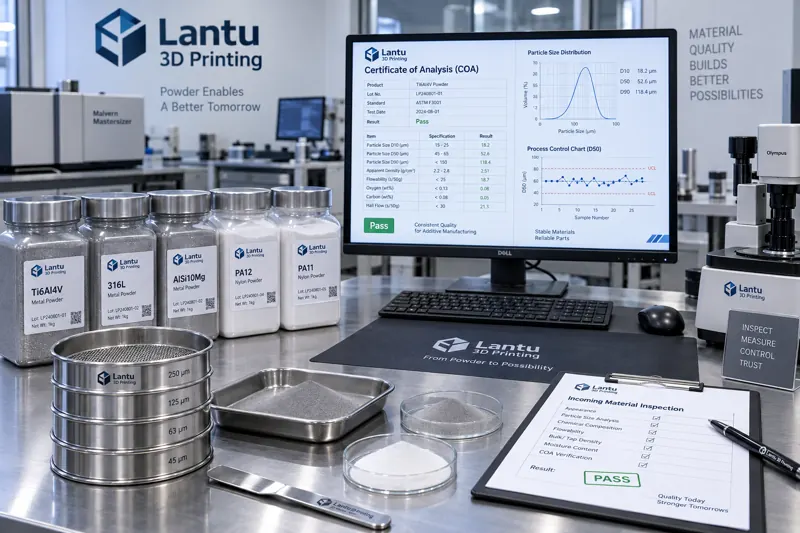
For metal powders, incoming inspection should cover at least four categories of indicators. The first is particle size distribution, commonly measured by laser diffraction to obtain D10, D50, and D90. For SLM titanium alloy or aluminum alloy powders, D90 is typically controlled within the 45–63 μm range, and the span (Span=(D90-D10)/D50) should preferably be less than 1.2. The second is oxygen content, measured by inert gas fusion (LECO). Total oxygen in titanium alloy powder is generally required to be ≤ 0.15%; excessive oxygen can react in the melt pool to form cubic titanium oxide, reducing toughness and fatigue performance. The third is sphericity and flowability, measured using a Hall flowmeter. A faster flow rate indicates uniform flow and stable powder spreading; abnormal flow often suggests excessive satellite particles or fine powder. The fourth is apparent density and tap density, which reflect powder packing behavior and are directly related to the consistency of powder layer thickness.
2. Methods for Judging Batch Consistency
A single qualified batch does not mean every batch will be consistent. The real risk comes from drift between batches. In engineering practice, it is recommended to establish a supplier batch baseline: collect particle size, oxygen content, and flow rate data from 10–20 consecutive batches, calculate the mean and 3σ control limits, and create control charts. A newly arrived batch can be released as long as it falls within the control limits; once it exceeds the limits, a deviation review should be triggered instead of direct rejection. For nylon PA12 powder, moisture content (usually ≤ 0.2%) and melt flow index should also be monitored. Excessive moisture can cause bubble defects and orange-peel surfaces during SLS sintering. Using a “baseline + control limits” approach rather than a “single-point veto” helps ensure stability while reducing misjudgments and production stoppages.
3. How Incoming Material Variation Affects Process and Performance
Incoming material variation is transmitted to final parts through three pathways. The first is powder spreading uniformity: an excessive proportion of fine powder reduces apparent density, resulting in insufficient actual metal content per layer and increased porosity. The second is melt pool behavior: oxygen content and surface oxide layers change laser absorption and wettability, causing melt depth to vary under the same power and leading to drift in dimensions and density. The third is dispersion in mechanical properties: with the same process sheet applied to different powder batches, tensile strength may fluctuate by 5%–15%, while fatigue life dispersion can be even greater. For high-reliability applications such as aerospace or medical devices, this level of dispersion is unacceptable, making incoming material consistency a prerequisite for process release.
4. A Practical Closed Loop for Incoming Material Release and Traceability
Companies are advised to embed incoming quality control into a digital workflow: after materials arrive, scan and register the supplier batch number, heat number, and certificate of analysis (CoA), and automatically verify whether key indicators meet requirements. Inspection data should enter a quality database and be linked to subsequent printing batches. Establish bidirectional powder-part traceability: any delivered part can be traced back to a specific powder batch, and any powder batch can be linked to all affected parts. When an abnormality occurs in a powder batch, the affected scope can be quickly defined, avoiding a full recall. For key customers, suppliers may also be required to provide a batch-to-batch consistency statement and evidence of statistical process capability (Cpk ≥ 1.33), shifting quality responsibility upstream into the supply chain.
5. Connection with Internal Inventory Management
Qualified incoming materials are only the beginning; powder circulation within the factory also affects consistency. It is recommended to implement first-in, first-out (FIFO) and manage the shelf life after opening. Reused powder should be mixed with virgin powder at a fixed ratio, such as no more than 30%, and flowability should be re-inspected to prevent repeated use from causing particle size refinement and oxygen accumulation. Incoming quality data should be connected with internal inventory and recycling calibration records to form a complete quality chain from supplier to printer. In its metal and nylon printing deliveries, Lantoo 3D uses this closed loop to keep batch dispersion within a range acceptable to customers.
Conclusion
Batch stability in 3D printing is not “tuned” by equipment alone; it is built through every inspection in supplier incoming quality control. By establishing clear incoming inspection items, judging batch consistency through control limits rather than single-point criteria, and binding powder to parts through digital traceability, companies can maintain consistent and reliable delivery quality from prototyping to batch production.
Submit a model, drawing, image or written notes. Engineers will review material, process, finishing and delivery based on actual use.