Introduction
In mainstream 3D printing processes such as FDM fused deposition modeling and SLA stereolithography, the support structure is a necessary sacrificial component to ensure the successful formation of suspended features. According to industry statistics, support structures account for an average of 15-35% of printing material consumption, while the man-hour cost of support removal can reach 40-60% of the total post-processing time. Surface defects, dimensional deviations and component damage caused by support residues are prominent issues affecting product yield. Actual measurement data from an auto parts supplier shows that the scrap rate due to improper support removal is as high as 8.3%. Mastering scientific and systematic support removal technology is of key significance to improving the quality and production efficiency of 3D printed parts.
1. Classification of support types and removal methods
Support structures can be divided into two categories: homogeneous supports and heterogeneous supports according to material characteristics. The homogeneous support is printed with the same material as the part, mainly thermoplastic materials such as PLA, ABS, and PA. The molding temperature is 180-260°C. There is partial fusion at the interface between the support and the part, making removal difficult. The heterogeneous support uses water-soluble PVA, HIPS or alcohol-soluble PVA materials, which can achieve damage-free separation through soaking and dissolution. The support interface bonding strength is 98%. Heat treatment utilizes the difference in softening points of materials to achieve support peeling through a hot air gun or infrared heating. The working temperature is 80-150°C, which is suitable for material combinations with large differences in thermal expansion coefficients.
Selecting a removal method requires comprehensive consideration of support materials, part geometry and surface quality requirements. A process comparison test by a medical device manufacturer showed that for complex internal flow channel structures, the chemical dissolution method of water-soluble PVA supports reduced the internal surface roughness from Ra 12.5μm to Ra 3.2μm, the dimensional accuracy increased from ±0.3mm to ±0.15mm, and the overall efficiency increased by 3.2 times compared with mechanical removal.
2. Detailed explanation of mechanical removal process
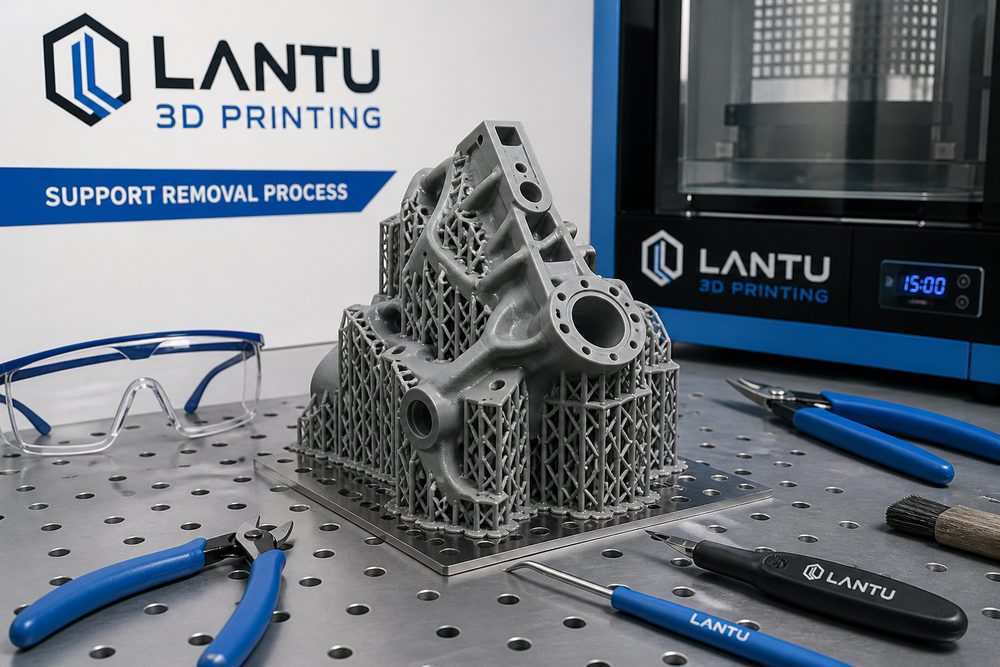
Mechanical removal is currently the most widely used method of support removal, with high process maturity and low equipment cost. Manual stripping is the most basic method. Use needle-nose pliers, diagonal pliers and other tools to gradually separate along the interface between the support and the workpiece. It is suitable for rough removal of simple geometric structures. The key points of the operation include: the clamping point is 3-5mm away from the interface, the force application direction is at an angle of 15-30° with the interface, and the step-by-step peeling is done to avoid local stress concentration. The SOP of a consumer electronics company stipulates that the peeling force should be controlled within the range of 5-15N and the single-point force application time should be 1mm. Commonly used tools include utility knives, carving knives and wire saws. Cutting parameter selection: blade angle 15-25°, cutting speed 20-50mm/s, cutting depth not exceeding 2/3 of the support thickness. The process regulations of an aerospace parts manufacturer require that the residual height of the support after cutting is 85% (volume fraction), soaking temperature 25-35°C, dissolution time 1-4 hours. In a case of printing a home appliance shell, the removal integrity of the HIPS support reached 99.5% after being soaked for 2 hours, and there were no obvious traces of solvent erosion on the ABS surface of the part. It should be noted that limonene has a slight swelling effect on styrene materials such as ABS and PS. If the soaking time is too long, the surface will become sticky. It is recommended to control the soaking time to
Submit a model, drawing, image or written notes. Engineers will review material, process, finishing and delivery based on actual use.