Introduction: The complexity and importance of 3D printing project risks
In the field of 3D printing services, the lack of project risk management often leads to serious consequences. According to statistics, the failure rate of 3D printing projects without systematic risk assessment is as high as 35%, while the success rate of projects that have undergone professional risk assessment can be increased to more than 92%. Problems such as deviations in technical parameters, substandard material performance, failed process adaptation, and delivery delays may cause a decrease in customer trust and economic losses. Therefore, establishing a systematic project risk assessment system is a key component of the core competitiveness of 3D printing service companies.
1. Technical risk assessment: from design files to printing parameters
1.1 Design file risk identification
Design files are the starting point of 3D printing projects, and their quality directly affects the final output effect. The main risks include:
- File format compatibility risks: STL, OBJ, STEP, AMF and other formats may produce mesh errors, missing patches or size deviations during the conversion process. It is recommended to use professional detection software (such as Netfabb, Magics) for mesh repair to ensure water tightness and normal consistency.
- Geometric structure risks: The suspended structure exceeds 45°, the wall thickness is less than the recommended value of the material, the hole size is too small, etc. Taking the SLA process as an example, the wall thickness should be ≥1.0mm, and the hanging angle should be controlled within 45° or support should be added.
- Risk of tolerance design: Improper tolerance design of mating parts will lead to assembly difficulties. The XY direction tolerance of the FDM process is usually ±0.3-0.5mm, and the Z direction is ±0.2-0.3mm. The design needs to be adjusted according to the actual application scenario.
1.2 Printing parameter risk analysis
The printing parameter risk points of different processes are different:
| Process type | Key parameter risk | Risk threshold |
|---|---|---|
| FDM | Layer height, filling rate, printing temperature | Layer height>50% of nozzle diameter; filling rate 0.1mm detail loss; exposure deviation>10%|
| SLS | Laser power, scanning speed, preheating temperature | Power fluctuation >5%; temperature deviation >3°C |
| SLM | Laser power, scanning spacing, oxygen content in the molding chamber | Oxygen content>0.1%; spacing deviation>15% |
2. Material risk assessment: performance matching and supply chain stability
2.1 Material performance risk
Improper material selection is one of the main reasons for project failure, accounting for about 28%. Specific risks include:
- The mechanical properties are not up to standard: Tensile strength, bending strength, impact toughness and other parameters do not match the design requirements. For example, the tensile strength of PA12 (nylon 12) is 48-52MPa, while PA6-GF (glass fiber reinforced nylon 6) can reach 85-95MPa. The selection needs to be determined according to the application scenario.
- Environmental adaptability risk: Insufficient consideration of environmental factors such as temperature resistance, chemical resistance, and weather resistance. ABS material starts to soften above 80°C and is not suitable for high-temperature environment applications; while PEEK material can work in an environment of 250°C for a long time.
- Biocompatibility risk: Medical device projects need to choose materials certified by ISO 10993, such as medical-grade TPU, PEEK, etc. Ordinary materials have biotoxicity risks.
2.2 Supply chain risks
Interruptions in the material supply chain will lead to project delays. The main risk points are:
- The procurement cycle of special materials (such as titanium alloys, peek, etc.) is as long as 4-8 weeks
- Stability of material batches, performance of different batches The difference can reach 10-15%
- Performance attenuation caused by improper material storage conditions, such as reduced printing performance after nylon material absorbs moisture
3. Process adaptation risk assessment: equipment capabilities and process window
3.1 Equipment capability matching
Technical parameter limitations of different equipment:
- Molding size restrictions: The molding space of small equipment is usually 200×200×200mm, and that of large equipment can reach 1000×1000×1000mm. Oversized parts need to be printed in blocks and then spliced together, which poses strength risks.
- Accuracy capability limitations: FDM equipment accuracy is usually ±0.3-0.5mm, SLA can reach ±0.1-0.15mm, and SLM metal printing can reach ±0.05-0.1mm. Equipment needs to be selected according to accuracy requirements.
- Material compatibility restrictions: The types of materials supported by a single device are limited. For example, a certain model of FDM equipment only supports three materials: PLA, ABS, and TPU. When selecting equipment, you need to confirm the material compatibility list.
3.2 Process window risk
Deviation of process parameters from the optimal window will lead to quality problems:
- FDM process temperature window: The nozzle temperature is usually the melting point of the material +20-30°C. If the temperature is too low, it will cause plugging, and if the temperature is too high, it will cause wire drawing and strength reduction.
- SLA process exposure window: exposure Insufficient light leads to weak bonding between layers, and overexposure leads to blurred details and dimensional deviations
- SLM process heat input control: too high heat input leads to warping and residual stress, and too low heat input leads to excessive porosity
4. Delivery risk assessment: double guarantee of time and quality
4.1 Time risk
Main reasons for delivery delays and preventive measures:
| Reasons for delay | Percentage | Preventive measures |
|---|---|---|
| File repair time exceeded expectation | 25% | Build Establish a preprocessing time estimation model, reserve 20% buffer |
| Reprint if printing fails | 30% | First article verification system, real-time monitoring of key parameters |
| 20% | Establish post-processing time standards based on material type | |
| Rework if quality inspection fails | 15% | Process quality control, segmented inspection|
| Logistics delay | 10% | Reserve 2-3 days of logistics buffer time |
4.2 Quality risk
Delivery quality risk mainly includes:
- Dimensional accuracy risk: The actual measured size exceeds the tolerance range, and size compensation design needs to be carried out before printing. The FDM process usually requires compensation of 0.2-0.4mm in the XY direction
- Surface quality risk: The layer texture is obvious, the support remains, and the surface roughness exceeds the standard. A reasonable post-processing plan needs to be developed
- Mechanical performance risk: The actual test strength is lower than the design value, and sample testing and verification are required, especially functional parts
5. Risk assessment implementation methods and tools
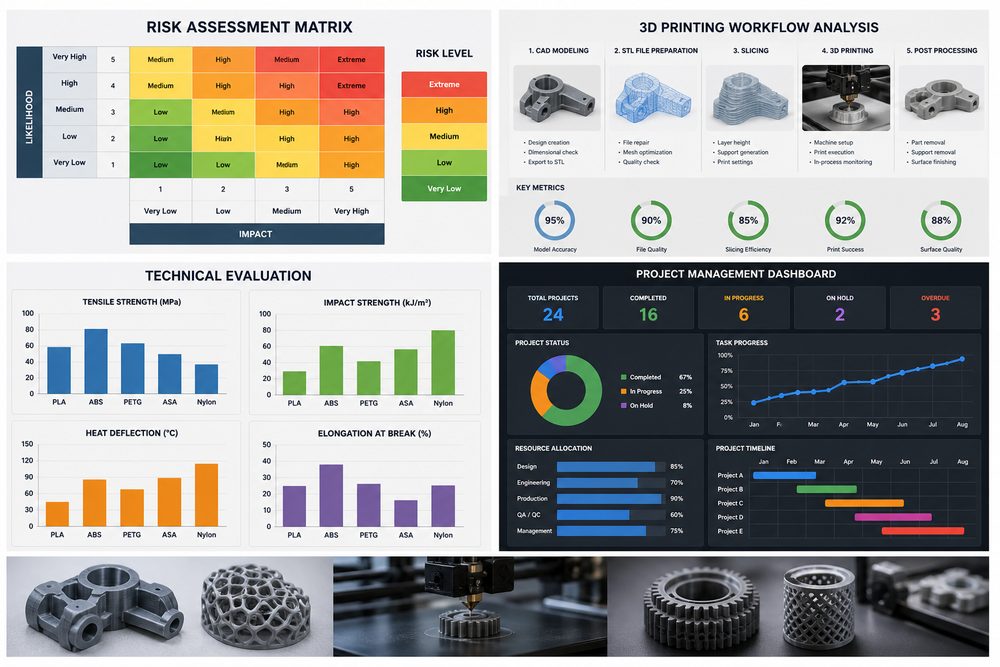
5.1 Risk assessment matrix
Use probability-impact matrix to classify risk levels:
- High risk (red): Probability >60% and serious impact (cost increase >30% or delay >7 days), immediate mitigation measures are required Next Step Is this close to what you need?
Submit a model, drawing, image or written notes. Engineers will review material, process, finishing and delivery based on actual use.