
No model yet, material choice and wall thickness are explained from a practical angle.
Centro Conoscenze
Blueprint News
lantu3D verifica spessore, struttura, materiale, processo, quantità e finitura prima del preventivo.
01Guides
02Materiali
03Punto di vista cliente
Content should help customer decisions
lantu3D articles focus on materials, processes, cost, modeling and manufacturability so customers understand key decisions before submitting a request.
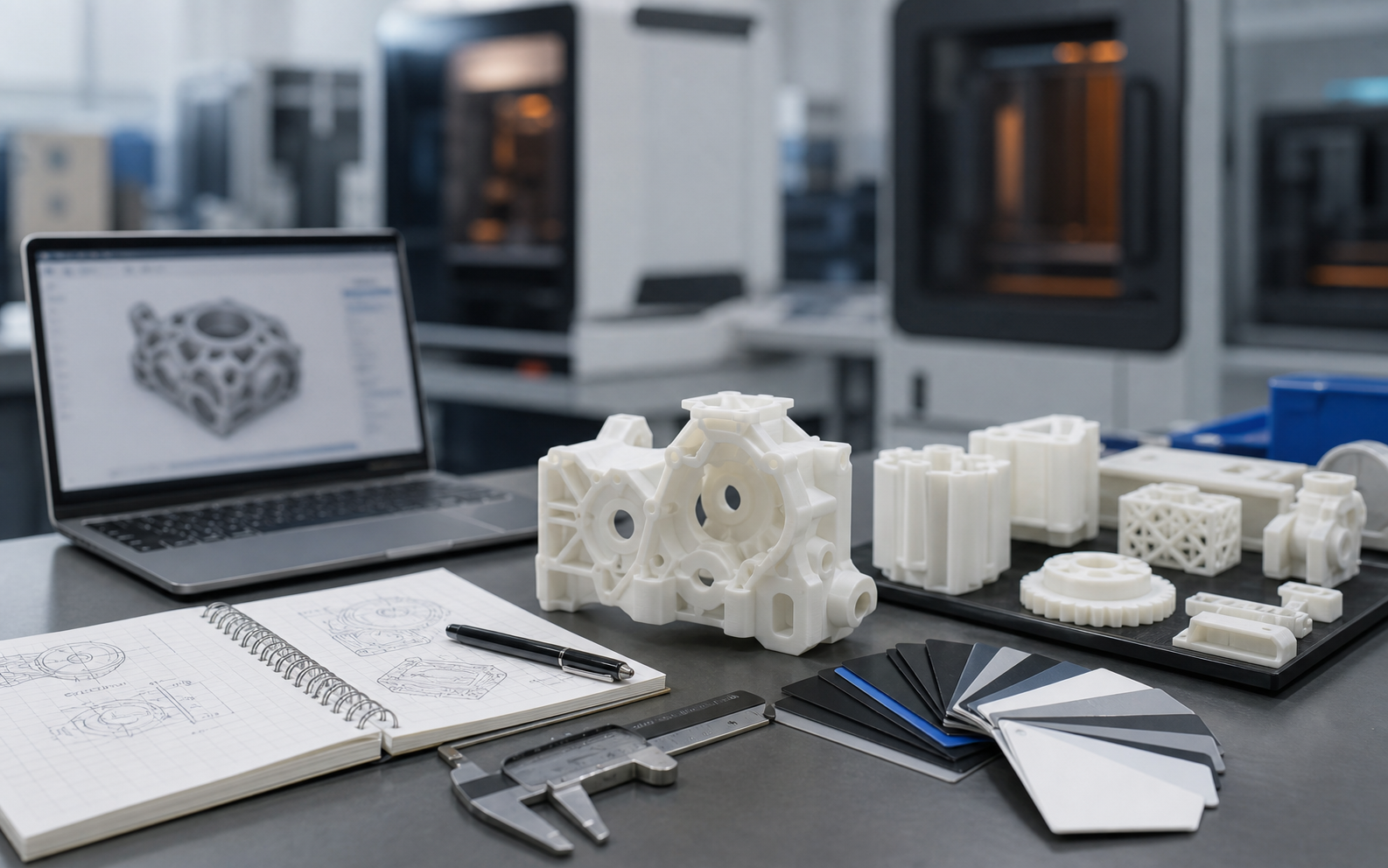
Prototype, fixture, custom part, small batch and cost-control topics for business users.
lantu3D is positioned as blueprint realization and lifecycle management, not just a print shop.
news
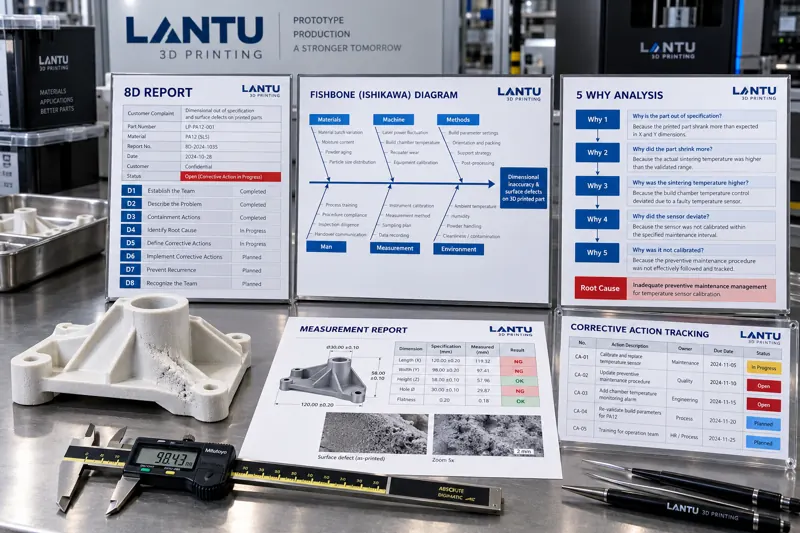
8D Root Cause Analysis for 3D Printing Customer Complaints: A Quantitative Closed Loop from Failure Attribution to Corrective Action Verification
3D printing customer complaints often end with a remake and an apology, allowing similar failures to recur. This article presents an additive manufacturing-focused 8D implementation path: quantified problem descriptions, interim containment and lot holds, the applicability limits of 5 Whys and fishbone diagrams, AM-specific process variation sources, process capability thresholds across consecutive lots, quantitative criteria for concession acceptance and claims, and feeding cases back into FMEA to build organizational capability.
news
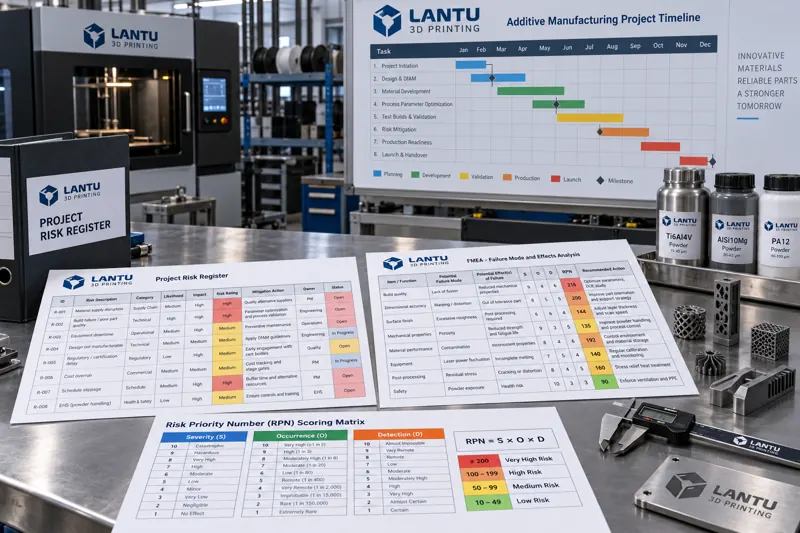
Metodi quantitativi per la gestione dei rischi nei progetti di stampa 3D: registro dei rischi, punteggi FMEA e priorità RPN
Nella maggior parte dei progetti di stampa 3D, la gestione dei rischi resta a livello di dichiarazioni generiche, senza criteri quantitativi verificabili. Questo articolo propone un percorso operativo: creare un registro dei rischi con campi strutturati, calcolare l’RPN tramite i punteggi di gravità S, occorrenza O e rilevabilità D con tabelle di ancoraggio, correggere le distorsioni del modello moltiplicativo mediante soglie di gravità e collegare il registro a quattro milestone: riesame dell’ordine, qualificazione del primo pezzo, avvio della piccola serie e rilascio alla produzione in serie, creando un ciclo del rischio verificabile.
news
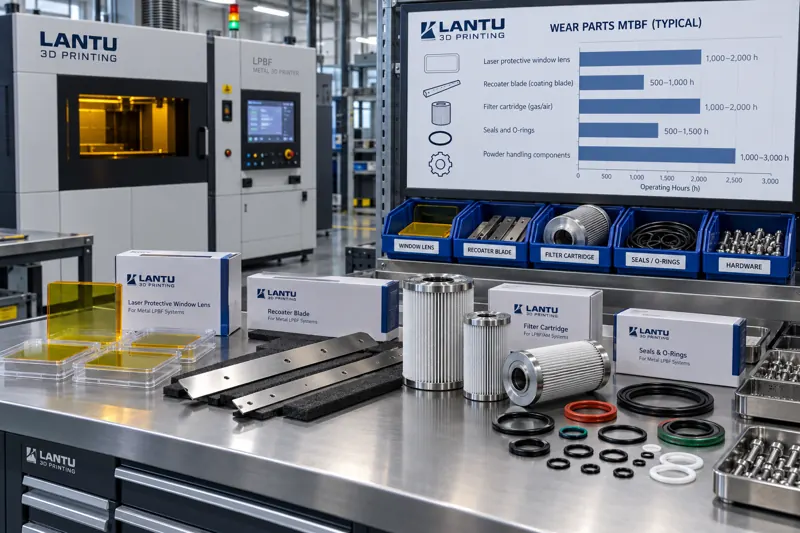
Lifecycle Management of Wear Parts and Spares in 3D Printing Equipment: Quantified MTBF-Based Replacement for Protective Windows, Recoater Blades, and Filters
Unplanned downtime in additive manufacturing workshops is usually caused not by costly assemblies such as lasers or galvanometers, but by low-value wear parts—including protective windows, recoater blades, filters, and seals—exceeding their service thresholds. This article classifies wear parts into optical-path, powder-bed, and environmental-support categories; explains their failure mechanisms; establishes site-specific replacement baselines using MTBF and MTTR; applies fault tree analysis to identify true bottleneck components; and outlines a complete methodology covering post-replacement standard coupon verification, interim inspection of measuring instruments, and ABC-classified spare-parts inventory.
news
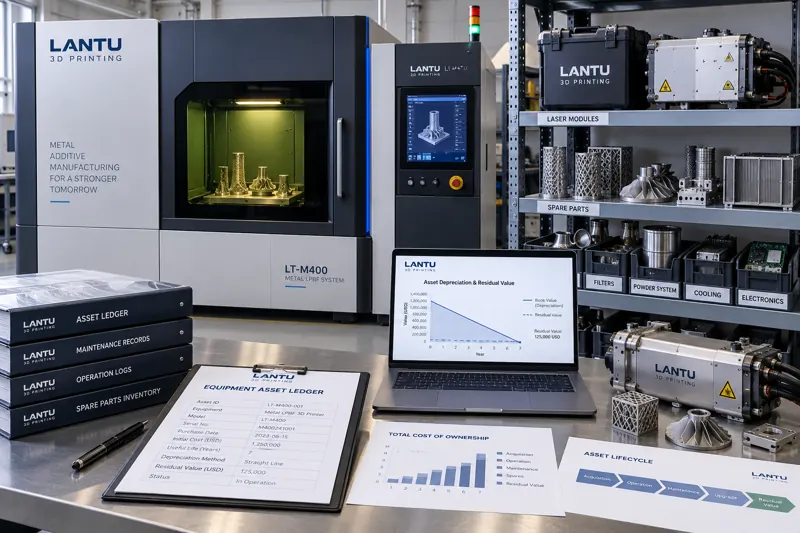
Lifecycle Asset Ledger for 3D Printing Equipment: From Depreciation and Retrofit Decisions to End-of-Life Value Recovery
Many companies stop rigorous equipment investment analysis once acceptance is signed. In the years that follow, performance degradation, retrofit spending, and end-of-life residual value often go unmeasured, creating a major disconnect between book value and actual capability. This article outlines dual-track financial and technical asset ledgers, quantitative thresholds for retrofit versus replacement, four retirement triggers, and a residual-value hierarchy covering resale, downgraded use, parts reuse, and compliant disposal. It also explains how retirement data can improve the next TCO model.

news
Skills Matrices and Cross-Training for 3D Printing Shops: From Capability Visibility to Flexible Scheduling
Additive manufacturing shops often describe employee capability with vague labels such as “can operate the machine.” When the order mix changes, this can expose the risk that only one or two people can handle critical processes. This article explains how to build a skills matrix using observable tasks, 0–3 proficiency levels, cross-functional calibration, and trial-assessment anchors, then use it to drive scheduling authorization, identify capability gaps, develop primary-role and secondary-role cross-training plans, and establish a practical-performance assessment loop.
news
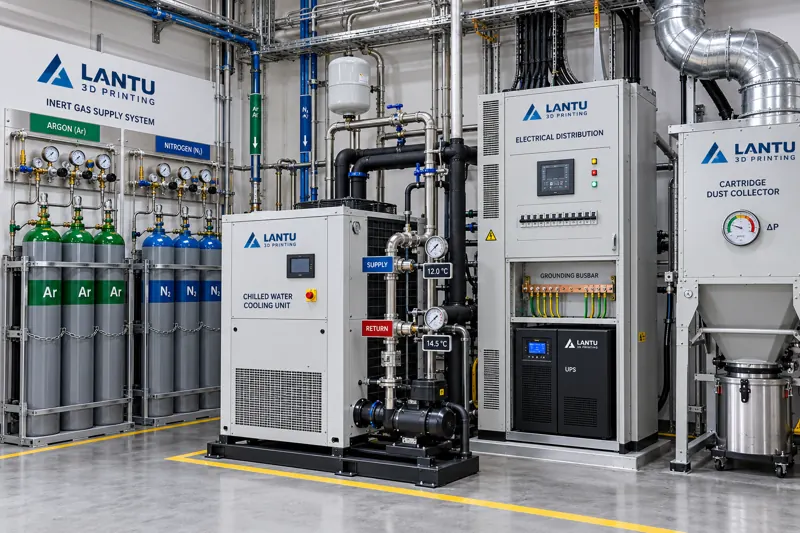
Managing Utilities and Auxiliary Systems in 3D Printing Workshops: Stability Engineering from Inert Gas and Cooling Water to Power Distribution and Dust Collection
Most unplanned downtime in additive manufacturing workshops originates not in the printer itself, but in four utility lines: gas, water, power, and dust collection. This article provides specific control limits and engineering practices for inert-gas purity and continuity, recirculating cooling-water temperature and quality, power quality and grounding, and dust-collection differential pressure.
news
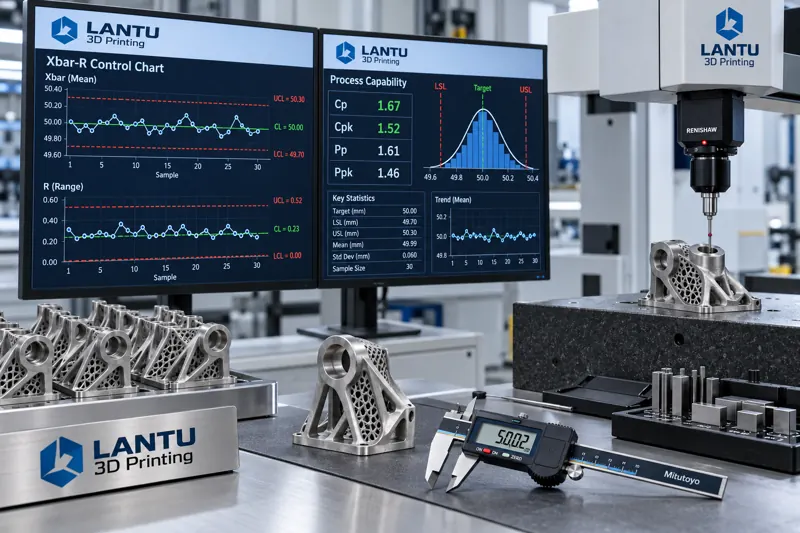
Statistical Process Control (SPC) for Volume 3D Printing Delivery: An Engineering Approach from Key Characteristics to Closed-Loop Out-of-Control Response
Addressing quality-control requirements as 3D printing advances from low-volume production to volume delivery, this article systematically explains how to implement statistical process control (SPC): identifying key characteristics, verifying gauge resolution, selecting Xbar-R charts and out-of-control rules, designing subgroup sampling so within-group variation reflects random causes while between-group variation exposes traceable causes, and establishing a four-step response loop covering confirmation, scope definition, six-dimension root-cause investigation, and corrective-action verification. It also clarifies the distinction between control limits and tolerance limits, the significance of Cpk thresholds, and common pitfalls such as failing to update control limits or monitoring without improvement.
news
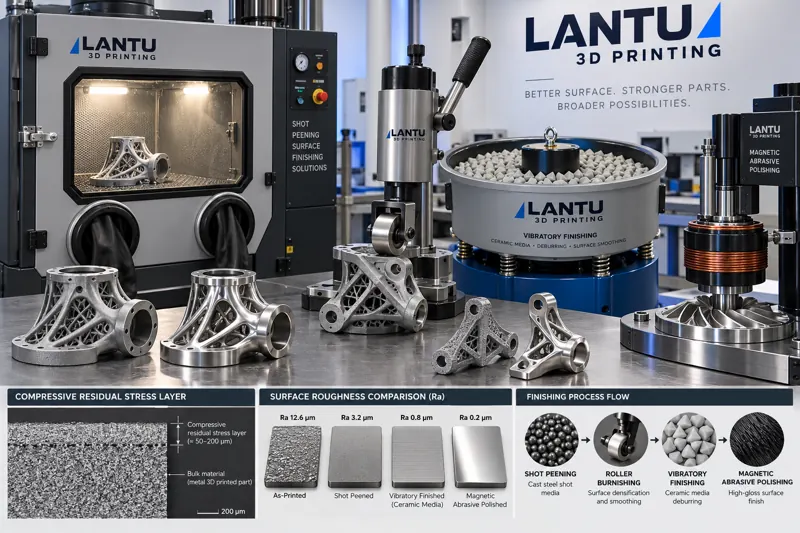
Mechanical Surface Enhancement and Finishing for 3D-Printed Parts: Engineering Methods from Shot Peening and Burnishing to Internal Channel Smoothing
As-built roughness, partially melted particles, and residual tensile stress are major weaknesses in the fatigue performance of additively manufactured parts. This article examines the application limits of shot peening, burnishing, laser shock peening, vibratory finishing, and magnetic abrasive finishing through four surface-integrity metrics, and outlines a failure-mode-driven process selection and sampling verification loop.
news
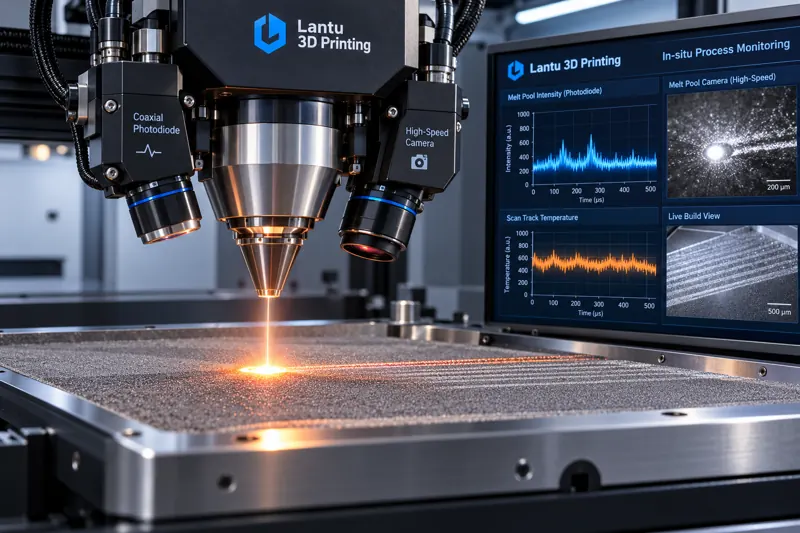
In-Situ Melt Pool Monitoring and Process Quality Control for Stampa 3D metallo
Quality defects in metal additive manufacturing occur within milliseconds inside a sealed build chamber, where the full cost of production has already been incurred by the time post-build inspection detects them. This article examines melt pool monitoring principles, engineering trade-offs between photodiode and coaxial imaging sensors, methods for establishing layered decision criteria, and ways to integrate process data into nonconformance control and corrective-preventive action loops for scalable production.
news
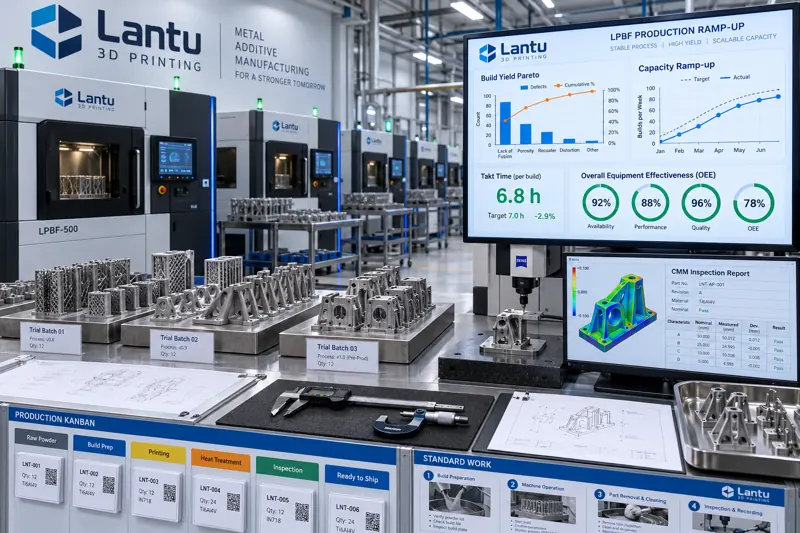
Scaling Capacity for Small-Batch 3D Printing: An Engineering Approach from Pilot Runs to Stable Production
First-article approval does not guarantee deliverable production at scale. This article presents a four-stage ramp-up method for 3D printing, covering process parameter package freezing and cross-machine validation, yield Pareto analysis, bottleneck takt time and line balancing, and six release gates before volume expansion.
news
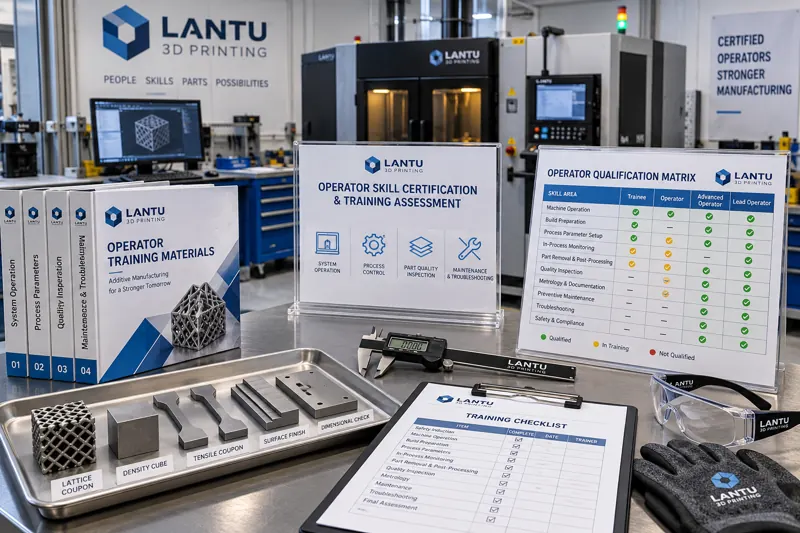
3D Printing Job Skills Certification and Training Assessment System: From Curriculum Maps to Authorized Certified Work
Most 3D printing shops maintain complete training records but cannot prove that operators are truly competent. This article presents an engineering-based approach to job skills certification: threshold-based competency units, a three-stage curriculum map, practical assessment question banks with critical-item disqualification, L1-L3 authorization matrices, Kirkpatrick four-level evaluation, and retraining and downgrade mechanisms that bring human-factor variation into traceable process capability management.
news
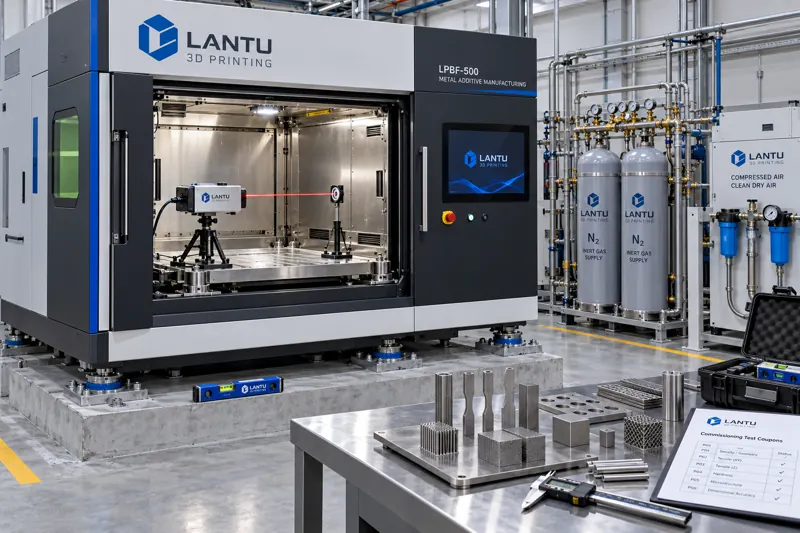
3D Printer Installation, Commissioning and Site Acceptance Testing (SAT): An Engineering Approach from Site Preparation to Production Release
Equipment delivery does not mean production readiness. This article outlines the complete process for additive manufacturing equipment installation, commissioning and Site Acceptance Testing (SAT): the division of responsibilities between FAT and SAT, five critical site and utility requirements, the establishment of geometric and process baselines, a four-part SAT checklist, production release criteria based on real orders, and countermeasures for three common pitfalls.
Inizia da qui
Have a model, drawing, or only an idea?
Submit your requirement and our engineers will recommend a better design and manufacturing path based on use, size, quantity, material, tolerance and lead time.