
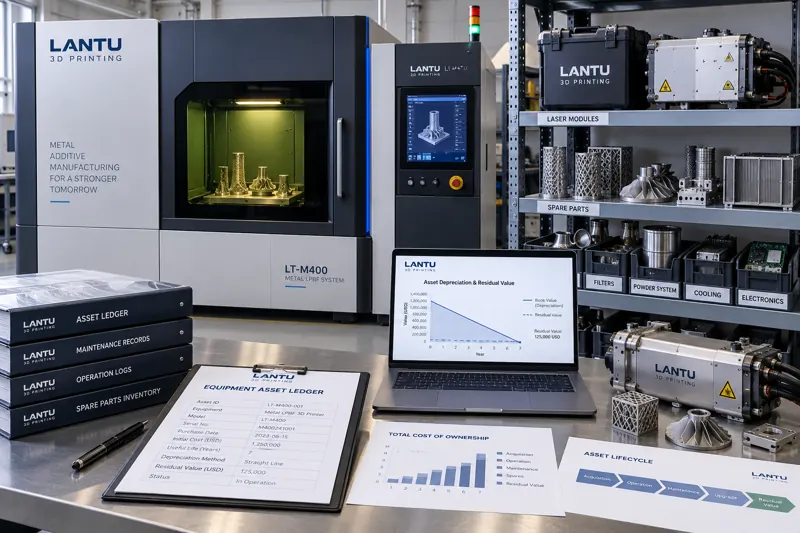
Introduction: Asset Management Begins When Equipment Acceptance Is Signed Off
Most 3D printing companies devote substantial effort to equipment investment decisions: capacity calculations, TCO models, ROI payback periods, and comparisons between purchasing equipment and using external services. However, once a machine passes site acceptance testing (SAT) and enters the fixed-asset register, this rigorous analytical approach often stops. Over the following years, the machine undergoes laser power degradation, galvanometer calibration, optical-path replacement, software-version iterations, and process-package upgrades, until one day it is labeled out of service because its accuracy no longer meets drawing requirements or its maintenance cost becomes too high—yet this process is typically not supported by any measurable data record.
The result is a severe disconnect between book value and actual equipment capability. Retrofit investment and replacement decisions are made by intuition, while residual value at retirement is recovered only as scrap metal. Across the equipment lifecycle, the factors that truly erode profit are often not an overly high purchase price, but unmanaged ownership and exit stages.
1. Why Asset Management for 3D Printing Equipment Is More Difficult Than for Conventional Machine Tools
The value-depreciation curve of a conventional CNC machine tool is relatively gradual. A machining center can remain in service for ten years while still maintaining its factory accuracy. Metal 3D printing equipment is different: its value depreciation results from three independent yet overlapping curves.
The first is performance degradation of core components. The output power of fiber lasers declines with operating hours. A typical industrial 500 W module may exhibit a 5% to 10% power loss after 8,000 to 12,000 hours; galvanometer zero-point drift directly affects contour accuracy; and lower protective-window transmittance causes the energy density actually reaching the powder bed to deviate from the set value. These effects can be compensated through component replacement, but the cost of doing so rises as equipment ages.
The second is generational change in process packages and material systems. The same machine may have been able to print only two or three powder types reliably two years ago, but may support more materials and a wider layer-thickness range after a process-package upgrade. Capability can become completely decoupled from book value: the machine's net book value declines while its production capability improves.
The third is software and data-chain compatibility. The control software of older equipment may be unable to connect to a new MES or scheduling system, or may be unable to export layer-by-layer process data. It can therefore lose eligibility to bid for work under new customer traceability requirements—not because of an accuracy issue, but because of a data-capability issue.
The combined effect of these three curves means that equipment status cannot be described using a single straight-line depreciation period. A layered asset ledger must be established.
2. Depreciation Ledger: Turning Equipment Value Changes into Accountable Data
A practical approach is to establish a dual-track ledger for each machine, comprising a financial layer and a technical layer.
The financial layer follows corporate accounting standards: original cost, estimated useful life, residual-value rate, accumulated depreciation, and net book value. Metal 3D printing equipment is typically depreciated over 8 to 10 years, while electronic equipment may be depreciated over 5 years, with a residual-value rate generally set at 3% to 5%. This layer addresses tax and reporting requirements, but offers limited support for production decisions.
The technical layer is the layer used for operational management. At minimum, it should record six condition indicators: cumulative operating hours; cumulative recoating layers or build volume; replacement records for critical components such as lasers, galvanometers, protective windows, filters, and recoater blades; the latest calibration results and deviation values; periodic validation data from standard test coupons; and software and process-package versions. Together, these six items form a profile of the machine's remaining technical capability.
Viewing the two layers side by side reveals typical risk signals. A machine may retain 40% of its net book value, while its laser has already been replaced twice and critical dimensions on standard test coupons have drifted outside the tolerance band for three consecutive verification cycles. In this case, the machine is no longer capable of handling high-precision orders, and its book value is nominal only. Conversely, a machine with only 15% of net book value remaining may have just received a process-package upgrade and provide complete process-monitoring data, making it the most cost-effective production capacity on the line.
The implementation threshold for such a ledger is not high: assign each machine an ID, update technical-layer data monthly, and automatically archive maintenance work orders and calibration reports under that ID. Consistency matters more than the sophistication of the system.
3. Retrofit or Replacement: When to Repair and When to Replace
The boundary between retrofit investment and equipment replacement can be quantified using allocated cost per part.
Let the equipment's remaining net book value be V, its expected remaining service life be N years, and its average annual available operating time be H hours. The asset cost per hour is approximately V divided by the product of N and H. Maintenance costs should then be added: sum spare parts, consumables, outsourced service, and downtime losses over the past 12 months, and divide the total by the number of parts actually produced during the same period to obtain maintenance cost per part. If a machine's maintenance cost per part exceeds 1.5 times the average for comparable equipment for two consecutive quarters, and the expected retrofit investment exceeds 30% of replacement cost, replacement can generally be considered preferable to retrofit.
It is worth distinguishing three types of retrofit. Performance-restoration retrofits, such as laser replacement and optical-path recalibration, restore capability to its factory condition. Their returns can be quantified and they should be prioritized. Capability-expansion retrofits, such as adding melt-pool monitoring modules or upgrading process packages, directly expand the range of orders the machine can accept; their return depends on incremental order volume. Compliance retrofits, such as dust-collection and emission upgrades or safety-interlock upgrades, generate no direct return but are mandatory for continued operation.
These three categories should be evaluated separately. Including the cost of compliance retrofits in the return model for performance restoration can lead to the incorrect conclusion that investment should not be made. Conversely, including expected capability-expansion gains in the holding value of obsolete equipment can delay necessary replacement.
4. Retirement Criteria and Residual-Value Recovery: From Decommissioning to Used-Equipment Disposal
Retirement is not a decision to be made only after equipment has completely failed. Four clear retirement triggers are recommended: first, critical dimensional capability still cannot meet minimum order requirements after two restorative maintenance attempts; second, annual maintenance costs exceed 60% of the annual asset cost of a new machine of the same type; third, the machine cannot meet customer-mandated process-data traceability or environmental-emission requirements; fourth, the manufacturer has discontinued supply of critical spare parts or software support for more than 12 months.
Meeting any one of these conditions should trigger a retirement assessment rather than continued operation in a degraded state. The hidden cost of such operation is high: it occupies floor space and electrical capacity, consumes maintenance labor, and can disrupt the entire production schedule when an unexpected stoppage occurs.
Once the retirement process begins, there are four residual-value pathways, in descending order of value: used-equipment resale, suitable for machines with intact capability that are being displaced only by higher-capacity equipment; transaction prices are typically 25% to 40% of the price of a new machine, but complete maintenance and calibration records are required. Internal downgraded use transfers the machine from mass production to prototyping or training; it does not generate cash flow but avoids new purchasing costs. Parts recovery and reuse involves removing lasers, galvanometers, filters, recoater blades, and electrical-control modules for use as spares on machines of the same model; for companies operating multiple identical systems, its actual value is often greater than selling the complete machine. Scrapping and disposal requires attention to the hazardous-waste characteristics of residual metal powders and oil-containing components; these must be transferred through hazardous-waste procedures with the required manifests retained.
Regardless of the selected pathway, two tasks must be completed before retirement. First, all customer model files, process parameters, and production data must be removed from the machine to meet confidentiality obligations. Second, an equipment condition report must be issued, including cumulative operating hours, critical-component replacement history, and the latest calibration data. This report directly affects the used-equipment transaction price.
5. How Asset Management Improves the Next Investment Decision
The true value of a lifecycle ledger is that it ensures the next investment decision is no longer based on theoretical parameters supplied by vendors, but on measured data from the company's own production line.
By entering the actual service life, total actual output, and total actual maintenance expenditure of retired equipment into the TCO model used during the original selection process, the model's error rate can be calculated. If the deviation remains above 20% over time, assumptions regarding consumables prices, downtime rates, or component life were likely incorrect and should be adjusted for the next equipment evaluation. This real-world exit data cannot be obtained from any public source.
A further step is to establish cross-equipment comparisons: rank different models and brands quarterly by total cost per part, including allocated asset cost, maintenance, consumables, and energy consumption. This table becomes the most reliable procurement shortlist for the next purchasing cycle.
Conclusion
Value management for 3D printing equipment should not end on the day equipment acceptance is signed off. The three independent curves of core-component performance degradation, generational process-package change, and software-data compatibility cannot be represented by a single depreciation period. A dual-track ledger covering both financial and technical layers is required. The boundary between retrofit and replacement can be quantified through maintenance cost per part and retrofit investment as a proportion of replacement cost, while performance-restoration, capability-expansion, and compliance retrofits should be accounted for separately. Retirement decisions should use four clear trigger lines, and residual-value options should be assessed in the order of complete-machine resale, downgraded use, parts reuse, and compliant disposal. Ultimately, real retirement data feeds back into the next TCO model, grounding investment decisions in measured production-line performance rather than vendor specification sheets.
Invia un modello, un disegno, un'immagine o note scritte. Gli ingegneri valuteranno materiale, processo, finitura e consegna in base all'uso effettivo.