
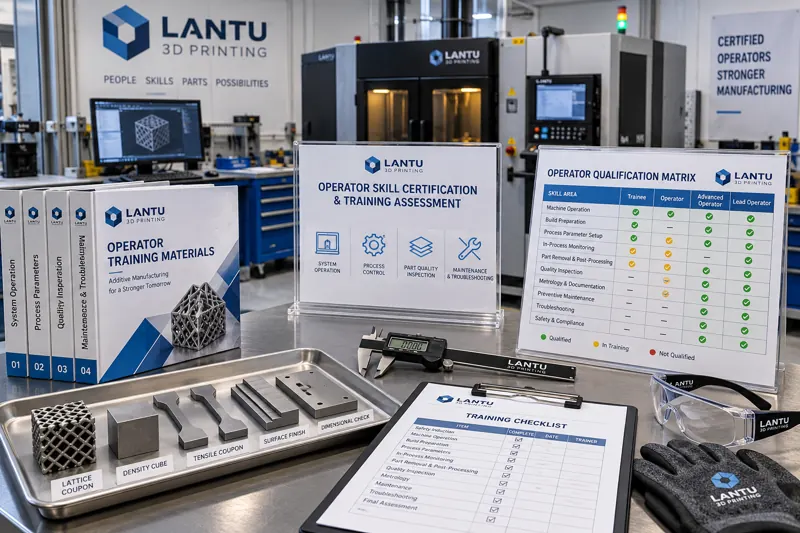
Introduction: Completing Training Does Not Equal Demonstrated Competence
Many 3D printing shops maintain complete training records: attendance sheets, course materials, examination papers, and qualification certificates are all in place. Yet when batches develop widespread porosity, scratches from residual supports, or powder cross-contamination, root-cause reviews often point to the same fact: operators have “been trained,” but have not been proven able to perform the work. Training addresses knowledge transfer; certification verifies competence. The two cannot substitute for each other. Converting job skills into qualifications that can be assessed, authorized, and traced is an engineering method for removing human-factor variation from quality risk—not an administrative procedure.
1. Break Down Each Role into Verifiable Competency Units
The first step in building a certification system is not writing training materials, but decomposing tasks. In a metal LPBF shop, for example, an “equipment operator” may actually be responsible for powder sieving and moisture confirmation, build-plate installation and leveling, recoater condition inspection, oxygen concentration and chamber-pressure verification, job startup and first-layer monitoring, part removal and depowdering, and routine equipment checks. Each task corresponds to a competency unit, and each unit must specify three elements: the action standard, acceptance threshold, and consequence of nonconformance. For example, the acceptance criteria for “recoater condition inspection” should specify a blade-edge nick of no more than 0.2 mm, straightness deviation across the full length of no more than 0.05 mm, and no streaking over three consecutive printed layers—not simply state “inspect the recoater.” Units with non-measurable thresholds cannot be included in the assessment question bank.
2. Curriculum Map: A Three-Stage Path from Hiring to Independent Work
Once competency units have been defined, the curriculum map should advance through three stages: a general safety stage (at least 40 hours, including metal-powder fire and explosion protection, inert-gas asphyxiation hazards, laser-radiation protection, and lockout/tagout procedures); a process fundamentals stage (material-process-defect relationships, such as moisture absorption in PA12 causing porosity, insufficient energy density causing lack of fusion, and accumulated thermal stress causing warpage); and a role-specific practical stage (completion of at least 20 actual work orders under mentor supervision, covering at least three material types and two typical part geometries). Gates should be established between the stages. Without practical records from the preceding stage, trainees may not advance to the next one. The value of the curriculum map is that it prevents “skipping levels”: allowing new employees to directly operate equipment for complex thin-wall parts is one of the main reasons for persistently high early scrap rates.
3. Design of Practical Assessment Question Banks and Scoring Standards
The question bank consists of a theory examination and a practical examination. The theory examination should contain no fewer than 60 questions for each role, covering parameter definitions, abnormal-condition identification, and emergency response. The passing score should be set at 80 rather than 60, because process-judgment questions allow very little margin for error. The practical examination is the core of this system: assessors issue task cards on site, and candidates must complete the work within the required cycle time. Scoring is divided into two categories: critical items and general items. Critical items are disqualifying—for example, failure to record the powder batch number, depowdering without antistatic and respiratory protection, or starting a build before oxygen concentration meets the requirement. General items are scored through deductions, such as failing to promptly seal a part after removal or leaving fields incomplete on an inspection checklist. Each practical examination should be independently scored by two assessors. Questions with an inter-rater agreement rate below 90% should have their scoring criteria revised, indicating ambiguity in the standard itself.
4. Certified Work Authorization and the Authorization Matrix
Certification results must be implemented through an authorization matrix: the horizontal axis lists roles—powder handling, equipment operation, post-processing, inspection, programming, and build preparation—while the vertical axis lists levels: L1, work under supervision; L2, independent work; and L3, capable of mentoring and auditing. The system should permit an employee to accept work only when the corresponding matrix cell has been activated. After one shop integrated its authorization matrix with its work-order dispatch system, uncertified personnel could no longer receive high-value aerospace-part assignments. Within six months, rework hours caused by improper operation fell by approximately one-third. Authorization should also distinguish between materials and equipment: an individual holding L2 authorization on an aluminum-silicon-magnesium machine does not automatically receive the same authorization on titanium-alloy equipment. Cross-equipment authorization requires reassessment.
5. Training Effectiveness Evaluation: From Satisfaction to Behavior and Results
Training evaluation often stops at “trainee satisfaction,” which is the easiest metric to inflate and provides the least decision-making value. Apply the four Kirkpatrick levels: Level 1, reaction (satisfaction surveys, for reference only); Level 2, learning (theory and practical scores, focusing on distribution rather than averages); Level 3, behavior (within three months after certification, conduct on-site audits of critical-item compliance, with a target of no less than 95%); and Level 4, results (compare first-pass inspection yield, equipment failure rate, and on-time work-order completion rate for the same role before and after certification). Training investment can be considered converted into productive capacity only when Level 3 and Level 4 data improve. Displaying Level 4 metrics on team dashboards prevents training from becoming merely an annual recordkeeping exercise.
6. Retraining, Downgrading, and Qualification Maintenance
Qualifications are not permanent. Set a validity period of 12 months, requiring refresher training and spot assessments before expiration. Any of the following conditions should immediately trigger a temporary reassessment: two consecutive nonconforming batches in the same role, a major equipment change, a revision to process documentation, or an absence from the role exceeding 90 days. If an audit identifies a critical-item violation, apply a downgrade—for example, reduce L2 to L1—and require the employee to reaccumulate practical work orders. All certification, refresher training, downgrading, and reinstatement records should be included in personnel qualification files and linked to work-order and batch numbers. This enables rapid identification of the qualification status of on-duty personnel during quality traceability investigations, and is a mandatory audit item for customer reviews and system assessments involving aerospace and medical orders.
Conclusion
The core of job skills certification is not issuing more certificates; it is converting “can the person perform the work?” into a measurable chain of evidence: competency units have thresholds, training has three-stage gates, assessments include disqualifying critical items, authorization is constrained by a matrix, effectiveness is measured through four-level indicators, and qualifications have validity periods and downgrade mechanisms. For service systems such as lantu3D that cover the full workflow from design and production through post-processing and delivery, personnel qualifications are a component of process capability, just like process documentation and equipment status. Only by controlling human-factor variation through a robust system can consistency in volume production have an explainable and auditable foundation.
Invia un modello, un disegno, un'immagine o note scritte. Gli ingegneri valuteranno materiale, processo, finitura e consegna in base all'uso effettivo.