
No model yet, material choice and wall thickness are explained from a practical angle.
Centro Conoscenze
Blueprint News
lantu3D verifica spessore, struttura, materiale, processo, quantità e finitura prima del preventivo.
01Guides
02Materiali
03Punto di vista cliente
Content should help customer decisions
lantu3D articles focus on materials, processes, cost, modeling and manufacturability so customers understand key decisions before submitting a request.

Prototype, fixture, custom part, small batch and cost-control topics for business users.
lantu3D is positioned as blueprint realization and lifecycle management, not just a print shop.

news
Quantified Schedule and Cost Management for 3D Printing Projects: Engineering Implementation of Earned Value Analysis, SPI/CPI, and Estimate at Completion
3D printing orders are often described as “80% complete,” yet layer progress is not synchronized with actual delivery status or cost incurrence, causing delays and cost overruns to occur at the same time. This article presents an engineering implementation path for Earned Value Management (EVM) in print shops: define PV using work-package weights, define EV using verifiable criteria, consolidate AC under a consistent accounting basis, derive SV/CV/SPI/CPI and forecast EAC and ETC, then link warning thresholds to specific management actions. The result is a measurable foundation for delivery and cost commitments.

news
Bid Response and Contract Performance Management for 3D Printing Projects: From Scoring Criteria Analysis to Quantitative Payment Control
Risks in additive manufacturing projects often lie not in pricing, but at the two ends of bid response and contract performance. This article presents quantitative methods for scoring-criteria matrices, technical deviation tables, milestone-based payment structures, change-order mechanisms, and receivables ledger monitoring to help teams engineer commercial terms and reduce advance-funding and overdue-payment risks.

news
Cross-Border Documentation Engineering for 3D-Printed Parts: An Actionable Method for HS Classification, Declaration Elements, and Document Consistency Checks
For exported 3D-printed parts, the most common cause of delays is not quality nonconformance but mismatches between documentation and physical goods: conflicting HS classifications and descriptions, missing declaration elements, invoice terms inconsistent with contracts, or non-compliant wood packaging. This article provides an engineering workflow covering classification reference sheets, part-number-level declaration data, contract-invoice-packing-list cross-checks, packaging-marking compliance, and exception handling.

news
Trademark Protection for 3D Printing Brand Assets: A Tiered Approach from Class Planning to Infringement Monitoring
Because 3D printing delivery workflows are highly digitalized, a brand name can be copied almost as soon as it becomes visible. This article outlines an actionable trademark and brand protection framework for 3D printing companies across six stages: class planning, pre-filing searches, use-evidence retention, authorization for printed content, infringement monitoring, and trademark portfolio management.

news
Shift Handover and Team Management in 3D Printing Workshops: Standard Operating Methods from Status Transfer to Cross-Shift Consistency
3D printing build jobs often span multiple shifts, making handover quality critical to work-in-process continuity and delivery reliability. This article divides handover content into four categories—equipment status, in-process jobs, exceptions and deviations, and pending actions and commitments—and presents a 15–20 minute overlap period, fixed inspection routes, an exceptions-first handover sequence, and three quantitative metrics: handover completion rate, handover-related exception ratio, and cross-shift first-part acceptance-rate variance.
news
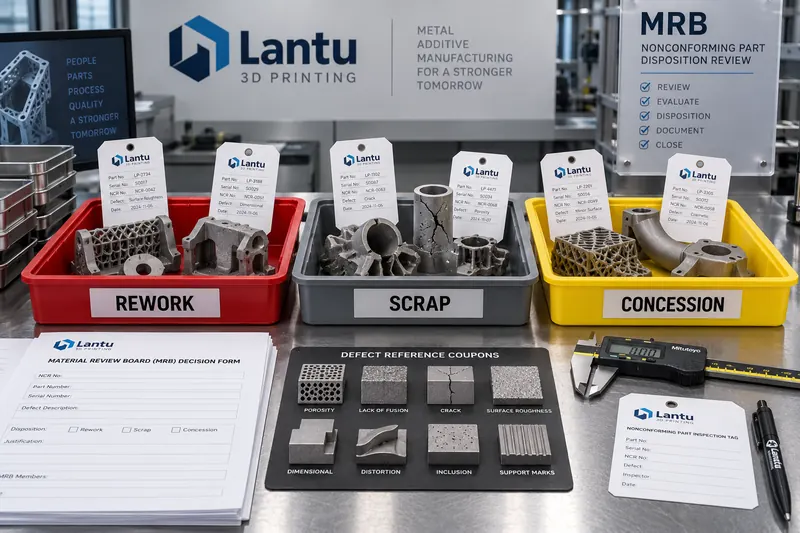
Disposition Decisions for Nonconforming 3D-Printed Parts: An MRB Closed-Loop Method from Defect Classification to Rework, Concession, and Scrap
Once a defect is found in a 3D-printed part, the subsequent disposition decision is often the real cost driver. This article presents an actionable closed-loop method: classify defects by severity, detectability, and repairability; assess rework feasibility by asking whether drawing requirements can be restored, whether the rework process has been validated, and whether rework costs less than remanufacturing; define batch limits and written customer-approval requirements for concession acceptance; specify containment scope after scrapping based on build jobs and powder lots; and convert individual cases into process-improvement inputs through MRB reviews and disposition records.

news
Material Kitting and Delivery Management in 3D Printing Workshops: Engineering Methods from Job-Package Verification to Line-Side Inventory and Shortage Response
Delivery delays in 3D printing workshops are often misattributed to capacity or process issues, when many stoppages actually result from incomplete material kitting at the scheduled start time. This article presents job-order-based kitting checklists, start-time kitting-rate metrics and three-tier thresholds, differentiated line-side inventory strategies for routine consumables and batch-controlled materials, minimum standards for delivery containers and labeling, a three-level shortage-response mechanism, and interfaces with finite-capacity scheduling and batch traceability.

news
Engineering Control of Inert Gas Consumption in 3D Printing: From Purity Criteria and Leak Testing to Per-Part Gas Accounting
Inert gas consumption in metal 3D printing is often treated as a negligible auxiliary material, yet a single build can consume 80–150 m³ and cost more than RMB 1,000. This article breaks consumption down into purging, gas replacement, powder handling, and unplanned losses; defines quality criteria for oxygen content and dew point; outlines pressure-hold leak testing and standby baseline-flow methods; and presents per-part gas accounting, tiered gas use, and consolidated-build scheduling strategies.
news
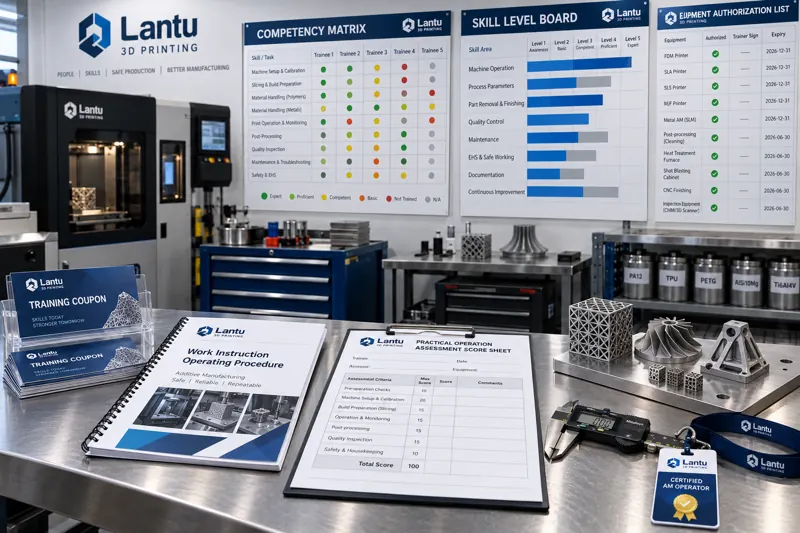
Evaluating 3D Printing Training Effectiveness: A Quantified Closed Loop from Kirkpatrick’s Four Levels and Hands-On Assessments to Certified Work Authorization
Completing a training schedule does not mean competence has been established. This article presents an engineering-based approach to evaluating 3D printing training: use Kirkpatrick’s four levels to structure evaluation, establish attributable baseline metrics such as changeover time, unplanned downtime, and first-pass acceptance rate, replace written tests with workstation practical assessment sheets, validate sustained performance through sampled behavioral observations, and embed results into production scheduling through ROI-based course decisions, certification authorization, and retraining cycles.

news
3D Printing Procurement: Quote Comparison and Supplier Sourcing from Normalized Pricing to Contractual Controls
Three 3D printing quotations differed by 37%, yet choosing the lowest price led to rework and delays far exceeding the initial savings within two months. This article examines hidden variables such as powder batches, layer thickness, post-processing, and inspection methods, and provides a framework for quote normalization, price benchmarking, supplier scoring, and six essential contract clauses that turn procurement from a price-reduction exercise into a risk-control function.

news
Sampling Inspection and Acceptance Methods for 3D-Printed Sample Validation: From Sample Size and AQL to Release or Rejection Rules
For low-volume 3D printing deliveries, measuring every first article and sampled part is time-consuming and lacks clear decision rules. This article presents a practical sampling-validation method: determine sample size by lot size, use dispersed sampling to cover variations in build location, set AQLs and acceptance/rejection numbers (Ac, Re) by characteristic class, and define reinspection, concession, and rejection paths for nonconformities. Critical characteristics must not be accepted by concession, ensuring consistent and traceable quality decisions.
news
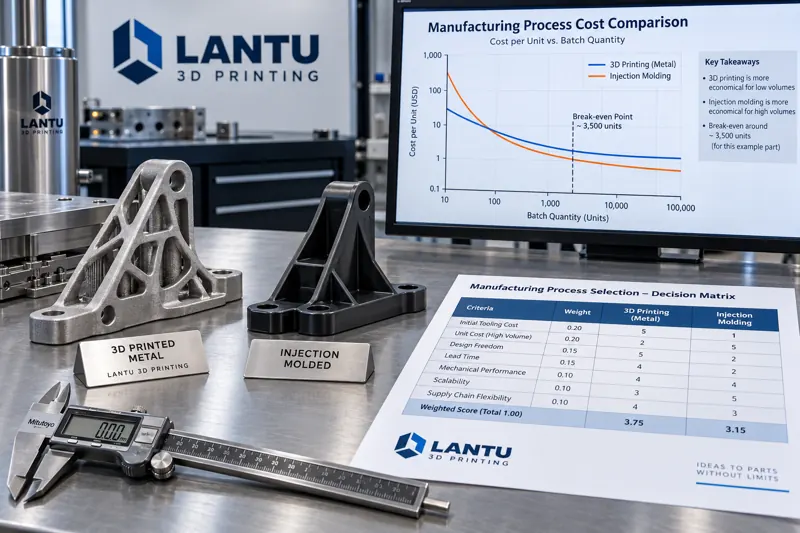
The Substitution Boundary Between 3D Printing and Traditional Manufacturing: A Quantity–Complexity Matrix, Economic Batch Break-Even Points, and a Quantified Decision Method for Switching Costs
There is no absolute superiority between additive manufacturing and traditional manufacturing—only boundary conditions. This article presents a practical framework for substitution decisions: first locate the opportunity using a quantity–complexity matrix, then calculate the economic batch break-even point using N=F/(c2-c1), incorporate four hidden cost categories—data reconstruction, post-processing, quality validation, and switching fallback—into one comparison sheet, and finally use small-batch trials and first-article qualification to calibrate parameters in a closed loop. This shifts process-route decisions from experience-based judgment to accountable, reproducible, and auditable analysis.
Inizia da qui
Have a model, drawing, or only an idea?
Submit your requirement and our engineers will recommend a better design and manufacturing path based on use, size, quantity, material, tolerance and lead time.