Introduction: Why Small-Batch Orders Often Lose Control in the Final Mile
In 3D printing services, a single prototype can usually move forward quickly based on an engineer's experience. But when an order grows to 30, 80, or 200 units, the question changes from "can it be printed" to "can it be delivered with consistent quality, on the promised schedule, and with traceability." A single batch may include SLA resin appearance parts, SLS nylon functional parts, and metal SLM connectors, with layer thickness ranging from 0.05 mm to 0.12 mm. Post-processing may also involve powder removal, curing, sandblasting, dyeing, painting, tapping, and dimensional inspection. If any step lacks takt control, the entire batch will be slowed by rework, waiting, and communication costs.
lantu3D focuses more on end-to-end management from blueprint design to physical delivery, rather than treating 3D printing as an isolated equipment capacity issue. The core of small-batch production management is to establish measurable control points between quotation, design review, scheduling, fabrication, post-processing, quality inspection, and packaging, so that every order can be broken down, tracked, and reviewed.
1. Order Breakdown: Split "Batch Production" into Manageable Process Packages
When a small-batch order comes in, the first step is not to schedule the machine directly, but to build a process package. A process package should at least include part number, material, process, quantity, critical dimensions, appearance surfaces, assembly relationships, post-processing requirements, delivery lots, and risk level. SLA appearance parts with wall thickness below 1.2 mm, slender parts with an aspect ratio greater than 8:1, and snap-fit parts with assembly clearances below 0.2 mm should be marked as high-risk parts and arranged for trial printing or design confirmation in advance.
An effective approach is to split the BOM into three layers: core structural parts, appearance/display parts, and consumables/spares. Core structural parts should be prioritized for dimensional and strength verification, appearance parts should prioritize texture, color, and surface grade, and consumables should be grouped together to reduce setup change costs. This helps prevent all parts from entering production at the same time and creating bottlenecks.
2. Capacity Assessment: Use the Bottleneck Process to Set Delivery Commitments
Many delivery delays are not caused by insufficient printers, but by post-processing, inspection, or rework consuming the buffer. An SLA machine may finish fabrication overnight, but cleaning, secondary curing, support removal, and finishing may still take 5 to 20 minutes per part. SLS nylon parts must cool naturally after fabrication, then undergo powder removal, sandblasting, and dyeing. Metal parts may require heat treatment, wire cutting, sandblasting, and CNC finishing. Scheduling should therefore be based on bottleneck processes, not just machine build time.
It is recommended to establish standard takt times for each process type: for SLA appearance parts, calculate build time plus 30% post-processing buffer; for SLS functional parts, calculate based on build chamber utilization plus cooling cycle; for metal parts, estimate in four stages: fabrication, stress relief, cutting, and inspection. If the customer requests staggered delivery, the first batch of critical parts can be released 2 to 3 days earlier to reduce the risk of waiting for the entire order.
3. Process Kanban: Let Abnormalities Surface Within 24 Hours
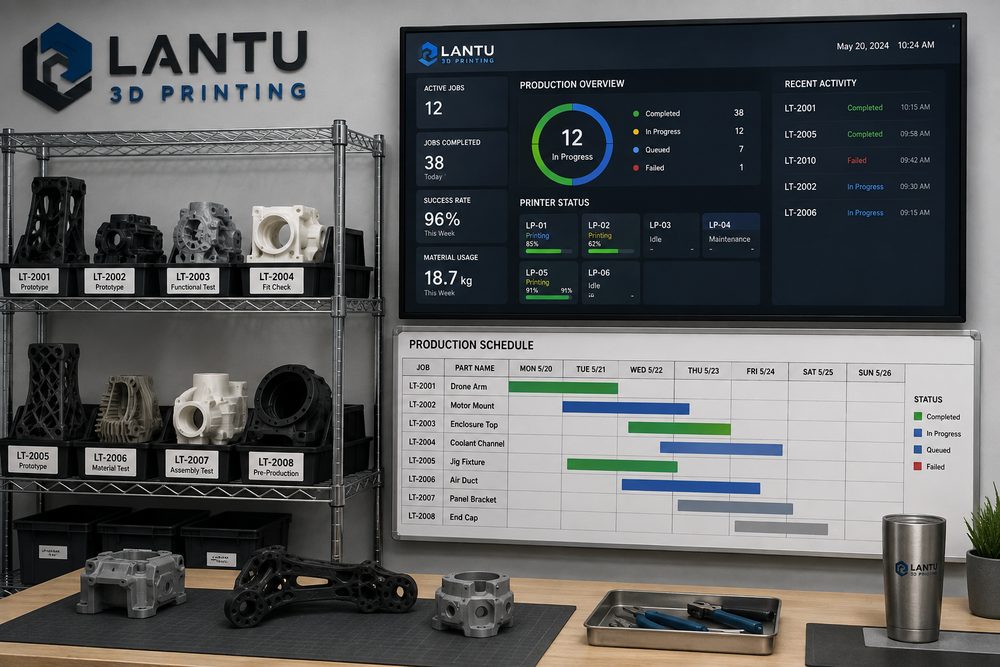
Small-batch production requires a visual kanban. The kanban fields should not be overly complex, but they must cover status, owner, estimated completion time, and the cause of any exception. Common statuses can be divided into: awaiting review, awaiting scheduling, printing, post-processing, awaiting inspection, awaiting packaging, shipped, and exception paused. Each order should be updated at least once a day, and high-risk parts should be updated immediately after each key process is completed.
Exception handling must have clear escalation rules. For example, if printing fails more than once, the placement angle, support structure, and material batch must be reviewed. If dimensional deviation exceeds ±0.2 mm, model scaling, equipment calibration, and post-processing deformation must be checked. If appearance rework exceeds 5% of the total, production of the same type of part must be paused. Using data to stop the line is cheaper than reworking an entire batch afterward.
4. Quality Gates: Turn Sampling into Process Control
Small-batch production is not mass production, but it still cannot rely only on final inspection. It is recommended to set three types of quality gates: first article approval, in-process sampling, and outbound re-inspection. First article approval focuses on dimensions, fit, and appearance surfaces; in-process sampling focuses on consistency within the batch; outbound re-inspection focuses on quantity, labeling, packaging, and documents. For assembled parts, the first article must be tested in actual assembly, not just checked as an individual part.
Inspection tools can be configured by risk level: ordinary appearance parts use calipers, gauges, and visual standards; functional parts add torque, insertion, or load tests; high-precision parts use CMM or scan comparison. Inspection records should at least retain the part number, inspection item, measured value, judgment result, and handling opinion for future quality traceability.
5. Delivery Review: Turn One Order into the Efficiency of the Next
After an order is delivered, a lightweight review should be conducted, focusing on actual print time, number of failures, post-processing time, rework reasons, and customer feedback. If a certain structure repeatedly shows warping or support marks, design recommendations should be formed. If a material changes dimensions significantly after dyeing, the process notes and quotation buffer should be adjusted. Review is not an administrative formality; it is the entry point to knowledge management.
In small-batch projects, lantu3D typically links model review, process recommendations, production scheduling, and delivery feedback to help customers gradually establish digital manufacturing standards suited to their own products. In this way, small-batch production is not just a purchase order, but part of product iteration and supply chain validation.
Conclusion: The Essence of Small-Batch Management Is a Closed Loop of Takt, Quality, and Knowledge
To achieve stable delivery in 3D printing small-batch production, you must start with order breakdown, use bottleneck processes to calculate cycle time, expose abnormalities through kanban, control rework through quality gates, and accumulate experience through reviews. For enterprise customers, when choosing a service partner, it is important to look not only at the number of machines, but also at whether the partner has full-process management capability from design blueprint to physical delivery.
Submit a model, drawing, image or written notes. Engineers will review material, process, finishing and delivery based on actual use.