Introduction: 3D printing is evolving from “making a sample” to “managing a delivery”
In the past, many people understood 3D printing mainly as a rapid prototyping tool, with the core value being the ability to turn a design file into a model you can see and hold as quickly as possible. But as materials, equipment, and software have matured, customer needs have shifted from “Can it be printed?” to “Can it be delivered consistently? Can it be reproduced in small batches? Can quality be traced? Can it work with the supply chain?” This means 3D printing services are no longer just isolated processing tasks; they are digital manufacturing workflows made up of design data, process parameters, material batches, post-processing, inspection, and logistics. The idea emphasized by Blue lantu3D—moving from blueprint/design to physical delivery—fits this industry evolution very well.
1. Small-batch production is becoming a key growth area for additive manufacturing
Rapid prototyping remains important, but small-batch production is becoming a higher-value application. For custom parts, jigs and fixtures, consumer electronics housings, medical support models, or industrial spare parts in quantities of 10 to 500, traditional mold development is slow and expensive. 3D printing avoids tooling investment and supports fast iteration. To achieve reliable small-batch delivery, service providers must manage batch consistency, including machine status, material batch, build orientation, cooling cycles, post-processing windows, and sampling ratios. The industry trend is not simply to add more printers, but to record the key data for each batch so that the same type of part can still achieve predictable quality when ordered at different times.
2. Materials engineering is expanding the boundaries of application
Material capability is increasingly determining the upper limit of 3D printing applications. Standard photopolymer resins are suitable for appearance models and structural validation, but demand for heat resistance, toughness, flame retardancy, transparency, elasticity, and metal materials continues to grow. Materials such as SLS PA12, glass fiber reinforced nylon, high-temperature resistant resins, flexible TPU, aluminum alloys, and titanium alloys are pushing 3D printing from display models toward functional parts, fixtures, and end-use components. The future trend is for material selection to be tightly linked to application scenarios: for example, heat-resistant fixtures must evaluate both heat deflection temperature and dimensional stability, snap-fit parts must consider fatigue and resilience, and transparent parts must account for haze changes caused by post-processing. Material databases and performance validation records will become important assets for service platforms.
3. Quality traceability is moving from large-scale manufacturing into 3D printing services
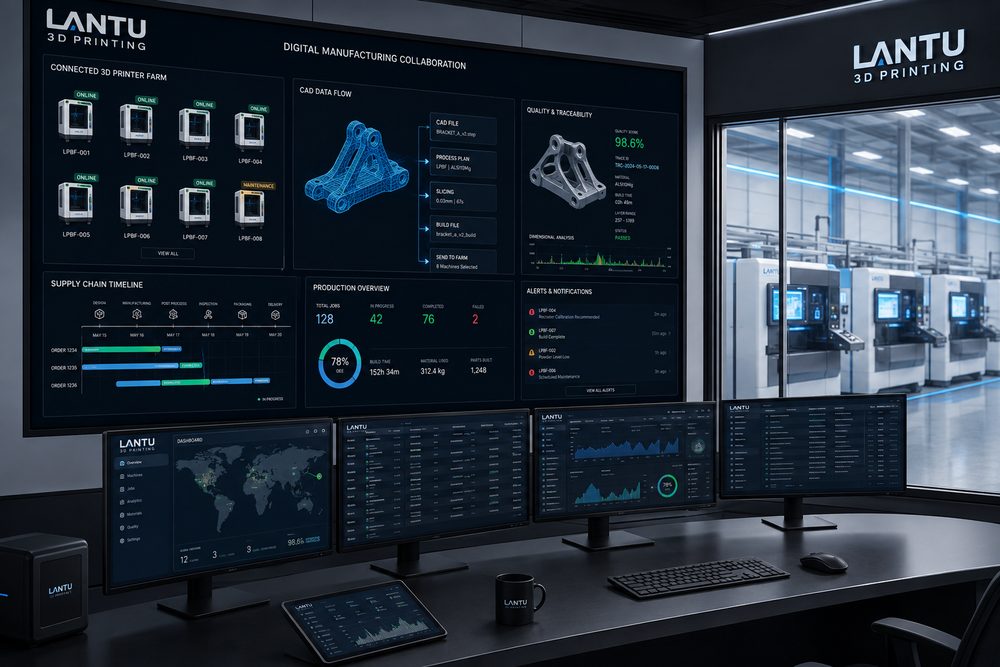
When 3D printing is used for functional parts and small-batch delivery, quality traceability is no longer optional. A mature project should at least record the file version, material batch, machine ID, print date, key parameters, post-processing method, inspection results, and shipping records. For high-risk projects, it should also retain first-article approval, in-process sampling, customer changes, and exception-handling records. These data help platforms quickly identify the cause when issues such as dimensional deviation, cracking, color variation, or assembly problems arise. The industry is shifting from “explaining problems based on experience” to “reviewing problems with data,” which is the core foundation of collaborative digital manufacturing.
4. Online quoting and engineering review will become more closely integrated
More and more customers want to upload a model and get a quote quickly, but a truly reliable quote cannot be based only on volume and material unit price. Thin walls, supports, enclosed cavities, post-processing complexity, assembly risk, quantity tiers, and lead time requirements all affect cost. Future online quoting systems will be deeply integrated with engineering review: the system will automatically identify volume, bounding box, wall thickness, and holes, engineers will add process-risk judgments, and the platform will then provide multiple options such as an economical option, appearance-focused option, functional option, and expedited option. This improves quoting efficiency while also preventing rework caused by overlooked risks after a low-price order is accepted.
5. Distributed capacity requires unified standards and data interfaces
As demand grows, a single factory can no longer cover all materials and lead times, so coordinated distributed capacity will become a trend. But distributed does not mean arbitrary outsourcing; it requires unified file specifications, material naming, process capability descriptions, inspection standards, and delivery records. The platform needs to know which types of orders are suitable for which capacity nodes, and which suppliers can provide painting, dyeing, metal heat treatment, or CMM inspection. Only when data interfaces and standards are consistent can customers enjoy a consistent experience. Otherwise, multi-node collaboration will amplify communication errors and quality fluctuations.
Conclusion: platform capabilities will determine the next stage of competitiveness
The next stage of the 3D printing industry is not just about faster equipment or more materials, but about stronger platform-based, data-driven, and collaborative capabilities. Whoever can integrate design review, material selection, process parameters, production scheduling, post-processing, inspection, and logistics into a transparent workflow will gain a competitive advantage in small-batch manufacturing and customized delivery. For customers, choosing a service provider should also involve evaluating whether it has needs analysis, quality traceability, and delivery management capabilities—not just a price per part. Blue lantu3D will continue to focus on full lifecycle management from blueprint to physical product, helping design ideas turn more reliably into verifiable and deliverable manufacturing results.
Submit a model, drawing, image or written notes. Engineers will review material, process, finishing and delivery based on actual use.