Introduction: Quality Traceability Is the Trust Foundation of Engineering Delivery
In the early prototyping stage, customers usually care more about speed and appearance. But once 3D printing moves into functional validation, small-batch production, or end-use delivery, quality traceability becomes an essential capability. Customers want to know not only whether a part was completed, but also what material was used, which machine printed it, which parameters were applied, what post-processing was performed, how the inspection went, and how any abnormality was handled. Without traceability records, issues can only be guessed at based on experience, making it difficult to identify root causes quickly.
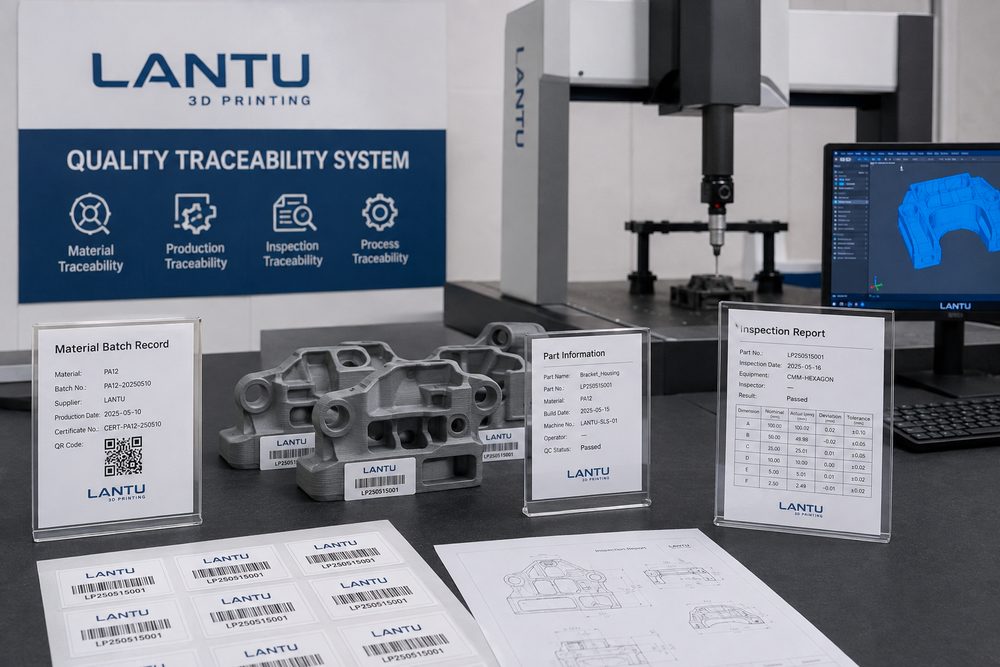
lantu3D is positioned not simply as a printing factory, but as a lifecycle management and execution platform that turns design blueprints into physical delivery. The value of quality traceability is to preserve the evidence chain for each part, from file and material to process, inspection, and logistics, making delivery more transparent and reviews more efficient.
1. What to Trace: Trace the Order, the Part, Not Just the Customer
Quality traceability should cover at least four levels: order, model, batch, and individual part. The order level records customer requirements, delivery date, version notes, and quality specifications. The model level records file version, revision history, key dimensions, and process notes. The batch level records material batch, machine, print time, and post-processing. The part level records the serial number, inspection results, packing location, and shipping information.
For display models or standard prototypes, tracing to the batch level is usually enough. For functional parts, assemblies, or high-value components, assigning a unique ID to each part is recommended. This ID can be in the form of a QR code, label, or packing list and does not need to be engraved directly on the part surface. The key is that when a problem occurs, you can trace whether other parts from the same batch carry the same risk.
2. Material Records: Batch Number Matters More Than Material Name
Recording only “PA12 nylon” or “photopolymer resin” is not enough. Material traceability should include the supplier, batch number, receiving date, opening date, storage conditions, and remaining stock status. For powder materials, the ratio of virgin powder to recycled powder should also be recorded. For resin materials, the usage period after opening, filtration status, and contamination risk should be noted. Metal powders require even stricter records, including particle size range, composition certificate, and reuse count.
For example, if an SLS nylon part shows increased brittleness, it is hard to determine whether the cause is insufficient wall thickness, a printing temperature deviation, or powder aging without powder batch and recycled ratio records. If the records show that the batch had a high recycled powder ratio and a long storage time, the engineering team can quickly narrow the cause and adjust the powder strategy for the next run.
3. Process Parameters: Record the Key Variables That Can Reproduce Results
The focus of traceability varies by process. SLA should record resin type, layer thickness, exposure settings, part orientation, support strategy, cleaning time, and secondary curing parameters. SLS should record powder batch, layer thickness, build position, preheat temperature, cooling time, and depowdering method. FDM should record nozzle temperature, bed temperature, layer height, infill ratio, print orientation, and material drying status. SLM should record laser power, scan speed, powder layer thickness, shielding atmosphere, heat treatment, and wire-cutting parameters.
Traceability records do not need to duplicate every internal machine parameter, but they must preserve the key variables needed to reproduce and explain the result. For repeat orders of the same model, it is recommended to turn mature parameters into a process template and only record differences from that template going forward. This reduces the recording burden while preventing the loss of critical know-how.
4. Post-Processing Traceability: Many Quality Issues Happen After Printing
Not all 3D printing quality issues come from the printing process itself. Support removal, depowdering, sanding, bead blasting, dyeing, painting, electroplating, heat treatment, and insert assembly can all affect dimensions, surface finish, or strength. Post-processing traceability should record the method, key parameters, consumables used, processing time, and any abnormalities.
For example, if an SLA transparent part is not cleaned thoroughly, it may become tacky or cloudy during later curing. An unstable heat-treatment curve for a metal part can affect residual stress relief. Overly long dyeing times for nylon parts may cause slight dimensional changes. Treating post-processing as an independent quality stage rather than a miscellaneous step after printing is an important step toward stable delivery capability.
5. Inspection Records: Turn the Pass/Fail Conclusion into Verifiable Evidence
Inspection records should include the inspection item, tool, standard, result, and judgment. Common tools include calipers, pin gauges, thread gauges, height gauges, CMMs, surface roughness testers, and assembly fixtures. Standard structural parts can record key dimensions and appearance grade. High-precision parts should keep measurement reports. Functional parts should also record assembly or load-test results.
It is recommended to build a table for critical dimensions with “nominal value, upper limit, lower limit, measured value, and judgment.” If the target hole diameter for a batch of parts is 6.00 mm with an allowable range of 5.90-6.10 mm, and 2 out of 10 sampled parts measure 5.86 mm, the batch should not be released casually. Instead, it should be determined whether secondary machining, reprinting, or customer risk notification is required. Evidence-based records make quality decisions more transparent.
6. Exception Handling: The Traceability System Must Support Corrective Actions
Quality traceability is not about assigning blame after the fact; it is about correcting issues quickly. Exception records should include the discovery time, process stage, quantity affected, temporary containment, root cause analysis, and preventive measures. Common causes can be divided into design issues, material issues, equipment issues, parameter issues, post-processing issues, and logistics issues. Each type of cause should have a corresponding corrective action.
For example, a customer complains that parts fit too tightly. After tracing, it is found that the holes in the batch are generally undersized and the print orientation left obvious support marks inside the holes. Corrective actions may include adjusting hole compensation, changing part orientation, adding a re-drilling step, or updating the design guidelines. If parts are simply re-shipped without updating the rules, the next batch may repeat the same problem.
7. Delivery Evidence: Packaging and Logistics Are Also Part of the Quality Loop
Delivery traceability should record the packaging method, quantity list, photos, tracking number, and shipping time. For parts that are prone to deformation, scratching, or high requirements for surface treatment, the buffering material, separation method, and orientation markers should also be recorded. Judging responsibility for transport damage often depends on pre-shipment photos and packaging evidence.
Small-batch orders especially require counting evidence. It is recommended to photograph parts by serial number or tray position before packaging and to note quantities, versions, and special instructions on the packing list. If the customer finds missing or mixed-up parts after receipt, the records can be checked quickly instead of re-counting the entire project.
Conclusion
A 3D printing quality traceability system should cover the order, model, material, process, post-processing, inspection, exceptions, and delivery evidence. Its goal is not to increase paperwork, but to ensure that every delivery has evidence, every problem can be located, and every review can lead to improvement. Through lifecycle management capabilities, lantu3D helps customers turn scattered manufacturing actions into a traceable, reusable, and continuously optimized engineering delivery system.
Submit a model, drawing, image or written notes. Engineers will review material, process, finishing and delivery based on actual use.