Introduction: Why Small-Batch Orders Demand More Management Than Single-Part Prototypes
In 3D printing services, the main goal of a single prototype is usually to validate structure, appearance, or assembly fit. Small-batch production, however, must maintain dimensional consistency, delivery stability, and cost control across dozens or even hundreds of parts. Many projects appear to go smoothly at the sample stage, but once they move into small-batch production, issues such as queueing delays, post-processing bottlenecks, rising rework rates, and packaging and counting confusion quickly emerge. The root cause is often not insufficient equipment capability, but the lack of a takt control method that spans the full process from order breakdown to delivery review.
Blueprint3D emphasizes full lifecycle management from design blueprints to manufacturing and physical delivery. For small-batch orders, the platform should not only record that “printing is complete,” but also track the frozen process version, batch number, critical dimensions, post-processing status, and shipment batch. Only by linking these data points into a closed loop can customers receive a stable delivery experience.
1. Order Breakdown: Turn “Quantity” into Manageable Production Units
The first step in small-batch production is not to schedule the machine immediately, but to break the order into several production units. It is recommended to split by six dimensions: material, process, color, post-processing, precision class, and delivery time. For example, if one customer submits 80 structural parts, with 50 in natural-white SLS nylon PA12, 20 requiring black dyeing, and 10 requiring painting, this should not be treated as a single 80-piece order. Instead, it should be divided into at least three production routes.
Each production unit should have a process version number. The version number includes the model file, build orientation, layer thickness, infill or wall-thickness constraints, post-processing instructions, and inspection criteria. If the customer changes hole locations or surface requirements during production, the old version should be frozen and a new version created to prevent parts with different standards from being mixed into the same batch.
2. Takt Calculation: Use the Bottleneck Process to Determine Delivery Commitments
The delivery cycle for small-batch 3D printing is usually determined by the bottleneck process. In SLA projects, the bottleneck may be washing, secondary curing, and painting. In SLS projects, it may be cooling, depowdering, and dyeing. In metal SLM projects, heat treatment, wire cutting, sandblasting, and dimensional inspection often become the constraints. If quotes are based only on print time, the actual delivery promise is likely to be overly optimistic.
It is recommended to build a standard takt table that includes “printing time + cooling/curing time + post-processing time + inspection time + packaging time.” For example, if a batch of PA12 parts takes 14 hours to print, 8 hours to cool, 2 hours to depowder, 6 hours for dyeing and drying, and 3 hours for sampling and packaging, the shortest controllable cycle is not 14 hours, but more than 33 hours. If multiple batches are queued on the same machine, time for powder changes, cleaning, and exception buffers must also be added.
3. Scheduling Method: Small-Batch Jobs Should Not Always Go on the Machine First
Effective scheduling must balance equipment utilization and delivery risk. For powder-bed processes, it is best to combine parts with the same material, same color, and similar height into one build job to improve build chamber utilization and reduce post-processing changeovers. For SLA or DLP, jobs should be arranged by resin type, precision requirements, and cleaning tank load to avoid contamination and extra cleaning time caused by frequent material changes.
A three-level priority system can be used during scheduling: Level 1 for orders with confirmed delivery dates and frozen data; Level 2 for orders waiting on customer confirmation but with materials already prepared; Level 3 for projects still undergoing design changes. Projects without a frozen version should not occupy critical machine time, otherwise customer revisions can easily trigger rush insertions and rework.
4. WIP Kanban: Give Every Part a Status, Not Just an End Result
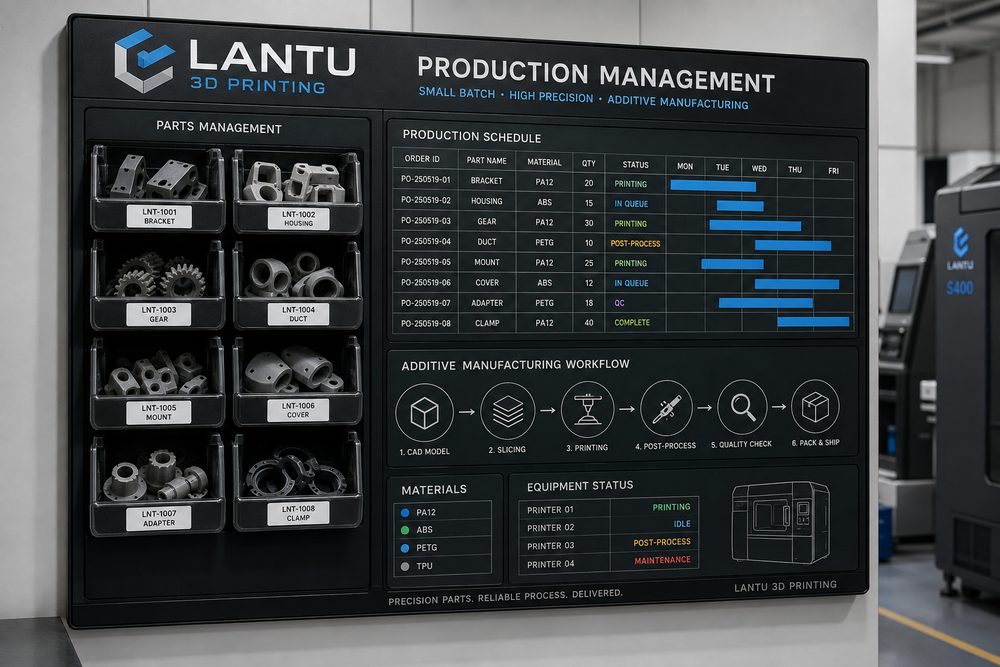
Small-batch orders require a visual management board. Recommended statuses include: file check, quotation confirmation, process programming, printing, cooling/curing, support removal/depowdering, surface finishing, dimensional inspection, packaging pending shipment, and shipped. Each status should record the responsible person, start time, and exception notes. For orders with multiple parts, the board should also track completed quantity, quantity awaiting rework, and quantity awaiting customer confirmation.
For example, if a batch of 60 housings shows whitening in the latch area after support removal, and the board only shows “post-processing complete,” the issue may not surface until final inspection or customer receipt. If the status is broken down to “support removal exception awaiting evaluation,” the engineer can quickly determine whether the support points were too thick, curing was insufficient, or the wall thickness was too thin, and decide whether to reprint or locally repair the parts.
5. Quality Gates: Place Sampling Where the Risk Is Highest
Small-batch production does not require complex inspection on every piece, but quality gates must be set at high-risk points. It is recommended that first article inspection cover appearance, critical dimensions, assembly fit, and material/color confirmation. In-process sampling should focus on batch consistency, while final-piece inspection is used to detect machine drift or post-processing deviations. For functional parts, critical bore sizes, snap-fits, threaded insert locations, and sealing-surface flatness should be included in the inspection checklist.
Sampling ratios can be set according to risk. Standard display parts can be sampled at 10% to 20%; functional assembly parts are best confirmed 100% on the first article, then sampled at 20% to 30%; medical, aerospace, or high-value tooling projects should follow stricter records according to the customer quality agreement. The Blueprint3D platform can turn these checkpoints into project templates, reducing the cost of repeated communication.
6. Delivery Review: Make Each Batch More Stable Than the Last
After each small-batch order is completed, at least three indicators should be reviewed: the gap between planned and actual cycle time, the rework/reprint ratio, and customer feedback issues. If actual cycle time exceeds the plan by more than 20%, trace whether the cause was equipment waiting, post-processing backlog, delayed customer confirmation, or logistics issues. If rework is concentrated in similar structures, return to the design guidelines and update recommendations for wall thickness, support strategy, or assembly clearance.
The value of review is to turn project experience into reusable rules. For example: “When producing small-batch PA12 thin-wall snap-fit parts, the root fillet of the snap-fit should not be less than 0.8 mm, and elasticity recovery should be checked before dyeing.” Guidance like this is far more actionable than a generic reminder to “pay attention to strength.”
Conclusion
The key to small-batch 3D printing production management is connecting order breakdown, process freeze, bottleneck takt, scheduling priority, WIP status, quality gates, and delivery review. The value of Blueprint3D is not only in completing the print, but in helping customers reliably turn design blueprints into deliverable, traceable, and repeatable physical products.
Submit a model, drawing, image or written notes. Engineers will review material, process, finishing and delivery based on actual use.