Introduction: Functional Part Material Selection Should Not Rely on Material Names Alone
In 3D printing projects, many failures are not caused by an inability to print the model, but by choosing the material too early. A sample that looks acceptable at first glance may still require rework if it warps, cracks, absorbs moisture and expands, or fails during assembly, under heat, under load, or during long-term use. When undertaking projects from design to physical delivery, lantu3D typically breaks requirements down into five categories: mechanical performance, environmental conditions, dimensional stability, surface requirements, and delivery volume, before deciding on materials and processes, rather than making a simple choice among “resin, nylon, or metal.”
For example, for the same type of enclosure, a presentation sample may prioritize SLA photopolymer resin to achieve a fine surface and shorter lead time; an assembly validation part may be better suited to SLS PA12 because its toughness, impact resistance, and more stable isotropic performance; if the part must withstand continuous loads or a high-temperature environment, nylon reinforced with glass fiber, a heat-resistant resin, or a metal printing solution must be evaluated further. The value of material innovation is not in chasing new terminology, but in turning material capabilities into engineering results that can be verified, delivered, and reordered.
1. Define the Use Case First, Then Build a Candidate Material Pool
The first step in material selection is to define the real operating conditions. Common indicators include operating temperature range, sustained load, instantaneous impact, contact media, assembly method, surface friction, flame retardancy, and appearance color. If the customer only provides descriptions such as “high strength,” “durable,” or “like an injection-molded part,” engineers need to continue asking: what is the load direction, will the screw bosses be repeatedly assembled and disassembled, will the part contact grease or alcohol, must dimensional tolerances be controlled within ±0.2 mm, and is the use cycle a one-time display or long-term operation?
The candidate material pool can be established by process. SLA resin is suitable for appearance parts, transparent parts, and detailed models, with common layer heights of 0.05-0.1 mm; the surface is refined, but toughness and weather resistance must be evaluated carefully. SLS PA12 is suitable for complex structures, low-volume functional parts, and snap-fit features, with common layer heights of 0.1-0.15 mm; powder support makes complex cavities easier to realize. MJF nylon parts offer stable batch consistency and detail performance. SLM metal printing is suitable for high-strength, heat-resistant, or lightweight structures, but support removal, heat treatment, machining datums, and inspection cost must all be considered.
2. Replace Subjective Judgement with Sample Validation
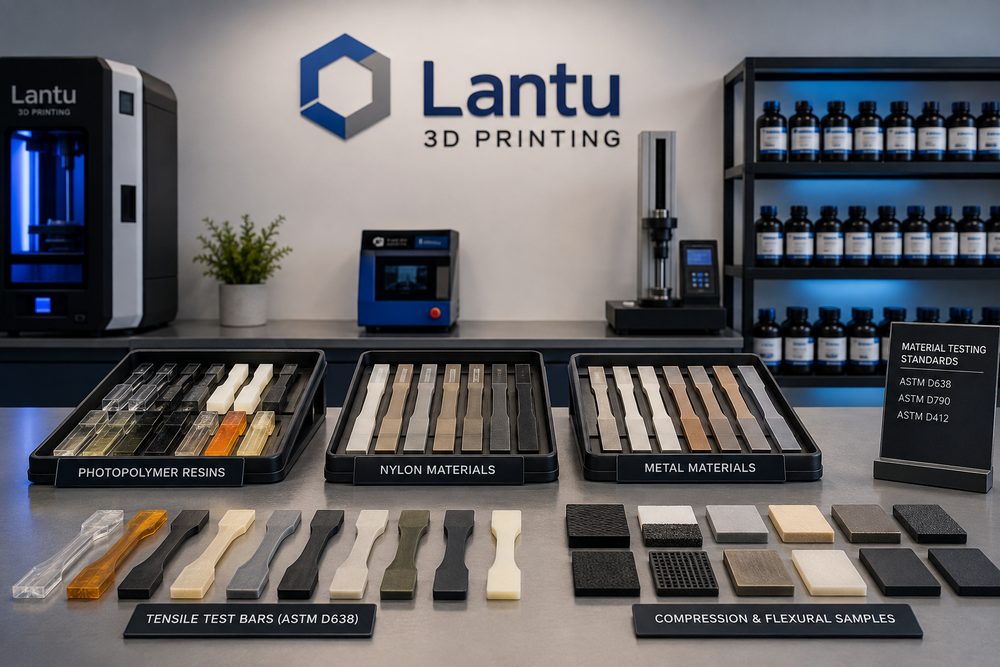
Material innovation must be validated. For functional parts, it is recommended to produce standard test coupons and representative structural parts before formal production. Standard coupons can follow tensile, bending, impact, or heat deflection test requirements, while representative structural parts should include real features such as thin walls, snap fits, threads, hole positions, cantilever beams, and assembly surfaces. Only by combining these two types of samples can the problem be avoided where “the material datasheet looks good, but the part does not work well on site.”
During validation, record print orientation, layer height, placement position, post-processing method, and test results. Taking nylon parts as an example, if a snap fit is repeatedly bent in the Z direction, interlayer bonding and placement orientation will significantly affect service life. If the part will be used in a humid environment, dimensional changes after moisture absorption must also be evaluated in advance. For resin parts, overly long secondary curing may increase hardness but reduce toughness, while insufficient secondary curing may cause a sticky surface or unstable long-term performance. Therefore, the validation report should not merely say “pass”; it should provide traceable process conditions.
3. Material and Structural Design Should Be Optimized Together
Many material problems can be mitigated through structural design. Thin-walled parts are not necessarily reliable just because a “stronger material” is used. Reasonable wall thickness, fillets, stiffening ribs, and load paths are often more effective. In general, the wall thickness of display parts can start at 1.0-1.5 mm, while critical load-bearing areas of functional nylon parts are often recommended to reach 2.0 mm or more. Screw bosses need root fillets and external stiffening ribs to avoid stress concentration. Long parts must consider warping direction and support strategy, and in some cases splitting the part for later assembly is necessary.
lantu3D emphasizes collaborative management from blueprint to delivery, meaning that materials, processes, structural modifications, and inspection methods are reviewed together before quoting and production. If a customer insists on a certain material, the engineering team will also define the risk boundaries. For example, transparent resin parts are suitable for display and optical appearance verification, but should not be directly equated with the long-term impact resistance of injection-molded PC. By moving risk management earlier through design review, more time is usually saved than by reworking finished parts.
4. Post-Processing and Inspection Determine Final Delivery Quality
Material performance does not end when printing is complete. SLS nylon parts require powder removal, sandblasting, dyeing, or infiltration; surface roughness and porosity affect appearance and cleaning difficulty. SLA resin parts require washing, secondary curing, sanding, and coating; excessive sanding may alter dimensions. Metal parts often require support removal, heat treatment, sandblasting, CNC finishing, and coordinate measuring. If the post-processing path is not considered during material selection, both quoting and lead time will be distorted.
Inspection should also match the intended use. Appearance parts should focus on surface quality, color variation, and assembly feel. Functional parts should inspect critical dimensions, threads, hole positions, flatness, and load-bearing areas. Metal parts may also require density, hardness, nondestructive testing, or material certification. For repeat orders, it is recommended to establish first-article records and batch traceability sheets, including material batch number, equipment, process parameters, post-processing personnel, and inspection results, to facilitate continuous improvement.
Conclusion: The Core of Material Innovation Is Verifiable Delivery
Material innovation in 3D printing is not a simple replacement of material names, but the establishment of a closed loop among use case, material, process, structure, post-processing, and inspection. When choosing a 3D printing service, companies should pay attention to whether the supplier can propose a validation plan, define risk boundaries, and establish delivery standards. The value of lantu3D lies in connecting early concepts, engineering design, and physical delivery, shifting material selection from experience-based judgement to data-driven, process-oriented, and traceable engineering decisions.
Submit a model, drawing, image or written notes. Engineers will review material, process, finishing and delivery based on actual use.