
Introduction: Why PA12 Batch Printing Often Reveals Gaps in Stability
In SLS (selective laser sintering), PA12 nylon is often used for functional prototypes, low-volume structural parts, fixtures, and lightweight housings. Its advantages include good toughness, fatigue resistance, and the ability to form complex parts in a single build without support structures. But once production moves into batch delivery, customers care less about whether a single part can be printed successfully and more about whether dimensions, appearance, and mechanical performance remain consistent across parts and across batches. In project evaluations, lantu3D often sees this scenario: parts perform well during sample validation, but during repeat batch orders they begin to show edge warping, hole-position deviations, or a heavier powdery surface finish. The root cause is usually not the model itself, but a lack of quantified control over material condition and process windows.
PA12 powder is sensitive to moisture content, powder aging, and thermal-field uniformity. If the storage environment stays above 50% RH for long periods, or if the powder is not sealed and equilibrated properly after opening, micro-porosity, surface roughness, and reduced local strength can appear during sintering. If the ratio of reclaimed powder is too high, melt flow decreases and shrinkage becomes less uniform at the part edges, increasing warpage risk. To move PA12 from "printable" to "deliverable," material innovation, process optimization, and inspection traceability must be managed within the same closed loop.
1. Material Condition: Drying, Screening, and Equilibration Are the First Line of Defense Against Warping
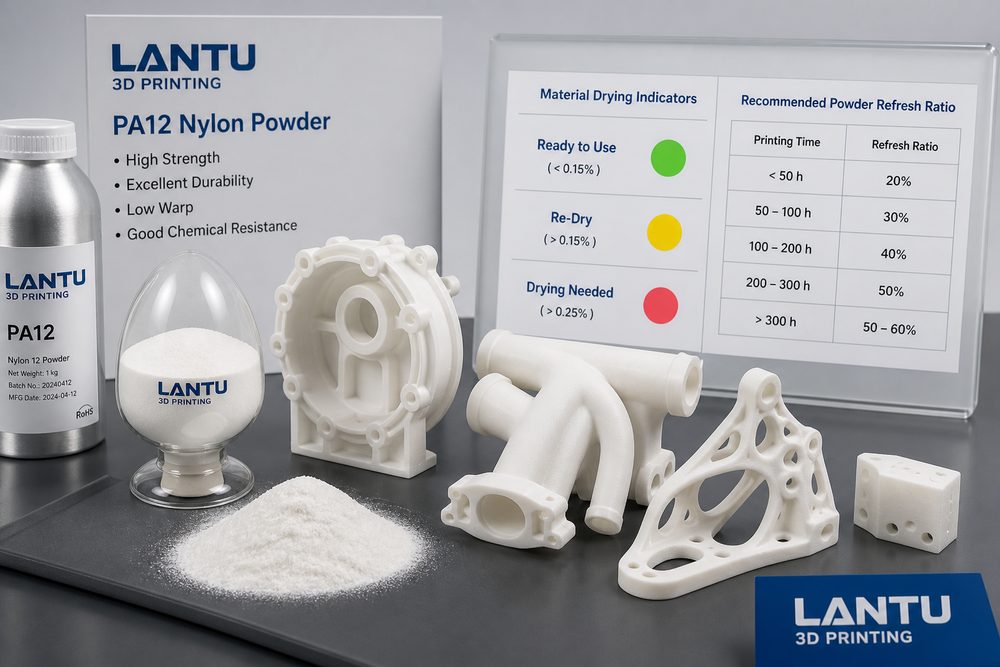
Before PA12 powder enters the machine, it is recommended to record the batch number, opening time, storage temperature and humidity, number of screening cycles, and usage ratio. For powder that has been stored for a long time or used across different seasons, lantu3D typically recommends low-temperature drying followed by equilibration at room conditions to prevent the outside of the powder from being dry while the interior still retains moisture. In actual production, powder moisture content, flowability, and bulk density can be used as pre-load inspection items. If the powder is clumped, noticeably darker in color, or spreads unevenly, it should not be used for precision-sensitive parts even if it has not yet reached its theoretical discard cycle.
The purpose of powder screening is not only to remove large particles, but also to maintain uniform powder layers. Common SLS layer thickness is around 0.1 mm, and local agglomerates can be amplified on the part surface, causing rough hole walls, under-sintered thin edges, or missing fine details. For parts with wall thickness below 1.5 mm, long strip-like geometries, or snap-fit structures, powder quality directly affects warpage and assembly feel. Before scheduling, lantu3D marks risk features such as thin walls, long cantilevers, and dense hole arrays, then links them to powder-condition records to create material risk alerts.
2. Powder Recycling: Refresh Rate Is Not a Cost Item, but a Quality Parameter
In SLS, unsintered powder can be recycled, which is one of the main reasons PA12 is cost-effective in batch manufacturing. However, unsintered powder undergoes high-temperature preheating, and its particle-size distribution, melt index, and color gradually change. If the old-powder ratio is increased blindly in the name of reducing material cost, short-term savings may be offset by higher scrap rates, more rework, and unstable delivery cycles. A better approach is to establish a powder refresh strategy, setting different virgin-powder ratios according to part precision, appearance grade, and mechanical requirements.
For standard appearance parts, a higher proportion of recycled powder can be used, with bead blasting and dyeing improving the surface finish. For assembly holes, thin snap-fit features, or load-bearing structural parts, the virgin-powder ratio should be increased, and the refresh strategy should remain consistent within the same order. In batch projects, lantu3D typically records the powder refresh rate in the manufacturing log and archives it together with the machine ID, layer thickness, part placement, and post-processing batch. If dimensional deviation appears later, the team can trace whether the issue came from model compensation, machine thermal conditions, material batch variation, or post-processing shrinkage.
3. Thermal Field and Nesting: Low Warpage Depends on a Stable Temperature Gradient
The essence of PA12 warping is uneven cooling shrinkage. The SLS build chamber must maintain a stable preheating environment close to the material's melting point, while the laser is only responsible for local melting. If the chamber edge temperature is too low, or if parts are concentrated too heavily in the Z direction, edge lift and large-flat-surface deformation become more likely. Process optimization should consider part orientation, spacing, thermal mass distribution, and cooling rhythm together, rather than simply increasing laser power.
In batch nesting, lantu3D avoids placing large flat parts in the same thermal zone and often tilts elongated parts to reduce abrupt changes in cross-sectional area from layer to layer. For parts with strict hole-spacing and mating-surface requirements, dimensional compensation is validated during the sample stage and first-piece measurement data are retained. For batch orders, first-piece inspection alone is not enough; process sampling is still required, with close attention to long-edge dimensions, hole spacing, snap-fit elasticity, and threaded insert positions. A stable thermal field and reasonable nesting can significantly reduce the burden of post-straightening and rework.
4. Post-Processing: Avoid Secondary Deformation from Depowdering to Dyeing
Common SLS PA12 post-processing steps include cooling, depowdering, bead blasting, dyeing, infiltration, and local polishing. Many warping issues do not form at the moment of printing, but are amplified by opening the chamber too early, aggressive blasting, or high-temperature dyeing. For parts with uneven wall thickness or large flat surfaces, sufficient cooling before removal is recommended. Blasting pressure and distance should remain stable to avoid prolonged localized impact on thin-wall areas. Dyeing temperature, time, and fixture support method should also be recorded, because nylon undergoes slight dimensional changes during moisture absorption and heating.
If the part is used for assembly, key dimensions must be checked again after post-processing, rather than relying only on post-print initial inspection. lantu3D divides inspection priorities according to the customer's application: display parts focus on surface uniformity and color consistency; functional parts focus on hole positions, mating surfaces, and elastic structures; fixtures and jigs focus on datum flatness and locating-pin hole accuracy. Only by including post-processing parameters in the quality record can the gap of "printed OK, delivered failed" be avoided.
5. Enterprise Implementation: Turning Material Parameters into a Reproducible Delivery Standard
For enterprise customers, the value of low-warpage PA12 batch printing is not just obtaining a set of parts, but creating a manufacturing solution that is repeatable, traceable, and optimizable. lantu3D connects design review, material selection, print nesting, post-processing, inspection, and delivery feedback to help customers transition smoothly from prototype validation to small-batch production. At the start of a project, key dimensions, tolerance grades, appearance requirements, mechanical use scenarios, and acceptance methods should be clearly defined. During production, powder batch numbers, refresh rates, machine parameters, and sampling results should be recorded. After delivery, assembly feedback should be fed back into the next round of model compensation.
Once this information is consolidated into a project template, quoting, scheduling, and risk assessment for similar orders become much faster. Material innovation does not mean frequently changing materials; it means matching material performance, process windows, and business goals. For PA12 nylon, the real innovation is using quantifiable process management to reduce uncertainty, allowing SLS to evolve from a rapid prototyping tool into a reliable flexible manufacturing capability.
Conclusion
Low-warpage batch 3D printing with PA12 requires simultaneous control of powder condition, refresh rate, thermal-field nesting, post-processing, and inspection traceability. lantu3D recommends that companies establish material and process records during the sample stage rather than waiting to correct problems after batch issues appear. Only by turning material parameters into executable control points can cost, lead time, and quality remain in stable balance.
Submit a model, drawing, image or written notes. Engineers will review material, process, finishing and delivery based on actual use.