Introduction: Material innovation is changing how parts are delivered
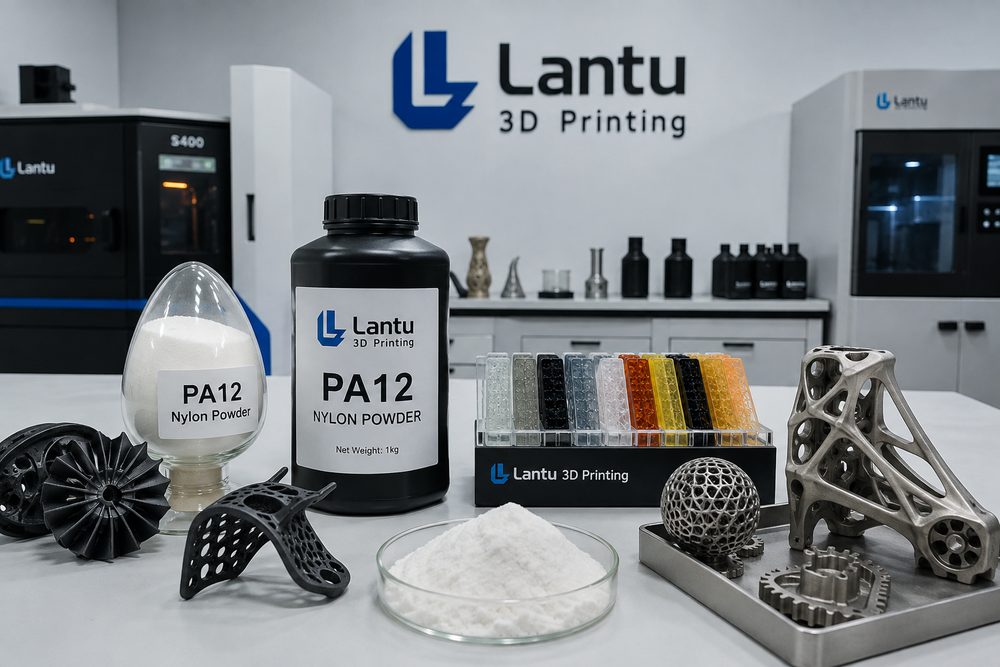
In 3D printing projects, material selection often determines more than 80% of the downstream engineering risk. Many customers first focus on whether a part can be printed, but in lantu3D’s actual evaluations, the more critical questions are whether the part’s service temperature, load direction, assembly tolerance, surface finishing, and batch repurchase consistency are aligned with the use case. For example, if a functional prototype housing must withstand an environment of 60-80°C, ordinary photopolymer resin may deform under long-term thermal load; if a fixture must be clamped repeatedly, the service life differences between PA12 nylon, glass-filled nylon, or metal powder solutions will directly affect the cost per part.
1. Shifting from “material grade” to “application scenario parameters”
The value of material innovation lies not only in adding a new resin or powder, but in mapping material properties to real-world operating conditions. Common metrics include tensile strength, elongation at break, heat deflection temperature, water absorption, surface roughness, and post-processing compatibility. SLS PA12 is typically suitable for complex snap fits, lightweight enclosures, and low-volume structural parts, with recommended wall thicknesses of 1.2-2.0 mm or more; SLA resins are well suited for appearance validation and fine textures, with layer heights selectable between 0.05 and 0.1 mm; metal SLM is ideal for high-strength, heat-resistant, or topology-optimized parts, but support removal, heat treatment, and machining datums must also be considered.
2. Material combination strategies reduce trial-and-error costs
A single material rarely covers the full path from concept validation to production launch. A more reliable approach is to build a staged material roadmap: use a low-cost resin in the first round to verify dimensions and assembly, use nylon or a high-toughness resin in the second round to test snap features, hinges, and drop risks, and then decide in the third round whether to move to glass-filled nylon, aluminum alloy, or titanium alloy based on the load requirements. This approach places high-value materials at the points where they matter most and avoids burning through expensive metal printing budgets before the model is finalized.
3. lantu3D’s material evaluation checklist
At the early project stage, lantu3D recommends that customers provide the operating environment, load direction, target lifespan, assembly relationships, post-processing requirements, and budget range. Engineers use this information to propose candidate materials, process risks, and alternative routes. For instance, wear-resistant sliding parts require close attention to friction coefficient and surface treatment; transparent display parts require attention to yellowing, polishing, and UV aging; medical display models require color stability, detail reproduction, and shipping protection.
4. Quality validation should not stop at appearance
Material innovation only has commercial value once it has been validated. It is recommended to record key dimensions, weight, assembly feel, failure points under load, and surface defects during the first article stage; for small-batch runs, sample at least 3-5 parts and compare dimensional deviation and post-processing consistency; for long-term repeat orders, establish records for material batches, print orientation, machine parameters, and inspection results. In this way, material moves from being merely “printable” to becoming an engineering asset that is deliverable, traceable, and reusable.
Conclusion
Material innovation is not about chasing the newest buzzword, but about building a verifiable material roadmap around product goals. lantu3D emphasizes full life-cycle management from design blueprints to physical delivery, helping customers make executable engineering decisions among strength, appearance, lead time, and cost.
Submit a model, drawing, image or written notes. Engineers will review material, process, finishing and delivery based on actual use.