Introduction: 3D printing project failures are often management failures, not printing failures
In enterprise 3D printing projects, the real causes of delays, rework, and disputes are often not that the machine cannot form the part, but that the requirements were never frozen, the design never went through manufacturability review, the material performance does not match the use case, the post-processing standards are vague, or the acceptance criteria are inconsistent. Even if a part is successfully printed, it may still be treated as a project failure if the color does not meet presentation requirements, the holes do not assemble properly, the strength is not suitable for testing, or the delivery misses the validation window.
That is why 3D printing project management must move risk control upstream. Blue lantu3D emphasizes lifecycle management from concept and design to physical delivery. In essence, this means connecting requirements, engineering decisions, manufacturing processes, quality records, and delivery acceptance so that every critical stage has clear inputs, outputs, and responsibility boundaries.
1. Requirements freeze: define the "acceptable result" before discussing how to print it
The biggest risk in the requirements stage is that the customer and the manufacturer do not share the same understanding of the goal. A customer may say, "Make a sample," but that sample could be for visual display, assembly verification, functional testing, trade show presentation, or small-batch trial use. Different purposes require different materials, accuracy, surface finishes, and acceptance standards. For example, display parts focus on color and surface quality, assembly parts focus on hole position and clearance, and functional parts focus on strength, temperature resistance, and chemical resistance. If the use case is unclear, every downstream process choice may be off target.
At project kickoff, at least six types of information should be frozen: the 3D model version, 2D drawings or key dimensions, intended use scenario, material performance requirements, appearance grade, delivery time, and acceptance method. Key dimensions should include tolerances, such as general outline ±0.2 mm, critical hole-to-hole spacing ±0.1 mm, and post-processed hole positions handled to machining standards. For appearance, define the A-side, color, texture, and acceptable defects. Requirements freeze does not mean changes are forbidden; it means every change must document its impact on cost, schedule, and quality.
2. Design and process review: uncover most problems before manufacturing starts
DFM/DFAM review is the core method for reducing rework. Common risks include walls that are too thin, stress concentration at sharp corners, holes that cannot be cleaned out, sealed internal cavities that cannot release powder, insufficient assembly clearance, support marks on visible surfaces, non-manifold geometry, or broken mesh surfaces. For SLA resin parts, thin walls and support contact areas should be checked; for SLS nylon parts, powder evacuation holes and warpage risk should be reviewed; for metal SLM parts, thermal stress, support removability, and machining allowance for finishing should be assessed in particular.
Process review must also align material with application. PA12 is suitable for toughness and complex structures, resin is suitable for fine detail and appearance validation, and metal is suitable for high-strength and high-temperature scenarios, but each material has its limits. If a customer needs load-bearing tests, it is not enough to simply say the part has "high strength"; the team should explain tensile strength, heat deflection temperature, layer-direction performance differences, and testing limitations. The more transparent the engineering decision, the fewer disputes later.
3. Scheduling and resources: manage printing, post-processing, and inspection separately
Many delays come from overly optimistic scheduling estimates. Project teams often treat print time as the delivery cycle while ignoring data repair, nesting, machine queue time, cooling, support removal, washing and curing, sandblasting, dyeing, painting, machining, inspection, and packaging. A large SLS batch may take more than ten hours to print, but cooling and powder removal also take time; an appearance-grade display part may print quickly, but sanding and painting may require 2 to 4 days.
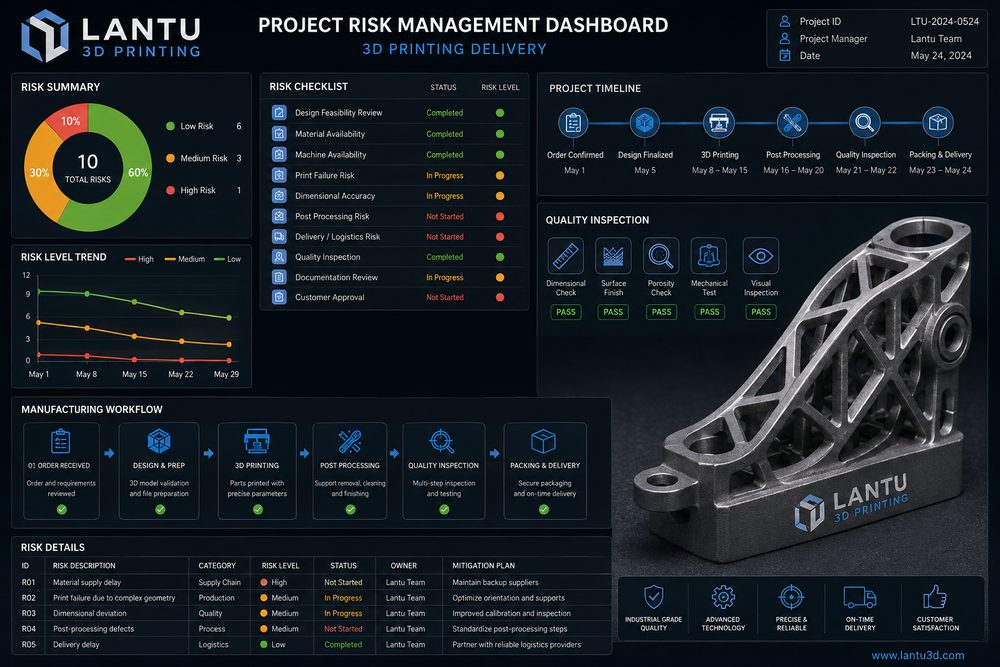
The risk control method is to build a staged schedule: data confirmation, process confirmation, print start, print completion, post-processing completion, quality inspection completion, and shipment. Each milestone should have an estimated duration and an exception-handling plan. For important projects, it is recommended to set a first-article confirmation step: deliver 1 to 2 parts first to verify dimensions and appearance, then move into full production. For trade shows, launches, and testing-window projects, keep at least a 20% to 30% time buffer.
4. Quality control: reduce acceptance disputes with inspection records
Quality control should be centered on the project use case rather than applying the same standard to every job. Appearance parts need checks for surface quality, color, layer lines, support marks, and coatings; assembly parts need checks for hole diameter, hole spacing, clips, threads, and fit clearance; functional parts may also require weighing, hardness checks, sealing tests, temperature resistance tests, or load testing. Inspection methods can include calipers, pin gauges, thread gauges, CMM measurement, 3D scanning, fixture trial assembly, and photo documentation.
It is recommended that every project maintain a minimum quality record package: final model version, material batch or process parameters, results of spot checks on key dimensions, appearance photos, post-processing notes, and exception handling records. For batch parts, the sampling ratio and the handling method for defects should also be recorded. For example, for a small batch of 100 parts, 10% to 20% of the critical dimensions can be sampled; if a systematic deviation is found, expand the sampling and analyze the cause. Quality records are not only for acceptance, but also provide a basis for future reorders and iterations.
5. Delivery acceptance and change management: define responsibility boundaries clearly
The risk at the delivery stage lies in unclear standards and verbal changes. After the customer receives the parts, disputes may arise if they request rework based on standards not stated in advance, such as a higher gloss level, tighter tolerances, or a different color. Before the project begins, the acceptance basis should be明确: model, drawing, sample, photo, color swatch, or written standard. If the project is manufactured only from a 3D model without 2D tolerances, the default accuracy range and the impact of post-processing should be explained.
Change management is equally important. Model revisions, quantity changes, material substitutions, color adjustments, and expedited delivery should all be documented as change records and re-evaluated for cost and schedule impact. For projects with multiple iterations, file versions can be managed with version numbers, such as V1 for structural validation, V2 for assembly optimization, and V3 for presentation appearance. This avoids mixing different versions and makes it easier to trace the source of problems.
Conclusion: risk management makes 3D printing delivery more predictable
3D printing is highly flexible, but flexibility does not mean management can be neglected. Requirements freeze, design review, process selection, schedule breakdown, quality records, and acceptance standards are the basic framework for stable enterprise delivery. Through a lifecycle management approach, Blue lantu3D connects customer concepts, engineering judgment, and physical delivery, helping project teams reduce uncertainty and upgrade 3D printing from a rapid prototyping tool into a reliable engineering delivery capability.
Submit a model, drawing, image or written notes. Engineers will review material, process, finishing and delivery based on actual use.