Introduction: 3D printing scheduling is not just first come, first served
When the number of orders is small, 3D printing scheduling seems simple: receive files, assign equipment, complete post-processing, and ship. But when a platform handles multiple materials, multiple processes, and orders with different lead times at the same time, a simple first come, first served rule leads to idle equipment, post-processing congestion, urgent orders cutting in line, and uncontrolled delivery times.
lantu3D's production scheduling goal is not to maximize the utilization of a single machine, but to deliver the overall order portfolio on time. Scheduling must consider printing time, cooling time, powder removal time, curing time, sanding and painting time, quality inspection, and packaging. If any one step becomes a bottleneck, the front-end printing efficiency will be offset.
1. Order grading: clarify delivery priorities first
The first step in production scheduling is order grading. It is recommended to establish priorities based on lead time, customer commitment, process complexity, and post-processing duration. Emergency functional prototypes, small-batch delivery parts, display parts, and ordinary samples should not use the same scheduling rules. For orders that must be delivered on time, machine windows and post-processing resources should be locked in advance.
Order grading should also identify risks. For example, thin-walled resin parts have a higher failure rate, so rework time should be reserved; metal printed parts have long post-processing cycles, so heat treatment or machining should be arranged in advance; multi-part kits need to be shipped only after all parts are ready, so attention should be paid to the completion time of the slowest part. Priority is not based on who pushes hardest, but on an engineering judgment of commitments and risks.
2. Equipment task pool: aggregate orders by material and process
The efficiency of 3D printing equipment depends largely on task matching. The SLS process is suitable for combining parts made of the same material and with similar due dates into one powder bed; the SLA process must consider resin type, support orientation, and wash-and-cure rhythm; the FDM process should focus on material changes and nozzle configurations. Frequent material changes increase preparation time and quality risk.
When building an equipment task pool, orders can be divided into five categories: "ready for immediate production," "awaiting file confirmation," "awaiting customer confirmation," "awaiting material preparation," and "awaiting post-processing resources." Only orders with complete information and a clear process enter the production pool. This avoids equipment waiting for confirmation and also prevents discovering version errors only after production is complete.
3. Identify the real bottlenecks: post-processing is often tighter than printing
Many teams focus their scheduling efforts on the number of printers, while ignoring post-processing capacity. Sandblasting, dyeing, polishing, painting, assembly, and quality inspection can all become bottlenecks. A batch may finish printing in 8 hours, but post-processing may take 16 hours, so delivery cannot be promised based only on the printing completion time.
It is recommended to establish a process capacity table to record the number of parts or hours that can be completed each day for each type of post-processing. For example, sandblasting may process a certain number of nylon parts per hour, clear resin polishing may take 20 to 40 minutes per part, and painting also requires primer, topcoat, and drying time. The scheduling system should include these times in lead time calculations instead of queuing them only after printing is finished.
4. Dynamic adjustment: use data to reduce last-minute firefighting
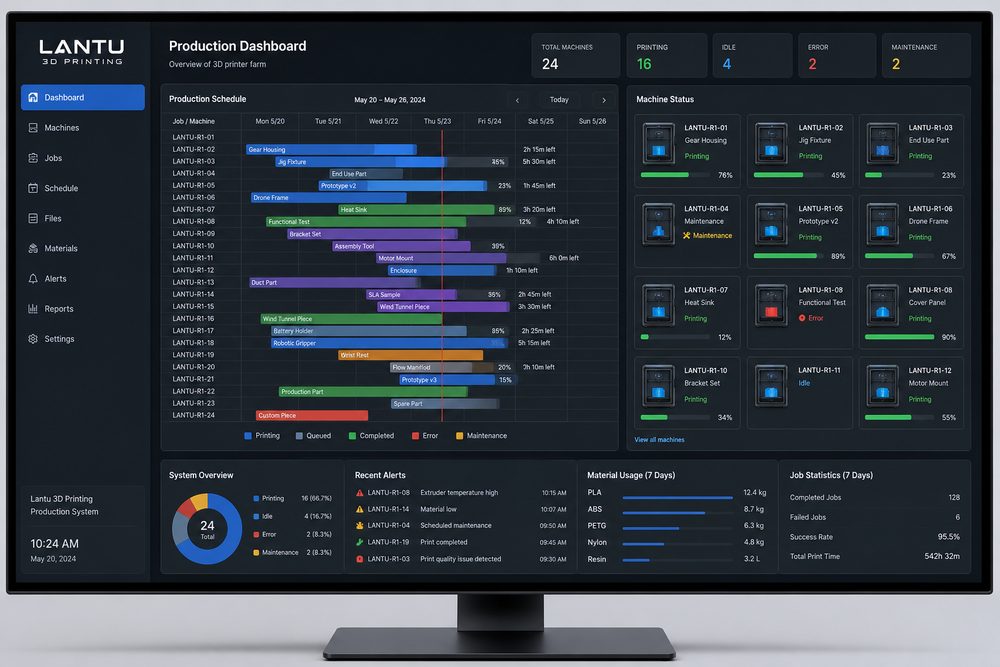
The production floor will inevitably experience equipment alarms, print failures, customer revisions, and logistics delays. Dynamic scheduling needs real-time status data, including equipment operation, remaining task time, failed reprints, post-processing queues, and quality inspection results. Every adjustment should record the reason to prevent the same problem from recurring.
For peak-period orders, a twice-daily scheduling review can be used: in the morning, confirm the printing and post-processing work that must be completed that day; in the afternoon, adjust the plan for the next day based on actual progress. For critical orders, set alert time points. If the order is still not in the next process after exceeding the planned completion time by 20%, the project manager should be triggered to intervene.
Conclusion: good scheduling makes flexible manufacturing truly flexible
The advantage of 3D printing is fast response and multi-variety manufacturing, but without scheduling management, that advantage will be consumed by shop-floor chaos. Through order grading, task pool aggregation, bottleneck identification, and dynamic adjustment, companies can maintain stable delivery during order peaks. lantu3D hopes to use platform-based management to put every printing task into a production rhythm that is visible, controllable, and optimizable.
Submit a model, drawing, image or written notes. Engineers will review material, process, finishing and delivery based on actual use.