Introduction: Why 3D Printing Workshops Need a Dedicated Scheduling Method
Under an on-demand manufacturing model, a typical 3D printing service provider often handles three types of tasks at the same time: R&D prototyping (single parts, tight deadlines, uncertain processes), small-batch pilot production (dozens to hundreds of parts with unified materials), and urgent replacement parts (after-sales repair parts and unpredictable rush orders). Unlike machining, where “one machine corresponds to one process,” a single 3D printer completes an entire part in one build, and equipment types are often mixed—SLA photopolymerization, SLS nylon sintering, SLM metal melting, and FDM fused deposition may all coexist. High material changeover costs, such as 30–45 minutes for SLS powder cleaning and material switching, plus post-processing across multiple stations, such as support removal, sandblasting, dyeing, and CNC finishing in different areas, mean that 3D printing workshop scheduling cannot fully follow traditional discrete manufacturing logic. A scheduling system adapted to additive manufacturing processes is required.
1. Order Priority Evaluation: Turning “Who Goes First” from Guesswork into a Quantifiable Model
The root cause of rush orders and firefighting is often unclear priority criteria. It is recommended to establish a four-dimensional scoring model: delivery urgency (calendar days until the promised delivery date, with ≤2 days as the highest level), process complexity (whether support optimization, finishing post-processing, or multiple materials are required), customer tier (strategic customers, regular customers, one-off orders), and equipment conflict level (whether only one equipment type can produce the part). Assign weights to the four dimensions to calculate a priority score, for example, 40% for delivery urgency, 25% for customer tier, 20% for process complexity, and 15% for equipment conflict. When scores are close, prioritize orders with higher build volume utilization to avoid occupying a large build chamber for a long time with small parts. This model enables schedulers to complete daily production planning decisions within five minutes during the morning meeting and reduces subjective disputes.
2. Batch Scheduling: Grouping the Same Material and Process Is Key to Cost Reduction
The greatest waste in 3D printing comes from equipment idling and frequent changeovers. An SLS build chamber can accommodate nylon parts from multiple customers and multiple part types in one build, as long as the material grade is the same, such as all PA12 black. A single build usually takes 8–12 hours, and build volume utilization should ideally reach 65%–80%. During scheduling, orders with the same material, same layer thickness (0.1 mm or 0.15 mm), and same post-processing requirements should be merged into one build task. This spreads equipment startup costs and reduces total support volume through support sharing. For SLM metal parts, attention should be paid to build plate utilization and support removal labor hours. When batching, the part height gradient within one chamber should be controlled to avoid the tallest part determining the build time of the entire chamber. For FDM, batching should prioritize color and material to reduce filament changes. As a rule of thumb, one changeover is equivalent to losing 15%–25% of effective single-shift capacity, so minimizing the number of changeovers should be a hard constraint in batch planning.
3. Capacity Load and Bottleneck Identification: Don’t Let Post-Processing Become the Hidden Weak Link
In many workshops, the bottleneck is not the printing equipment but post-processing. The output of one SLS machine over eight hours often corresponds to 20–30 hours of manual support removal and sandblasting. When the sandblasting station is fully loaded, work in process (WIP) accumulates in the post-processing area and slows down overall delivery. Scheduling must monitor two types of load indicators at the same time: on the equipment side, overall equipment effectiveness (OEE, with an industry benchmark of around 65%–75%) and build volume utilization; on the process side, post-processing station labor-hour load and CNC finishing queue length. It is recommended to calculate takt time for the “printing–post-processing” value stream. If the post-processing cadence is slower than the printing cadence, balance the flow by outsourcing part of the sandblasting work, adding automated cleaning equipment, or scheduling in staggered shifts. Only by identifying the true constrained resource, or bottleneck, can a workshop avoid blindly purchasing more printers while still failing to improve delivery capacity.
4. Delivery Cadence and WIP Control: Replace “Please Follow Up” with Milestone Nodes
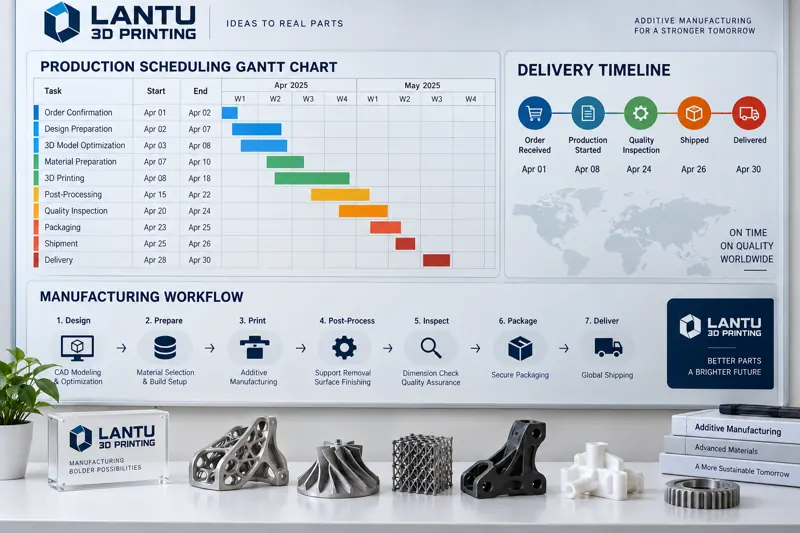
The most common failure point for long-cycle orders is “the print is finished, but no one follows up.” It is recommended to break each order into quantifiable milestones: file review → print start → print completion → post-processing start → quality inspection → shipment, and set target completion times for each node in an MES or kanban board. At the same time, set WIP limits, such as keeping WIP below 1.5 times the workshop’s daily capacity. When WIP at a station exceeds the threshold, an alert is triggered so the scheduler can intervene and clear the blockage instead of waiting for customer complaints. For strategic customers, a “delivery cadence commitment” can be established, such as synchronizing a progress snapshot every 48 hours, replacing uncertainty-driven anxiety with a predictable rhythm. Practical results show that after introducing a milestone kanban, the average order delivery cycle can be shortened by 18%–25%, and order-chasing tickets can drop by about 40%.
5. Digital Scheduling Tools: From Excel Planning to Algorithm-Assisted Scheduling
When the average daily order volume exceeds 30 orders and there are more than 10 machines, purely manual scheduling becomes highly error-prone. A lightweight approach is to use Gantt charts, such as online collaborative spreadsheets or open-source scheduling tools, to visualize build occupancy for each machine, with red, yellow, and green labels indicating delivery risk. A more advanced approach is to introduce a rule engine: when a new order enters the system, it automatically matches the optimal “material + equipment + post-processing” combination and provides batching recommendations. A truly mature approach is to integrate the scheduling module of an MES and use constrained optimization with objective functions such as maximizing build volume utilization and minimizing changeovers. Regardless of tool level, the accumulation of scheduling data—actual print time, post-processing labor hours, and changeover time for each order—is critical. Without historical baselines, any algorithm is merely running in circles.
Conclusion: Scheduling Is the Hidden Competitiveness of 3D Printing Service Providers
Today, as equipment becomes increasingly homogeneous and material prices more transparent, the real moat for 3D printing service providers lies more and more in delivery certainty. A clear order priority model, a scheduling logic centered on batching to reduce changeovers, a precise understanding of post-processing bottlenecks, and the management habit of replacing verbal order chasing with milestone kanban boards together form the competitiveness of workshop scheduling. For small and medium-sized service providers, it is not necessary to implement a full MES in one step. Starting with two low-cost actions—same-material batching and post-processing load monitoring—can often improve the on-time delivery rate by more than 10 percentage points within three months.
Submit a model, drawing, image or written notes. Engineers will review material, process, finishing and delivery based on actual use.