Introduction: The impact of defects on part quality
In the industrialization process of additive manufacturing, defect control is a key factor in determining the performance consistency of parts. According to the 2024 annual survey data of the "Additive Manufacturing" journal, about 18%-25% of industrial-grade 3D printed parts have substandard performance due to defects, with warpage deformation accounting for up to 34%, interlayer separation accounting for 21%, and internal pores accounting for 19%. These defects not only cause material waste and cost increase, but also directly affect the mechanical properties, geometric accuracy and service reliability of the parts.
Take aero-engine blade repair as an example. The 2023 quality report of a leading company shows that the rework rate due to defects is as high as 28.6%, with an average increased cost of $340-520 per piece, seriously affecting the delivery cycle. The establishment of a systematic defect analysis and prevention mechanism can increase the first printing pass rate from 71% to 89% and reduce production costs by 15%-22%. This article will provide engineers with actionable quality improvement plans from three dimensions: defect classification, cause mechanism, and preventive measures.
1. Geometric defects: warping and deformation
Warpage deformation is the most common geometric defect in FDM printing, especially when printing large-size flat parts or high-shrinkage materials (ABS, nylon). The fundamental reasons are accumulation of thermal stress and uneven cooling shrinkage.
1.1 Cause and Mechanism Analysis
The material is extruded at temperatures as high as 200-260°C and shrinks in volume as it cools to room temperature. The shrinkage rate of ABS thread is about0.4%-0.6%, while that of PLA is only0.2%-0.3%. When the bond between the bottom of the part and the print bed is not strong enough to resist shrinkage stress, the edges will lift up. Research shows that warpage stress is mainly concentrated in the 1-3mm area at the bottom of the part, and the peak stress can reach 15-25MPa, exceeding the material yield strength.
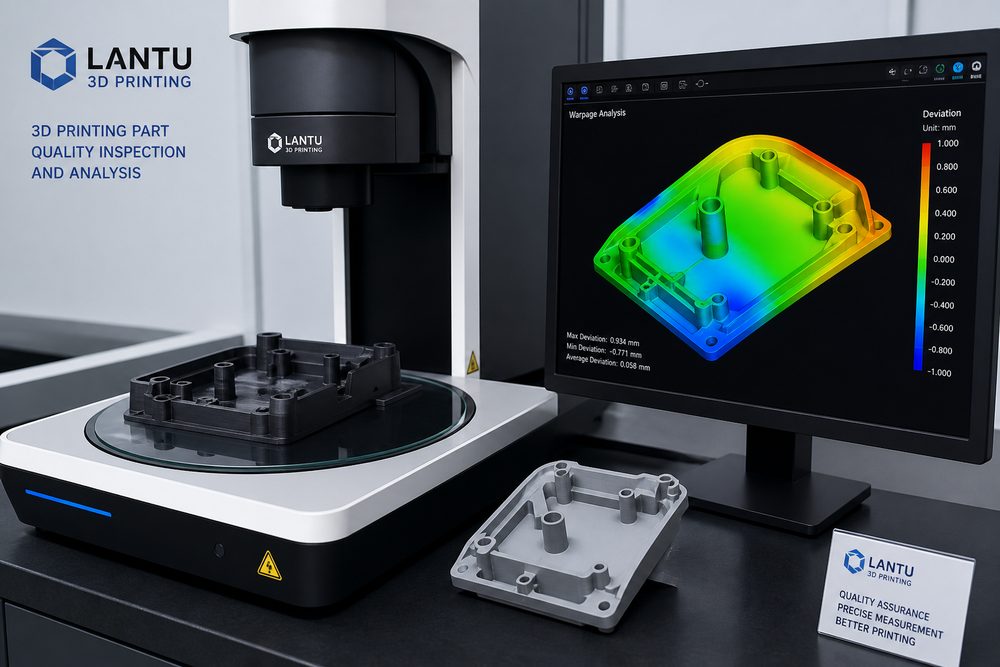
The degree of warpage can be quantified by the warpage angle θ, which is defined as the angle between the warp edge and the theoretical plane. According to experimental data, when θ>2°, the part size deviation will exceed±0.5mm, seriously affecting assembly accuracy.
1.2 Prevention parameter optimization
| Parameters | Recommended values | Optimization principle |
|---|---|---|
| Hot bed temperature | ABS: 100-110°C PLA: 60-70°C Nylon: 80-90°C | Reduce temperature difference and reduce thermal stress |
| Ambient temperature | 45-55°C (enclosed cavity) | Delay cooling and reduce temperature gradient |
| Height of the first layer | 0.2-0.3mm | Increase the contact area and improve adhesion |
| Printing speed | First layer: 15-20mm/s Normal: 40-60mm/s | Slowly increase the bonding time |
| Cooling fan | Close on the first floor and gradually turn on after the third floor | Avoid stress concentration caused by rapid cooling |
1.3 Structural design and post-processing measures
Design level: Add Mouse Ears or Brim edges to expand the base area; avoid large-area thin-walled structures and add reinforcement ribs to disperse stress; for high-shrinkage materials such as ABS, divide the parts and print them before assembly.
Post-processing measures: Use PVA glue or Magigoo special bed adhesive to increase the bonding strength by 40%-60%; for parts that have been slightly warped, they can be flattened and corrected by local heating with a hot air gun at 60-80°C.
2. Structural defects: interlayer separation and cracks
Layer Separation is one of the most fatal structural defects, which directly leads to a cliff-like decline in the mechanical properties of parts. Test data from an automobile company shows that for parts with interlayer separation, the tensile strength is reduced by 35%-50%, and the fatigue life is only 1/8 of that of intact parts.
2.1 Mechanism Analysis
The interlayer bonding of FDM printing relies on molecular chain diffusion and van der Waals forces. When a new layer is laid, the temperature of the bottom layer needs to be kept above the glass transition temperature Tg (ABS Tg≈105°C, PLA Tg≈60°C) so that the molecular chains can achieve effective diffusion bonding. If the interlayer temperature is too low, the bonding strength will only be 30%-45% of the matrix strength.
The main causes of interlayer separation include:
- Insufficient temperature: The printing temperature is lower than the lower limit of the melting temperature of the material, the melt fluidity is poor, and the fusion between layers is insufficient
- Cooling too fast: The fan speed is too high or the ambient temperature is too low. The new layer solidifies quickly and has no time to integrate with the lower layer
- The layer height is too large: When the layer height exceeds 80% of the nozzle diameter, the contact area between layers decreases and the bonding force decreases
- Material degradation: Hydrolysis of hygroscopic materials at high temperatures produces bubbles, or repeated recycling of materials causes a decrease in molecular weight
2.2 Process optimization plan
Temperature parameter optimization: Increase the nozzle temperature by 5-10°C to increase melt fluidity; for easily separated cantilever structures, partially turn off the cooling fan or reduce the wind speed to 10%-20%; use minimum layer height (0.1-0.15mm) to increase the interlayer contact area.
Material pretreatment: Hygroscopic materials such as ABS and nylon need to be dried in a 70-80°C drying oven for 4-6 hours, and the moisture content is controlled at Submit a model, drawing, image or written notes. Engineers will review material, process, finishing and delivery based on actual use.