
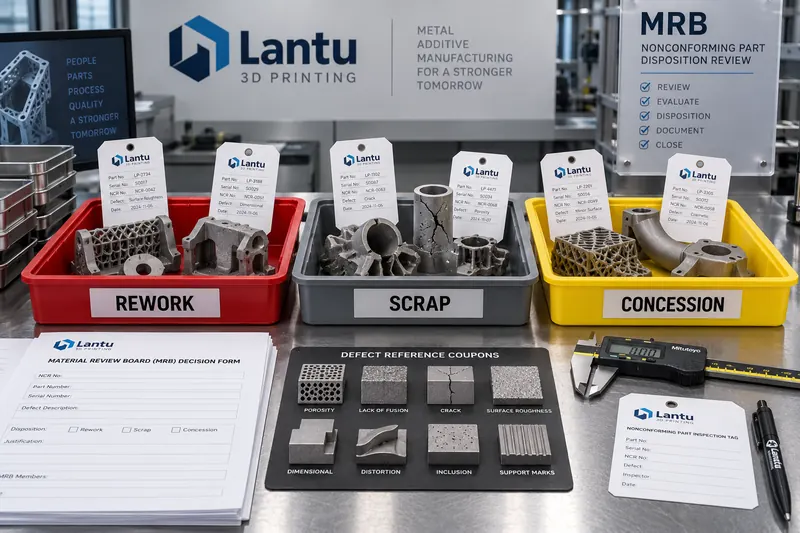
Introduction: The Real Decision Begins After a Defect Is Found
In a 3D printing shop, detecting a defect in a part is only the starting point. The real consumption of time and cost occurs in the disposition decision that follows. A common shop-floor scenario is a dimensional deviation of 0.15 mm, localized lack of fusion, or a surface scratch. The inspector writes “nonconforming” on the report, and the issue is handed back to process engineering, production, and quality. No one can clearly determine whether the part should be reworked, accepted by concession, or scrapped. As a result, the part sits in the shop for two weeks while the delivery deadline draws closer, and ultimately the most anxious person makes the call: use it—the customer probably will not notice.
The cost of this kind of ad hoc disposition is measurable. For a metal LPBF part, the total cost of a medium-complexity bracket blank is often in the range of RMB 800 to 2,500. Scrapping it blindly forfeits all printing and post-processing labor already invested; granting a concession blindly, however, can lead to recall and claim costs at the customer site that are typically more than ten times the value of the part itself. Defect-analysis articles address where defects come from. This article addresses how to decide once a defect occurs—turning disposition from an individual-experience exercise into a closed-loop method with classification, criteria, and records.
1. Classify the Defect Before Discussing Disposition
The first step in a disposition decision is not to debate the process, but to classify the defect. Classification translates the vague question of “how serious is it?” into an executable disposition path. From an engineering perspective, scoring across three dimensions is recommended: severity (whether function and safety are affected), detectability (whether the customer can detect it), and repairability (whether available methods can restore it). Each dimension is scored from 1 to 5, and the product of the three scores forms an approximate priority value. The higher the value, the more the issue requires formal review rather than shop-floor release.
By consequence, defects generally fall into four categories: critical defects (affecting safety-related functions such as load-bearing capacity, sealing, or insulation, including through-cracks and interconnected internal porosity in pressure-containing components), which must never be accepted by concession; major defects (affecting assembly or service life without causing immediate failure, such as out-of-tolerance critical mating surfaces or mislocated threaded holes), which require review to determine rework or scrap; minor defects (cosmetic issues and slight deviations on non-mating surfaces), which may be accepted by concession within defined limits; and negligible defects (surface color variation or minor machining marks that affect no function), which may be released directly against an approved reference sample.
Classification must be tied to specific criteria rather than descriptive terms. For example, for “surface scratches,” the requirement should state that scratches no deeper than 0.1 mm and no longer than 5 mm are permitted on non-mating surfaces, with no more than three per surface; no visible scratches are permitted on sealing surfaces. With measurable thresholds such as these, inspectors and process engineers no longer need to debate each part individually.
2. Assessing Rework Feasibility: Not Every Defect Is Worth Repairing
Before deciding to rework a part, three questions must be answered. First, can rework restore the drawing requirements? For dimensional defects, excess material can be repaired through grinding, machining, or milling. Missing material, however, is usually not repairable—insufficient material in a printed part means the geometry cannot readily be restored, while weld buildup or additional printing introduces new risks from heat-affected zones and bonding interfaces. This question alone can eliminate nearly half of rework requests.
Second, has the rework process itself been validated? Weld repair of metal parts requires qualification of the welding procedure, post-weld heat treatment, and subsequent nondestructive testing. Filling and sanding of polymer parts require confirmation that the filler material matches the substrate in strength and temperature resistance. If the rework process has never undergone process validation and first-article confirmation, the reworked part is effectively a product in an unknown condition, potentially posing a greater risk than direct scrapping.
Third, is rework less costly than remanufacturing? The calculation must include the full cost: rework labor, fixtures, consumables, secondary inspection, secondary testing such as CT or penetrant testing, and the additional lead time caused by rework. As a rule of thumb, when the rework route requires more than three setups or more than two heat-treatment steps, remanufacturing is often faster and less expensive. When handling small-batch orders, lantu3D records the “rework cost/remanufacturing cost” ratio on the disposition form. If the ratio exceeds 0.7, remanufacturing is generally preferred, preventing the delivery of an entire batch from being delayed to save a single blank.
3. Concession Acceptance: Conditional Release, Not Liability-Free Release
Concession acceptance is the disposition method most susceptible to misuse. It is legitimate only when the defect does not affect function, service life, or safety, and when the customer is informed and provides written approval. Any concession lacking either condition transfers risk rather than eliminating it.
A complete concession record should include, at a minimum: the defect description and measured data; the scope of impact, including part number, lot number, and quantity; the technical assessment conclusion explaining why function is unaffected; the validity period or applicable lot, limited to the current lot and not automatically extended; the customer’s signed confirmation; and the deadline for completing subsequent corrective actions. In particular, a concession must have boundaries: a defined lot, quantity, and use condition. Writing that “similar defects may be handled by reference to this case” is equivalent to abandoning control.
Internal concession approvals should also follow defined authority levels. General defects may be approved by a quality engineer, while concessions for major defects must be escalated to the technical lead and communicated to the customer. For safety-related parts, concessions should generally not be accepted, even with verbal customer approval. If a failure occurs, the written record will show that “the supplier proactively recommended a concession,” and liability cannot be avoided.
4. Scrap and Containment: Two Actions for Limiting Losses
When a defect cannot be repaired or rework is uneconomical, scrapping is the only correct decision. But scrapping should not end with “discard this one part.” Containment must be initiated at the same time to determine whether other parts from the same lot, build job, build plate, or powder lot may have the same type of defect. Defects in LPBF processes often cluster by batch. Excess moisture in a powder lot or contamination of a machine’s protective window can recur across multiple parts within the same time window.
The containment scope should be defined according to process characteristics: all parts from the same build must be inspected; one or two adjacent build jobs should be sampled; where the same powder lot has abnormal storage conditions, the scope should be expanded to all jobs covered by that powder lot. The containment conclusion must be written as a clear determination—for example, N parts subjected to expanded inspection, M parts found with the same defect, and the remainder judged conforming—rather than an untraceable statement such as “no abnormality found.”
Scrapped parts must also be controlled. They should be permanently marked by cutting, drilling, or painting and stored in a segregated area to prevent accidental entry into the conforming-product area. This may seem trivial, but it is among the most frequent failure points identified in quality-incident reviews.
5. The MRB Closed Loop: Turning Disposition into Organizational Capability
Isolated, temporary disposition decisions are lost as personnel change. The way to institutionalize the mechanism is to establish an MRB (Material Review Board) process: a standing team comprising quality, process engineering, and production that reviews items awaiting disposition at fixed intervals, such as daily or per shift, and records conclusions consistently in a disposition log.
The value of an MRB extends beyond deciding “what to do this time.” Its greater value lies in reusing disposition-log data. Once sufficient records have accumulated, distributions can be analyzed by defect type, process step, and equipment involved to identify the three defect categories with the highest rework rate, thereby driving process improvement and updates to DFM review rules. For example, if surface damage caused by support removal repeatedly occurs on the same feature, the manufacturability review should add a “support accessibility” check and prevent the defect before printing begins.
The final step in the disposition loop is corrective and preventive action (CAPA). Concessions and rework are corrective actions that address problems that have already occurred; prevention eliminates root causes through measures such as updating work instructions, revising process-parameter windows, adding poka-yoke fixtures, and adjusting incoming-inspection criteria. Without the preventive element, a disposition system will fall into a cycle of recurring defects and repeated dispositions.
Conclusion
The core of nonconforming-product disposition is not “identifying bad parts,” but “using consistent rules to determine where nonconforming parts go.” An executable path is to first classify defects by severity, detectability, and repairability; then assess rework feasibility through three questions—whether drawing requirements can be restored, whether the rework process has been validated, and whether rework costs less than remanufacturing. Concession acceptance must be limited to a defined lot, supported by written customer approval, and tied to a corrective-action deadline. Scrapping must trigger containment defined by build jobs and powder lots. Finally, MRB mechanisms and disposition logs transform individual cases into organizational capability. For additive manufacturing, where individual part value is high and process variables are numerous, clear disposition rules protect delivery performance and reputation more effectively than any on-the-spot judgment.
Invia un modello, un disegno, un'immagine o note scritte. Gli ingegneri valuteranno materiale, processo, finitura e consegna in base all'uso effettivo.