
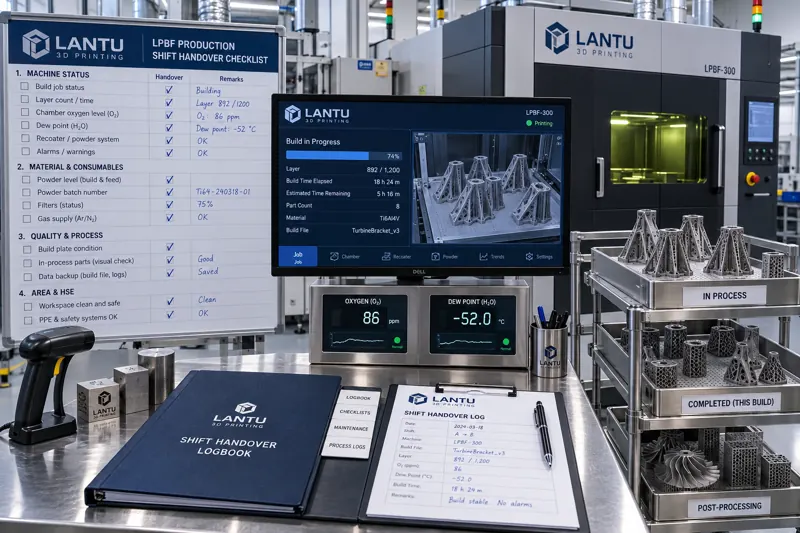
Introduction: Shift Handover Is the Most Overlooked Throughput Breakpoint in 3D Printing Workshops
In a 3D printing workshop, equipment can run continuously for more than ten hours, and a single build job often spans two or even three shifts. The day shift spreads powder, initiates the arc, and starts the build; the night shift monitors the melt pool and oxygen level; the following morning shift depowders, cuts, and sends the parts for inspection. The job itself is continuous, but personnel rotate. What truly determines whether a build is completed on schedule is often not the machine parameters, but the quality of the ten or so minutes of transfer between shifts.
Many shop-floor issues point to the same root cause: information known by the previous shift is unknown to the next. A protective lens may be close to its alarm threshold without being recorded; the seventh part on a build plate may have shown balling, mentioned only verbally; the reclaimed-powder sieve may not have been cleaned; or two customer-added parts may not yet have been scheduled. If such information exists only in an operator's memory, it effectively does not exist. By the time the next shift discovers it, an entire build may already be scrapped or the delivery date missed.
1. What Must Be Handed Over: Breaking Implicit Information into Four Categories of Status
An effective shift handover is not simply “saying a few words”; it is the structured transfer of operating status. In a 3D printing workshop, the information to be transferred can be divided into four categories.
The first category is equipment status. This includes the machine's current operating mode (printing, standby, depowdering, maintenance), accumulated laser operating hours and the date of the last power calibration, protective-lens transmittance or replacement date, current oxygen and dew-point readings, circulating-water temperature and filter differential pressure, and recoater blade service time. These are not binary judgments of whether something is “normal”; they are numerical trends. Simply stating that “the machine is normal” removes the basis for the next shift's assessment.
The second category is in-process job status. Each active build job should include its job number, assigned machine, completed and remaining layers, estimated completion time, whether printing has been interrupted and resumed, powder batch number and reuse count, and downstream post-processing route (stress-relief annealing, wire EDM, or hot isostatic pressing). Additive manufacturing jobs have long cycle times, and cross-shift execution is routine; progress information must therefore be quantifiable.
The third category is exceptions and deviations. Every issue occurring during the shift—including alarm codes, downtime duration, corrective actions, impact on in-process parts, and whether quality involvement is required—should be documented individually. This is especially important for exceptions that “appear manageable,” such as slight interlayer warping, localized uneven powder layers, or oxygen levels that briefly exceed limits before returning to normal. These deviations may not immediately stop the machine, but they can directly affect the final part's metallurgical quality.
The fourth category is pending actions and commitments. This includes the process stage of parts due for shipment the next day, the effective time of customer-requested technical changes, materials to be replenished, and batches awaiting quality release. Together, these four categories form a complete handover package.
2. Why Verbal Shift Handover Will Inevitably Fail
Many workshops rely on “covering it in the pre-shift meeting.” The issue with verbal handover is not attitude, but structure. First, under pressure, human memory is selective, and exception details are usually the first to be lost. Second, verbal descriptions lack numerical data, preventing the incoming engineer from assessing trends. Third, verbal information cannot be traced, making it impossible to confirm during a later review whether an item was actually communicated.
A more subtle risk is unclear accountability. When two shifts interpret the same statement differently—for example, “keep using that batch of powder for now”—disputes arise during quality traceability: Was its use approved, or was it awaiting sieving? Written handover records turn “approved for use under what conditions” into verifiable criteria, naturally eliminating such disputes. For parts subject to customer audits or traceability requirements, handover records are themselves part of the process evidence.
3. Standard Operating Procedure for Shift Handover: Time, Location, and Sequence
Turning shift handover into a standard operation requires clarity on three points.
Time window: A 15- to 20-minute overlap period is recommended, with both outgoing and incoming personnel present. A shorter period does not allow sufficient time for a complete shop-floor inspection; a longer period raises labor costs. The overlap is necessary because many conditions must be verified at the machine, rather than on paper.
Location and route: Handover should follow a fixed route: first review the job queue and alarm history on the main control screen; then verify the operating status and consumable levels machine by machine; finally, check physical work-in-process parts and labels in the temporary storage area. The value of a fixed route is that it does not depend on individual habits. Every shift checks in the same order, substantially reducing the probability of omissions.
Sequence and sign-off: Transfer exceptions first, then jobs, and finally pending actions. Exceptions have the highest priority; if time is limited, routine pending items—not exceptions—should be compressed. After handover is complete, both parties sign off. The incoming shift must confirm that the information has been received and understood before the outgoing shift leaves. Sign-off is not a formality; it establishes a clear point of accountability.
4. Cross-Shift Consistency: Parameters, Acceptance Criteria, and Operating Practices
Shift handover addresses more than continuity of information; it also addresses consistency. If the day and night shifts apply different force when removing supports, use different grinding sequences, or apply different surface acceptance criteria to the same part, delivery consistency will vary. Customers do not see which shift produced a part; they see whether the batch is stable.
The solution is to quantify acceptance criteria and incorporate them into work instructions: allowable support-remnant height, grinding grit sequence, surface-roughness comparison coupon ID, and permissible scope of manual rework. During handover, the key is to confirm whether the previous shift followed the same criteria and whether it made any “experience-based fine adjustments” to parameters. Any departure from standard parameters must record its reason and result; otherwise, the next shift cannot determine whether it was an effective optimization or the starting point of a deviation.
5. Quantitative Management of Shift Handover: From Records to Metrics
Shift handover records have value only when they are used. Three metrics should be extracted from the records for trend monitoring.
Handover completion rate: Audit the completion rate of mandatory items in handover records, including equipment readings, in-process job progress, exception entries, and pending actions. The target should be no less than 98%. The item most frequently omitted should become the next training priority.
Handover-related exception ratio: Measure the proportion of shift exceptions that already existed during the previous shift but were not documented. A declining figure indicates improving handover quality; if it does not decrease over time, records and actual execution are likely disconnected.
Cross-shift first-part acceptance-rate variance: Compare first-part inspection results after the same job is continued by different shifts. Excessive variance usually points to inconsistent parameters or operating criteria rather than equipment problems.
These three metrics require no additional investment. They only require structured handover records and monthly consolidation. Their value lies in converting the question of whether handover is being done well from a subjective impression into a set of discussable numbers.
6. Common Misconceptions and Countermeasures
The first misconception is turning shift handover into a form-filling contest, where records become increasingly long but no one reads them. The response is to limit the number of mandatory items, generally to no more than 15, with all other information recorded as supplementary notes.
The second misconception is valuing handover only after a problem occurs. Workshops with good handover practices rarely experience incidents caused by handover, which can make the effort appear wasteful. In reality, it is a typical preventive investment, with returns reflected in incidents that never occur.
The third misconception is omitting handover during single-person night shifts. Single-person shifts depend even more heavily on written records because there is no one available for face-to-face questions. In such cases, record granularity should be increased, particularly for exception entries.
Conclusion
Continuity in a 3D printing workshop depends on the lossless transfer of four categories of status between shifts: equipment, jobs, exceptions, and pending actions. By replacing verbal explanations with structured checklists, replacing “normal” with specific readings, and replacing experience-based judgment with quantified criteria, shift handover becomes a genuine throughput-assurance activity rather than a formality. For workshops handling low-volume, high-mix, long-cycle jobs, the marginal return from these three measures is often greater than that of adding another machine.
Invia un modello, un disegno, un'immagine o note scritte. Gli ingegneri valuteranno materiale, processo, finitura e consegna in base all'uso effettivo.