
Introduction: Goods Held at Customs Cost More Than Goods Waiting in the Printer
The waiting cost of a metal 3D-printed part on the shop floor is usually measured in hours. When the same shipment is held at a port for one day, however, the cost structure immediately becomes a combination of storage charges, late-declaration penalties, amendment fees, and customer production-line downtime. More importantly, most delays are not caused by product nonconformance, but because the documents do not match the physical goods: the HS classification conflicts with the product description, declaration elements are incomplete, the invoice amount contradicts the contractual Incoterm, or wood packaging lacks the required treatment mark. These issues have nothing to do with the printing process, yet they can prevent delivery of parts that have already passed quality inspection.
Managing cross-border delivery as an engineering function alongside manufacturing is an inevitable step as production capacity expands overseas. What is needed is not a one-time customs declaration engagement, but reusable data files: classification conclusions, declaration-element templates, document-consistency checklists, and exception-handling procedures.
1. HS Classification: Determine Material and Forming Process Before End Use
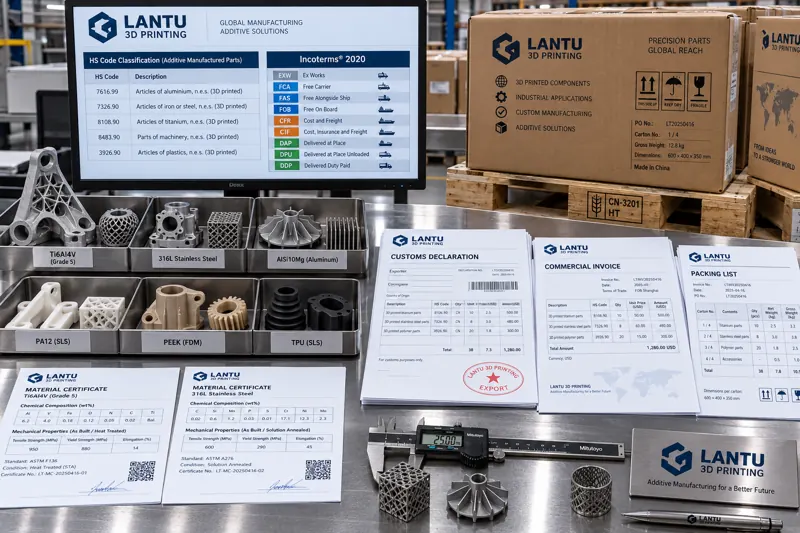
Disputes over product classification usually arise not from product names, but from the priority assigned to material, process, and end use. For 3D-printed parts, customs authorities first focus on the material used and the product's basic form. A part made by laser powder bed fusion from stainless-steel powder is generally considered under tariff headings for articles of iron or steel; titanium alloy parts fall under titanium and articles thereof; and PA12 parts produced by selective laser sintering fall within the category of plastic articles. The printing process itself does not generally change the classification, but it does determine whether a part has the characteristics of a finished product.
Two common misjudgments create classification risks. The first is declaring functional parts as “models” or “samples.” Once they are deemed commercial goods, declaration elements and regulatory requirements must be corrected. The second is declaring spare parts and accompanying sample parts shipped with equipment under the same line item as a complete “3D printer,” resulting in distorted quantities and unit prices. A practical engineering approach is to establish a classification reference sheet: cross-reference material grades (316L, Ti6Al4V, AlSi10Mg, and PA12) with part categories (structural parts, fixtures, samples, and spare parts), and specify recommended tariff headings, declaration elements, and reference regulatory requirements. Review each shipment against this sheet, retain the classification conclusion, and document its basis.
2. Declaration Elements: Convert Process Parameters into Verifiable Fields
Once the classification conclusion is established, the quality of declaration elements determines clearance speed. In addition to standard information such as product name, material, use, brand, and model, declarations for 3D-printed parts should include process-verifiable fields: forming process (such as laser powder bed fusion, selective laser sintering, or vat photopolymerization), material grade, individual part weight or dimensions, whether heat treatment or surface treatment has been performed, and whether the item is a finished or semi-finished product.
The value of these fields becomes apparent during inspection. For a customs declaration stating only “metal parts,” an inspector can only assess the item from the physical goods. Documentation stating “Ti6Al4V, laser powder bed fusion, stress-relief annealed, finished structural part, net weight 0.42 kg per piece” can be directly matched with physical labels and material certificates. It is recommended to prepare declaration details at the part-number level, rather than consolidating them at the order level. This is particularly important when one shipment contains multiple materials, as consolidated declarations will almost inevitably invite questions.
3. Document Consistency: A Three-Way Check of Invoice, Packing List, and Contract
Document discrepancies are the primary cause of customs declaration amendments at ports, and they often result from the accumulation of several minor differences: the commercial invoice states FOB while the contract specifies DDP; the packing list quantity differs from the actual pallet count by one package; or the invoice amount includes freight while the declared value is based only on the goods value. A three-way check should be performed before shipment: the contractual Incoterm determines the invoice price term, the price term determines which party bears freight and insurance, and the declared value must be consistent with the customs valuation basis applicable to that term.
For 3D-printed goods, which are often priced per piece and have high individual values, line-item details require additional verification. Each part number should correspond to a line showing quantity, unit price, net weight, and gross weight, with totals matching the overall invoice. Origin information should also be confirmed at this stage. If preferential tariff treatment is involved, origin declaration documentation should be prepared in advance rather than supplemented during customs clearance. If the goods include metal powders, resins, or other regulated materials, confirm during document preparation whether additional transport or composition documentation is required, rather than discovering the issue only after the goods arrive at the port.
4. Packaging and Transport Compliance: Wood Packaging and Markings Are Non-Negotiable Requirements
Compliance requirements for wood packaging in cross-border transport are mandatory thresholds. Pallets and crates containing solid wood must undergo treatment in accordance with international phytosanitary standards and bear the required mark. Wood packaging without a mark, or with a non-compliant mark, may result in the entire shipment being returned or treated at the point of entry. For precision printed parts, a more reliable solution is to prioritize exempt materials such as plywood or composite pallets, or to define wood-packaging requirements during the packaging-design stage.
For packaging markings, shipping marks, part numbers, batch numbers, and packing-list numbers should use a unified coding system so that outer packaging, internal labels, and documentation all refer to the same data object. Transport packaging for precision parts should also display handling marks such as keep dry, this side up, and fragile, with a copy of the packing list placed inside the crate to facilitate repacking after destination inspection. For consolidated containers holding multiple batches, goods should be separated by part number and packing photographs retained as evidence in the event of damage or shortages.
5. Exception Handling and Data Accumulation
Even with complete preparation, classification challenges, inspections, and declaration amendments may still occur. Three response paths should be established in advance: for classification challenges, respond with the classification reference sheet and technical documentation, and apply for an advance ruling when necessary to formalize the conclusion; for inspection, the delivery manager should attend with document copies and technical files to avoid improvised explanations of the process on site; for declaration amendments, first determine the scope of impact, including whether duties or permits are involved, then decide whether to cancel and resubmit or file a supplementary declaration, while recording the reason and time required for the amendment.
After each shipment, write the classification conclusion, declaration elements, document-check results, and exception records back into the delivery file for the relevant part number. After several shipments, this information becomes a reusable customs-clearance knowledge base: which materials are frequently questioned, which descriptions are more readily accepted, and which packaging solutions clear customs most reliably. This knowledge base is as valuable as a process-parameter database—it transforms delivery lead times from uncontrollable to predictable.
Conclusion
The core of engineering-based cross-border delivery management is to turn “declaration” from a one-time action into a documented, verified, and retained process. Classification reference sheets determine what to classify; part-number-level declaration elements determine how to describe it; three-way checks determine whether documents are internally consistent; packaging and marking compliance determine whether release can proceed smoothly; and exception-handling procedures and data accumulation determine whether the next shipment can move faster. For teams that already have stable printing capability, closing this gap often shortens customer-perceived delivery lead times more effectively than further optimizing process parameters.
Invia un modello, un disegno, un'immagine o note scritte. Gli ingegneri valuteranno materiale, processo, finitura e consegna in base all'uso effettivo.