Introduction: From One-Off Prototyping to Manageable Small-Batch Delivery
The most easily underestimated part of a 3D printing project is not producing the model, but managing uncertain requirements, material processes, delivery timelines, and quality evidence in a unified way. Blueprint3D/lantu3D positions itself as a lifecycle management and implementation platform from blueprint/design to physical delivery, so every update emphasizes an engineering closed loop: design input, process evaluation, manufacturing execution, post-processing, inspection, packaging and delivery, and lessons learned. For small-batch production management, companies need an operating framework that supports fast response without sacrificing consistency.
In real projects, an appearance prototype may take only one day to print, but if version marking, inspection criteria, and packaging requirements are missing, the rework that follows can consume three to five days. A small-batch functional order may involve only 20 to 80 parts, yet differences in material lot, machine parameters, and post-processing can amplify dimensional variation. This article explains, through actionable management steps, how to upgrade 3D printing from experience-driven to data- and process-driven.
1. Define Inputs: Break Requirements into Verifiable Engineering Conditions
Before any project starts, requirements should be broken down into five categories of input: model files, material performance, appearance level, dimensional tolerance, and delivery constraints. For model files, it is recommended to retain the source file, STL/STEP intermediate file, and final slicing version, with file names including the customer code, version number, date, and process, such as PRJ-A01-V03-SLS-PA12-0903. Material performance should at minimum record tensile strength, heat deflection temperature, chemical resistance, and color requirements. For display parts, surface roughness, paint color code, and assembly clearance should also be defined.
For small-batch or validation orders, it is recommended to establish a first-article approval rule: no fewer than five key dimensional points should be checked on the first part, functional parts should include assembly, load, or temperature-resistance verification, and appearance parts should be photographed and archived under standard lighting. If the customer has not provided a complete standard, the platform should proactively provide default acceptance recommendations. For example, for general SLS nylon parts, non-critical dimensions can be evaluated using ±0.3 mm or ±0.3%, whichever is larger; for SLA appearance parts, the focus should be on warping, support marks, transparency, and paint coverage.
2. Process Path: Making Engineering Trade-Offs Between Speed, Cost, and Reliability
Process selection cannot be based only on the unit price. SLA is suitable for high-detail appearance prototypes, with common layer heights of 0.05 to 0.1 mm, and is ideal for validating form and assembly interference. SLS nylon is suitable for complex structures and small-batch functional parts; it usually does not require supports and is well suited for snaps, housings, and duct-like components. SLM metal is suitable for high-strength complex parts, but pre-processing, heat treatment, and post-machining account for a larger share of the effort. CNC is suitable for high-precision flat surfaces, hole locations, and parts with higher requirements for batch stability. In project evaluation, Blueprint3D/lantu3D expands "printable" into "manufacturable, inspectable, and traceable."
For example, if a small-batch production project requires delivery of 30 nylon structural parts within three days, simply pursuing the shortest printing time may lead to equipment scheduling congestion, insufficient cooling time, and batch variation. A more stable approach is to divide the order into four rhythms: first-article approval, batch printing, post-processing, and sampling inspection. First-article approval takes 0.5 day, batch printing 1 day, cooling and powder removal 0.5 day, dyeing or sandblasting 0.5 day, and final inspection and packaging 0.5 day. Although the total cycle appears longer, exceptions are discovered earlier and the overall rework risk is lower.
3. Execution Control: Reduce Rework and Communication Costs with Node Data
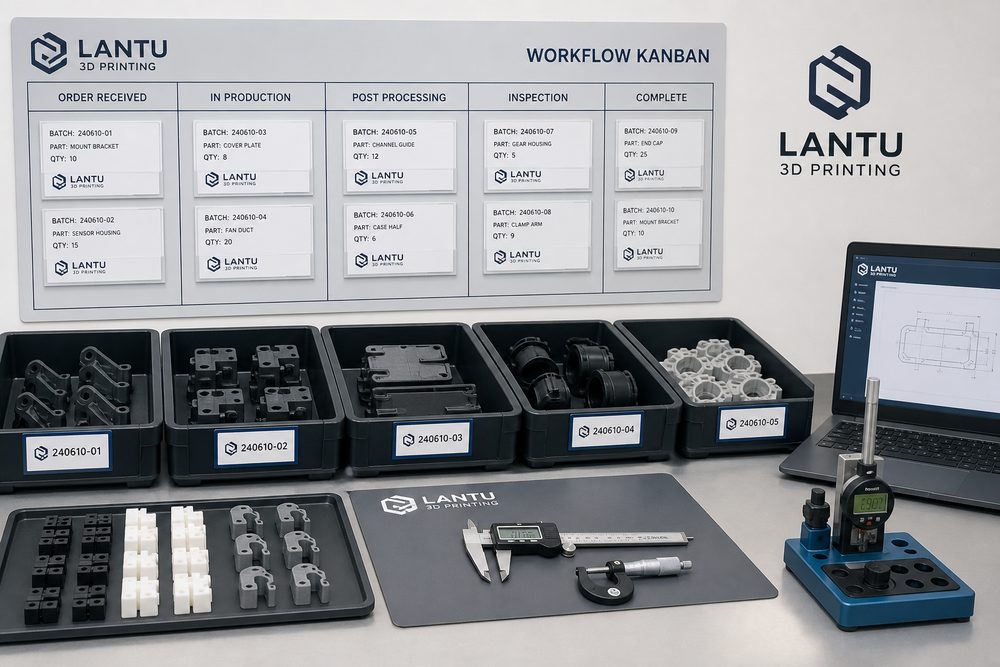
During execution, it is recommended to use three forms: a project dashboard, an equipment task sheet, and a quality record sheet. The project dashboard records requirement confirmation, quotation, file freeze, scheduling, printing, post-processing, quality inspection, shipping, and other statuses. The equipment task sheet records material batch, layer height, orientation, support strategy, machine number, and operator. The quality record sheet records key dimensions, appearance photos, weight, quantity, defect description, and disposition result. For cross-functional projects, all changes must be recorded with version numbers and reasons for change to prevent old files from being used by mistake due to verbal communication.
Common issues include insufficient wall thickness, hole shrinkage, unexpected support marks, reduced assembly clearance after painting, and deformation of thin walls caused by packaging compression. Each type of issue should have a response action: insufficient wall thickness should trigger DFM feedback first; hole shrinkage can be compensated by 0.1 to 0.3 mm; support marks should be identified in advance as non-display surfaces; for painted parts, assembly clearance should be reserved at 0.2 to 0.5 mm; and thin-wall parts should be packaged with positioning foam and separate compartments.
4. Quality and Traceability: Make Delivery Results Reviewable and Explainable
The core of quality traceability is not accumulating documents, but being able to answer four questions quickly when a problem occurs: which version of the model was used, which material and machine parameters were applied, what post-processing steps were performed, and whether the inspection results met the agreement. It is recommended to create a unique tracking number for each project and link the model version, quotation, production records, inspection photos, and shipping documents. For small-batch parts, an AQL-style sampling approach can be used: for orders of 20 parts or fewer, all key dimensions should be inspected; for 20 to 100 parts, the first and last parts should be fully inspected for key dimensions, and the rest sampled at 20% to 30%; appearance parts should be photographed and archived by defect level.
If a customer raises a complaint, traceability records can turn the dispute from subjective judgment into evidence-based judgment. For example, if a customer reports overly tight assembly, the platform can compare the model hole diameter, print orientation, post-processing thickness, and measured dimensions to determine whether the issue stems from insufficient design clearance, process shrinkage, or paint thickness. This not only enables faster repair, reprint, or design correction decisions, but also allows the experience to be incorporated into the next quotation and DFM review.
5. Blueprint3D/lantu3D Implementation Recommendations: Embed Management Actions into the Service Process
For enterprise customers, Blueprint3D/lantu3D recommends dividing 3D printing services into four delivery levels. The first level is rapid samples, used for appearance, dimensional, and concept validation, with emphasis on response speed and clear communication. The second level is engineering samples, used for assembly, load, temperature resistance, or test fixtures, with emphasis on process parameters and inspection evidence. The third level is small-batch delivery, with emphasis on batch consistency, packaging and transportation, and cost structure. The fourth level is long-term collaboration, with emphasis on knowledge management, standard parts libraries, and cross-functional process optimization.
For small-batch production management, the actionable checklist includes: freeze requirement inputs at project kickoff; do not start full-scale production before first-article approval; record material, machine, and parameters for each batch; verify key dimensions with calipers, coordinate measuring machines, or dedicated gauges; confirm display and functional surfaces before post-processing; check quantity, appearance, labels, and protection before packaging; and collect customer feedback within 48 hours after delivery. Through these actions, the platform not only delivers parts, but also helps customers build a repeatable digital manufacturing process.
Conclusion: A Slower Process Often Leads to a Faster Delivery Loop
The strengths of 3D printing are speed, flexibility, and adaptability to complex structures, but when delivery is aimed at enterprise use, speed must be built on a stable process. In small-batch production management, Blueprint3D/lantu3D focuses more on full-process management from design blueprint to physical delivery: clarify requirements upfront, record parameters and milestones midstream, and use inspection, packaging, and review to form an evidence chain afterward. Only then can rework rates be reduced, customer trust improved, and every project experience turned into an asset for the next delivery in small-batch production, sample validation, and cross-functional collaboration.
Submit a model, drawing, image or written notes. Engineers will review material, process, finishing and delivery based on actual use.