Introduction: Turning single-point technology into stable delivery capabilities
From support removal to heat treatment: The core of how 3D printing post-processing determines the final delivery quality is not to make a certain link more beautiful alone, but to connect design, materials, equipment, technology, inspection and delivery into a repeatable engineering chain. For practitioners, the most common problems in 3D printing projects are often not at the moment when the printing button is pressed, but in the gaps between requirement definition, parameter selection, process control and delivery verification. lantu3D pays more attention to the full life cycle management from blueprint to physical object: every manufacturing has a basis, every risk has a plan, and every delivery is traceable.
1. Support removal is not to clean up debris, but to control boundary damage
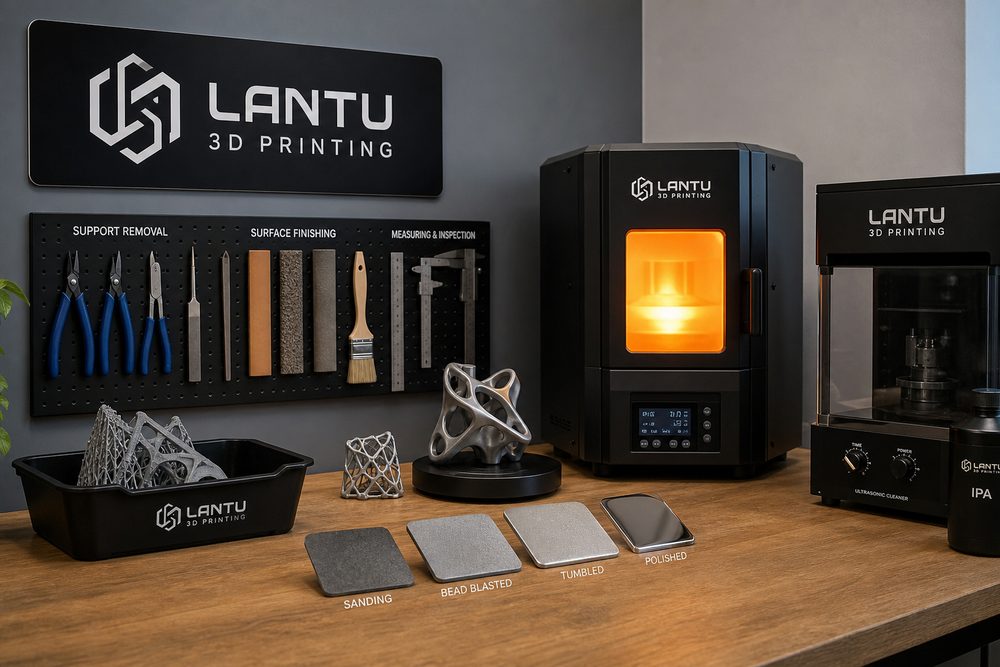
The support structure is responsible for forming stability, heat dissipation and anti-deformation functions, but the removal method will directly affect the integrity of the edges and corners. SLA resin parts are commonly used with diagonal pliers, scrapers and step-by-step grinding. It is recommended to leave a 0.2-0.5mm margin for support points before finishing. Metal SLM parts have high support strength and usually require wire cutting, grinding wheels or machining. The clamping surface and processing allowance must be planned in advance.
Risks of support removal include chipping, bleaching, cracking and localized over-wear. The project should reduce inaccessible supports at the design stage, avoid support contact points from assembly surfaces, sealing surfaces, and appearance A-level surfaces, and specify the allowable support mark levels in the delivery standards.
2. Surface treatment determines the customer’s first feeling of quality
3D printing surface treatment includes sandblasting, vibration grinding, grinding, polishing, spray painting, dyeing, electroplating and transparent parts polishing. SLS nylon parts can be sandblasted to remove floating powder and obtain a uniform matte surface; SLA transparent parts require step-by-step water grinding from 400 mesh to 2000 mesh, and then use varnish or polishing agent to increase the light transmittance.
Surface treatment should not only pursue appearance, but also consider dimensional changes. Spraying may increase the film thickness by 20-80μm, vibration grinding will passivate sharp edges, and electroplating will change the hole diameter and fitting gap. For assemblies, key surfaces should be protected first, and then the exterior surfaces should be processed.
3. Heat treatment and curing affect strength, stability and long-term reliability
Post-curing can increase the degree of cross-linking of photo-cured resin parts, but over-curing will cause increased brittleness and dimensional shrinkage. Metal SLM parts are often treated with stress relief annealing, solution aging or hot isostatic pressing to reduce residual stress, improve fatigue performance and reduce the impact of internal pores.
Heat treatment must be bound to the material grade and part usage. For example, if Ti6Al4V parts are used in load-bearing scenarios, you need to pay attention to the heat treatment system, oxygen content control and mechanical property testing; for nylon parts, more attention is paid to moisture absorption, heat deformation temperature and dimensional stability.
Summary: Turn experience into an executable system
The competitiveness of 3D printing does not only come from the number of equipment, nor does it only come from a certain material parameter, but from whether the company can form a stable closed loop of demand judgment, process decision-making, process recording, quality verification and customer communication. It is recommended that companies start with a typical part, a typical process or a typical customer scenario, establish parameter tables, checklists and review mechanisms, and then gradually expand to more materials and business types. In this way, 3D printing can move from "can be made" to "stable, explainable, and scalable delivery."
Submit a model, drawing, image or written notes. Engineers will review material, process, finishing and delivery based on actual use.