Introduction: Complaint Handling Determines Whether Customers Order Again
Customer complaints in 3D printing services often center on dimensional deviation, surface defects, insufficient strength, inconsistent color, delivery delays, and shipping damage. Many teams treat complaints as an after-sales issue, but in lantu3D’s delivery logic, complaint handling is the key link connecting requirement clarification, engineering judgment, production control, and customer relationship management. A well-handled complaint not only solves the immediate issue, but also exposes hidden design risks, process limits, and communication gaps. A poorly handled complaint, on the other hand, may cause a small batch project that could have been repeated to disappear permanently.
1. Start with Classification: A Complaint Is Not a Single Problem
It is recommended to divide 3D printing complaints into six categories. The first is design input issues, such as wall thickness below 0.8 mm, insufficient diameter for thin rods, or inadequate assembly clearance leading to breakage or jamming. The second is process capability issues, such as the powdery surface of SLS nylon parts, slight layer lines on SLA transparent parts, or support contact marks on metal parts; these are process characteristics that should be explained before ordering. The third is production anomalies, including machine interruption, warping, support failure, and insufficient curing. The fourth is post-processing issues, such as paint color differences, uneven dyeing, and over-polishing. The fifth is logistics and packaging issues, such as damage to sharp corners or cracked thin-wall parts during shipping. The sixth is expectation mismatch, where the customer interprets sample-level appearance as mass-production-level appearance, or assumes rapid prototyping means instant delivery without inspection. Only with clear classification can you choose the right strategy among reprint, rework, explanation, refund, or design optimization.
2. Response Rhythm: Close the Facts Loop Within 24 Hours
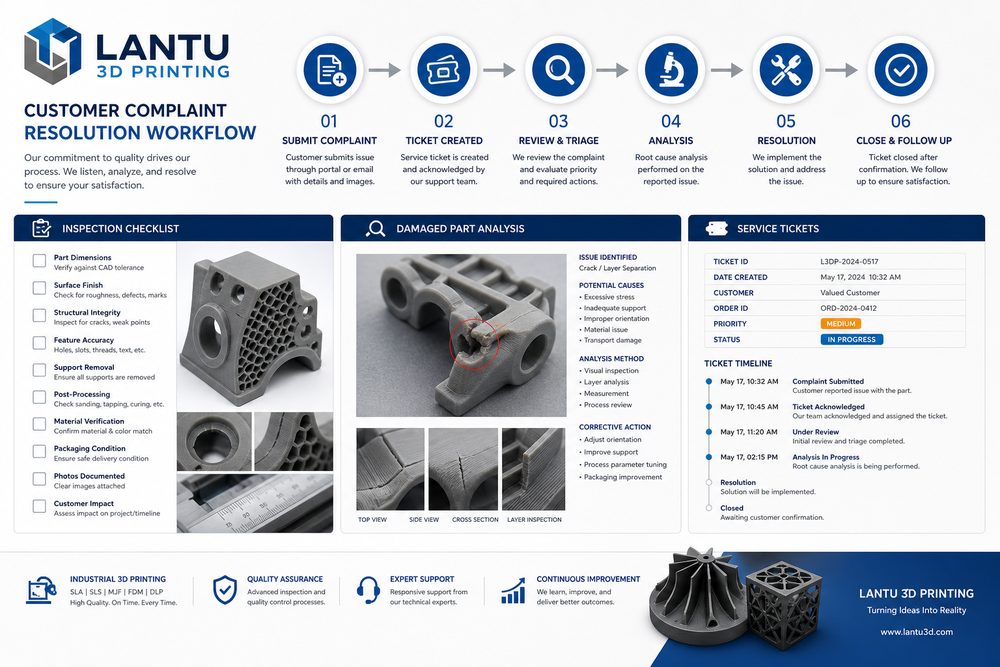
When a complaint occurs, the first step is not to argue about responsibility, but to collect facts. It is recommended to confirm receipt within 2 hours and ask the customer to provide photos, videos, usage scenarios, quantity affected, packaging condition, and key dimensions. Internally, the team should simultaneously retrieve the order number, file version, material batch, machine job, inspection records, and shipping photos. For dimensional issues, distinguish between the customer’s measuring tool, measurement baseline, and ambient temperature differences. For strength issues, confirm the loading direction, load size, and frequency of use. For appearance issues, compare against the sample standard or surface grade confirmed before ordering. Within 24 hours, provide an initial judgment: design risk, process limitation, production anomaly, shipping damage, or expectation gap, and state the next handling timeline.
3. Engineering Review: Replace Emotional Judgments with Data
Complaint handling should be built around a minimal review package. Dimensional complaints require key measurements from at least three samples, design tolerance, process tolerance, and measurement photos. Strength complaints require material parameters, wall thickness, print orientation, fracture location, and load estimates. Appearance complaints require original photos, post-processing records, lighting conditions, and the standard confirmed by the customer. Shipping complaints require packaging photos, cushioning materials, damage location, and logistics checkpoints. Take an SLS PA12 snap-fit part as an example: if the customer reports that assembly is too tight, the review should check snap-fit thickness, hole position deviation, powder cooling shrinkage, and design clearance at the same time. If the design clearance is only 0.10 mm while the stable process tolerance is ±0.20 mm, the conclusion should point to a design revision rather than simply reprinting the part.
4. Solutions: Remediation Should Have Boundaries and Sincerity
Common responses include free reprint, rework or post-processing, partial design optimization, discounted remake, partial refund, and technical explanation. Issues caused by production anomalies should be reprinted quickly and prioritized in the schedule. Shipping damage can be resent according to packaging responsibility and logistics evidence. Issues caused by design input should receive actionable modification suggestions, such as increasing wall thickness from 0.8 mm to 1.5 mm, changing sharp corners to R1.0 fillets, or adjusting assembly clearance from 0.15 mm to 0.30-0.50 mm. For process-limit issues, avoid vague excuses; explain the process characteristics clearly and mark them in advance in future quotations. lantu3D emphasizes “solve the usage problem first, then discuss responsibility proportion,” but it is also important to avoid unlimited promises and prevent unreasonable demands from becoming service standards.
5. Turn Complaints into a Prevention Checklist
Every complaint should be converted into a preventive action. If a certain structure breaks repeatedly, add DFM checks before quoting. If transparent resin parts are repeatedly criticized for not looking glass-like enough, clarify on the page and in the quotation that “transparency can be improved, but it is not equivalent to injection-molded acrylic.” If thin-wall parts are easily damaged in transit, add independent foam, support fixtures, or split-shipment plans for high-risk parts. If customers frequently misunderstand lead times, spell out production time, post-processing time, inspection time, and logistics time separately. Through complaint tag statistics, the team can identify the source of frequent issues and shift after-sales pressure to pre-sales prevention and process optimization.
Conclusion
The core of 3D printing customer complaint handling is not to respond quickly with a stance, but to complete the loop with structured facts, engineering data, and clear boundaries. lantu3D recommends building a five-step mechanism of classification, response, review, resolution, and prevention so that every complaint can be traced back to file versions, process parameters, inspection records, and customer expectation management. In this way, complaints are not only a cost, but also an entry point for improving delivery quality and long-term cooperation stability.
Submit a model, drawing, image or written notes. Engineers will review material, process, finishing and delivery based on actual use.