
Introduction: The Training System Is Built, but People Still Cannot Be Developed
Many additive manufacturing workshops have established job skill matrices, course maps, and certification-based work authorization systems, yet the same issues continue to recur on the shop floor: after three months of independently operating equipment, a new employee still does not know whether abnormal powder spreading warrants interrupting the build; during changeover, experienced operators adjust recoater blade clearance based on experience, while new employees follow the work instructions but consistently fall short. The issue is often not the number of courses, but the final mile of knowledge transfer—who provides mentoring, what is taught, and when a trainee can be released for independent work—which has not been engineered.
A skill matrix answers, “Can this person perform the task?” Mentorship must answer, “How did this person learn it, and to what level can they independently assume responsibility?” The former records outcomes; the latter engineers the process. Engineering the mentoring process is the critical step in converting individual experience into repeatable production capacity.
1. First Distinguish Three Types of Knowledge: What Documents Can Transfer and What Mentoring Must Transfer
Mentoring plans typically fail because all content is placed into the vague activity of “having the mentor demonstrate it once.” A more effective approach is to first categorize job knowledge by level:
Explicit knowledge (transferable through documentation): equipment startup and shutdown procedures, safety rules, powder grade and storage requirements, and production reporting field-entry standards. This type of content can be covered through standard operating procedures (SOPs) and online assessments, without consuming mentor time.
Semi-tacit knowledge (transferable through demonstration and practice): techniques for verifying clearance after recoater replacement, force control during support removal, and comparison methods for first-part visual inspection. This content must be demonstrated on site, and trainees need to repeat the operation several times under mentor observation to develop muscle memory and visual standards.
Tacit knowledge (requiring accumulated situational judgment): whether to interrupt a build when unusual melt-pool noise and increased spatter occur; whether to continue production when powder flowability declines slightly; and how to handle fillets not specified on a customer drawing. Such judgments cannot be fully written as a checklist of criteria; they can only be transferred through reviews of real or simulated situations.
Mentoring resources should focus on the latter two categories. Assigning the first category to mentors as well is one of the most common wastes in mentoring plans.
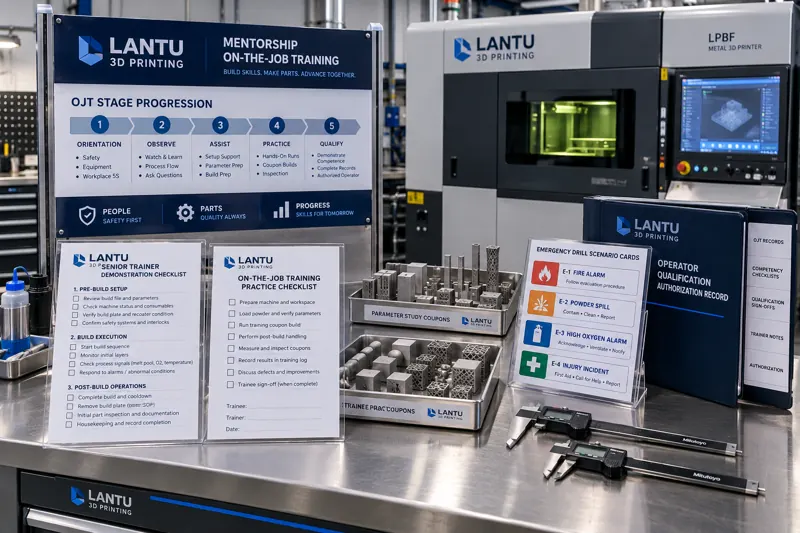
2. OJT Plan Structure: Break “Learning by Following” into Verifiable Stages
An executable OJT (On-the-Job Training) plan should include at least four elements: stage objectives, a mentoring content checklist, practice frequency requirements, and stage release criteria.
For example, a metal LPBF equipment operator role can be divided into four stages: observation stage (following the shift to complete auxiliary tasks such as powder sieving, chamber cleaning, and build plate leveling, without accessing the main control interface); assistance stage (completing machine setup and parameter loading with the mentor confirming every step, with all abnormalities reported rather than handled independently); semi-independent stage (independently completing routine work and first-part self-inspection, while executing abnormal-condition responses only after mentor review); and independent stage (independently handling issues on the defined abnormality list, while escalating anything outside that list).
Each stage should define a minimum number of practice repetitions and a minimum duration, then close with stage release criteria. Release criteria should be objectively verifiable, such as “independently complete build plate leveling three consecutive times, with all levelness measurements within 0.05 mm/m” or “correctly classify first-part visual defects five consecutive times, with results consistent with quality inspection findings.” Trainees should proceed only after meeting the criteria. If they do not meet them, the stage should be extended and additional practice provided rather than automatically releasing them based on elapsed time.
3. Internal Trainers Are Not a Title, but a Selection and Enablement Mechanism
Directly appointing technically capable veteran employees as internal trainers is another common cause of mentoring failure. Technical competence is not equivalent to mentoring competence: the former is the ability to perform work, while the latter is the ability to break down, demonstrate, correct, and assess a trainee’s performance.
Internal trainer selection should have three mandatory thresholds: continuous service in the role for a defined period without major quality-responsibility incidents; practical operating experience across shifts or machine models; and the ability to independently write or revise work instructions. After meeting these thresholds, candidates should complete targeted training in mentoring capability, covering at least how to break down operating steps, provide corrective feedback, and document trainee performance.
Internal trainer work must be included in working hours and performance evaluation; otherwise, mentoring will be continually squeezed out by production demands. A common practice is to convert mentoring assignments into standard labor hours and link them to trainee stage pass rates and post-independence quality performance, rather than merely evaluating how many people were trained.
4. Drills: Move Low-Probability, High-Consequence Decisions into a Controlled Environment
The most difficult tacit knowledge to transfer involves abnormal-condition response. Real abnormalities occur infrequently but have serious consequences, so trainees often face them for the first time in an actual event. The solution is to establish both tabletop exercises and hands-on drills.
Tabletop exercises are suitable for process-related abnormalities: high oxygen-content alarms, interrupted inert gas supply, or missing batch traceability information discovered before delivery. The internal trainer presents an initial scenario, trainees verbally describe the response sequence, others add input, and the group reviews differences against the contingency plan. Each exercise should be limited to 30 to 45 minutes. The goal is not to identify a single correct answer, but to familiarize trainees with the general sequence: isolate first, assess second, respond next, and document last.
Hands-on drills are suitable for operational abnormalities: simulated shutdown inspection after uneven powder spreading, or simulated re-clamping and leveling following build plate loosening. Drills should use actual equipment and tooling, but must be conducted during non-production periods or on dedicated equipment. Drill status must be declared in advance to avoid confusion with actual production records. Equipment must be restored after the drill, and records must be retained.
High-risk scenarios should be covered at least once per quarter, with an additional drill following new equipment introduction or process changes.
5. Authorization and Reassessment: Keep Qualifications Aligned with Current Status
Job qualification authorization is not a one-time event. Authorization should clearly define three elements: scope of authorization (which equipment, materials, and processes); authorization level (assistance, semi-independent, or independent); and validity period.
Qualification reassessment should be triggered in the following situations: returning to work after being away from the role for a defined continuous period; major equipment repairs or software version upgrades; substantive changes to process specifications; or batch-level quality issues caused by the operator. Reassessment may use simplified stage release criteria and does not need to repeat the full process, but it must be documented.
All authorization and reassessment records should be integrated with the work-order dispatch system. During work assignment, personnel without the required authorization should not be assigned tasks outside their authorized scope. If this requirement exists only in paper records, the practical control strength of the mentoring system will be greatly weakened.
6. Common Failure Modes and Countermeasures
Mentoring plans are consumed by production schedules: include mentoring tasks in weekly schedules, define protected time slots, and require explanations for incomplete tasks rather than mentoring only when time permits. Mentors assign trainees only miscellaneous work: use stage release criteria to drive mentoring content, and assess mentors when trainees fail to meet requirements. Assessment relies only on written tests: practical assessments must be completed on site; written tests should cover only explicit knowledge. Mentoring records are completed retroactively: link stage confirmation points to the work-order dispatch system so trainees cannot enter the next-stage tasks until confirmation is complete. The internal trainer pool becomes fixed: establish terms of appointment and refresher training, and regularly add new internal trainers from employees who have passed the independent stage to prevent knowledge from being concentrated in only a few individuals.
Conclusion
Engineering talent development cannot stop with course maps and skill matrices. What truly determines the speed of capacity replication is the mentoring process itself: knowledge categorization determines where mentor time is invested; stage release criteria determine how “competence” is verified; the internal trainer mechanism determines who mentors and how mentoring quality is sustained; drill mechanisms determine how low-probability, high-consequence judgments are accumulated in advance; and authorization and reassessment determine whether qualifications remain aligned with current status. Only by implementing these five elements in forms that can be inspected, documented, and traced can individual experience be reliably transformed into organizational capability.
Invia un modello, un disegno, un'immagine o note scritte. Gli ingegneri valuteranno materiale, processo, finitura e consegna in base all'uso effettivo.