Introduction: Being Able to Make It Does Not Mean You Can Legally Deliver It
3D printing projects commonly involve model files, material formulations, scan strategies, support structures, post-processing parameters, and dedicated tooling, while finished products may also be sold across multiple jurisdictions. Engineering teams typically first ask, “Can it be printed? Does it meet performance requirements? Is the cost acceptable?” Yet they can easily overlook a prior question: does the proposed technical solution fall within the scope of another party’s valid patent rights? When one company accepted an order for a batch of lightweight titanium-alloy brackets, its print parameters, heat-treatment profile, and inspection capabilities had all passed first-article validation. Only when the customer prepared for an overseas product launch compliance review did the company discover that the topology-optimized rib layout closely matched the claims of a granted patent in the target market. By then, approximately RMB 380,000 had been invested in tooling and inspection fixtures, while redesigning around the patent, rerunning thermal simulations and fatigue tests, and reconfirming the first article added another six weeks. Had a freedom-to-operate (FTO) search been conducted before quotation, an alternative solution would only have required changes to rib direction and connection fillets during the design phase, at virtually no cost. FTO is not a generic exercise in “IP protection”; it involves comparing a specific product, process, and sales territory against patent claims feature by feature, then delivering an actionable release, design-around, or licensing conclusion.
I. Define the FTO Search Scope First: Subject Matter, Territory, Timing, and Legal Status
The first step in an effective FTO review is not entering a few keywords, but documenting the search boundaries in a reviewable work order. The subject-matter scope should be divided into four layers: part geometry and functional features, such as lattice units, conformal channels, and snap-fit connections; manufacturing methods, such as laser power of 200 to 400 W, layer thicknesses of 20 to 60 μm, 67° scan rotation, and multi-laser zone stitching; material and post-processing combinations, such as Ti6Al4V subjected to HIP and solution aging, or PA12 subjected to vapor smoothing; and the software/data chain, including slicing compensation, automated support generation, and in-process melt-pool monitoring algorithms. Within the same project, a customer-supplied model and a company-developed process may correspond to different rights holders and should not be combined into a generic search for “3D printing patents.” Territorial scope is determined jointly by the manufacturing location, sales location, and location of use. Patents are territorial: even if printing is completed in China, finished products sold in Germany, the United States, or Japan require separate review of local family members and granted texts. For export batches, Incoterms delivery points should also be documented to avoid treating a transit country as a place of implementation. The time scope should cover at least the filing date, publication date, grant date, fee-payment status, term extensions, and invalidation decisions. The search report must record the database version and search date, for example: “As of November 4, 2026, including published CN, EP, US, WO, JP, and KR documents.” The legal-status scope must distinguish granted and active patents, pending applications, expired patents, and provisional protection periods. Pending applications cannot yet prohibit implementation, but may result in retroactive royalties after grant, so they should be monitored rather than ignored.
II. From Keywords to Claims: Translate Technical Features into a Comparison Table
Patent risk assessment rests on claims, not abstracts or titles. A three-track search strategy is recommended: “IPC/CPC classifications + keywords + citation/family expansion.” Classifications such as B22F, B33Y, B29C, C22C, and G05B help define process and equipment scope. Keywords should include Chinese and English synonyms and abbreviations, such as “conformal cooling,” “lattice/cellular structure,” “support removal,” and “hot isostatic pressing/HIP.” The search should then expand through citations, cited documents, INPADOC families, and applicant aliases for core patents, avoiding omissions caused by subsidiaries or university technology-transfer entities. After initial screening, each patent should be broken down into the technical features of its independent claims and compared feature by feature with the company’s solution: Column A lists claim features; Column B lists actual project parameters or structures; Column C records “identical/equivalent/missing/not applicable”; and Column D identifies the supporting evidence file. For example, if a method claim specifies “a scan direction for each layer rotated 60° to 70° relative to the preceding layer, laser power of 250 to 350 W, and oxygen content below 100 ppm in the build chamber,” and the project uses 67°, 320 W, and 80 ppm, all three features fall within the literal claim scope. A different equipment brand does not establish non-infringement. If the project instead uses a continuous rotation strategy without a fixed interlayer angle, the feature may be absent, supporting a clearer non-infringement opinion. However, dependent claims and the specification must still be checked to determine whether continuous rotation is described as an equivalent substitute. Under the all-elements rule, every feature of an independent claim must be found in the company’s solution. The absence of at least one essential technical feature is generally the basis for concluding that the solution does not fall within the literal scope. Equivalence analysis additionally requires documentation of the means-function-result analysis and prosecution-history estoppel; it is insufficient to merely state that “the parameters differ slightly.”
III. Risk Classification and Evidence Chains: Make Conclusions Reviewable by Customers and Legal Teams
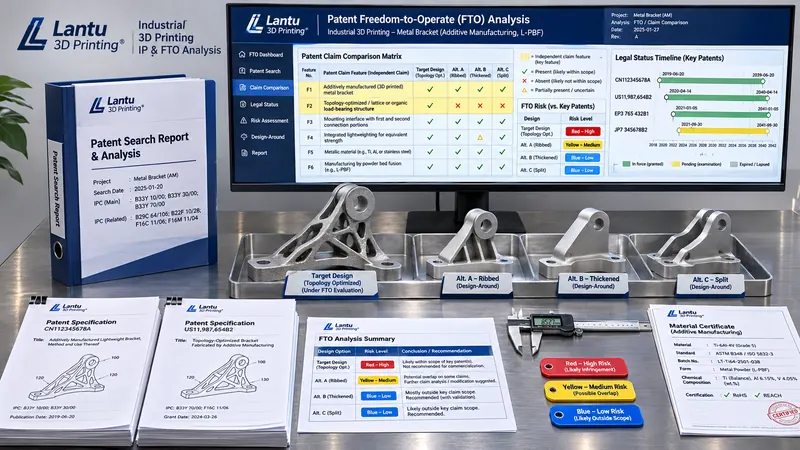
Comparison results should be converted into red, yellow, and blue categories with corresponding actions, rather than remaining at the level of “risk/no risk.” Red means that an independent claim of at least one valid granted patent is fully covered and no reliable invalidity evidence exists. The default position is that the original solution must not be released; that version should be frozen during quotation and contract review. Yellow means claim interpretation is disputed, an application is still pending, family status is unclear, or territorial coverage is incomplete. The project may proceed conditionally, but an owner, review date, and alternative solution must be assigned. Blue means no full claim coverage has been identified, or the relevant patents have expired with no possibility of reinstatement. The project may be released, while the search queries, hit list, and comparison table are retained. Each record should include at least the patent publication number, applicant, legal status, target territory, relevant features, basis for the conclusion, searcher, reviewer, and date. One often-overlooked part of the evidence chain is that non-hits also require documentation: search strings, databases, classification codes, family-expansion paths, and exclusion rationales are more valuable in a future dispute than a one-line conclusion. FTO reports should be linked to requirement specifications, design-freeze forms, and ECN numbers. Any geometry change, material substitution, scan-strategy upgrade, or newly added sales country should trigger a differential review rather than allowing a year-old report to remain permanently valid. Customer-supplied technology and company-owned processes should also be separately identified, preventing the manufacturer from assuming all risk arising from a customer-specified structure while recognizing that an NDA cannot replace patent infringement analysis.
IV. Design-Arounds, Invalidity, and Licensing: Engineering Trade-Offs Across Three Response Paths
A red conclusion does not necessarily mean the project must be terminated. The first response path is design-around, prioritizing changes that eliminate an essential technical feature without affecting CTQs. Examples include replacing a fixed interlayer rotation angle with continuous rotation, splitting an integrated conformal channel into two assemblable sections, or replacing a specific lattice unit with a non-periodic variable-density structure. Each modification must be followed by mechanical simulation, support and distortion compensation, specimen printing, and critical-dimension inspection to ensure that resolving a legal issue does not introduce new engineering risks. The second path is validity analysis: searching pre-filing-date papers, published standards, trade-show materials, prior sales, and equipment manuals to assess novelty or inventive-step defects. Where necessary, a patent attorney or agent can evaluate an invalidation action. However, invalidity proceedings involve uncertain timing and outcomes and cannot be the sole basis for on-time delivery. The third path is licensing or cross-licensing. Before negotiations, the parties should calculate minimum royalties, per-unit royalties, territorial scope, term, sublicensing rights, ownership of improvements, and treatment of remaining inventory after production stops. For interface geometries or communication protocols based on industry standards, standard-essential patents (SEPs) and FRAND declarations must also be reviewed separately. Compliance with a standard does not automatically grant a patent license, and licensing negotiation status should be included as a project milestone. The three paths can be compared in a unified decision table using added cost, validation duration, impact on performance and yield, legal certainty, and customer acceptance. For example, a design-around may require 42 additional simulation hours and two rounds of specimen testing, licensing may add a 3.5% per-unit royalty, and invalidity may take an estimated 9 to 15 months. The resulting decision is then based on evidence rather than subjective preference.
V. Embed FTO from Blueprint to Delivery: Milestones, Gates, and Lessons Learned
As a lifecycle management platform from design blueprint to physical delivery, lantu3D should treat FTO as a technical gate alongside manufacturability review, quotation, and first-article approval. Four milestones are recommended. Before quotation, conduct a “rapid FTO” review, completing an initial screen of core structures, process routes, and primary sales countries within 24 to 48 hours, and determine whether licensing or design-around costs need to be included in the quotation. Before design freeze, conduct a “detailed FTO” review, produce a complete claim comparison table, and obtain joint sign-off from engineering and legal counsel/external patent agents. When an ECN is issued or a new export country is added, conduct a “differential FTO” review covering only changed features and their patent families. Before production release, conduct a “status review” to confirm that patent grants, invalidation proceedings, assignments, licenses, and terms have not changed. Gate criteria must be objectively determinable: a red issue that has not been closed must prevent design freeze; a yellow issue must state conditions, owner, and closure date; and blue reports must be archived with the project for no less than the contractually agreed period after product discontinuation or the applicable statutory limitation period. Each quarter, review three metrics: the average time from identification to closure for red projects, FTO-triggered design-change cost as a percentage of project cost, and review timeliness after new sales countries are added. Frequently hit classifications, applicants, and process features should then be consolidated into controlled vocabularies and search templates to reduce repetitive work. In this way, FTO is no longer a static document added just before delivery, but engineering data that is searchable, comparable, verifiable, and traceable.
Conclusion
The value of freedom-to-operate analysis is not in listing a large number of patent numbers, but in answering four specific questions: where will implementation occur, which technical features will be implemented, do they cover valid patent claims, and, if they do, what engineering action will close the issue? Subject matter, territory, timing, and legal status define the boundaries; classification codes, patent families, and citations form the search network; feature-by-feature comparison of independent claims provides the core assessment; and red-yellow-blue classification, design-around validation, validity assessment, licensing calculations, and four process gates create the decision loop. For 3D printing, where design, materials, equipment parameters, and data chains are tightly coupled, moving FTO forward to the blueprint and quotation stages may require only a single structural or parameter adjustment. Waiting until first articles, tooling, and inspection plans are fully fixed can multiply the cost into combined losses of schedule, budget, and customer trust. An FTO process that can be searched, compared feature by feature, re-reviewed when changes occur, and supported by an evidence chain is the truly actionable compliance control from design through physical delivery.
Invia un modello, un disegno, un'immagine o note scritte. Gli ingegneri valuteranno materiale, processo, finitura e consegna in base all'uso effettivo.