Introduction: The Strategic Role of Carbon Fiber Reinforced Nylon in Additive Manufacturing
Carbon fiber reinforced nylon composites (CF/PA), with their outstanding specific strength, specific modulus, and excellent heat resistance and fatigue resistance, have become indispensable structural materials in aerospace, automotive manufacturing, and high-end sports equipment. In selective laser sintering (SLS), the addition of carbon fiber not only significantly improves mechanical properties but also profoundly changes the crystallization behavior of the polymer. Understanding and controlling the crystallization kinetics of this complex multiphase system during rapid heating and cooling is key to producing high-quality SLS parts. This article explores in depth the crystallization mechanisms of CF/PA composites in the SLS process, analyzes the effects of process parameters on microstructure and macroscopic performance, and provides actionable process optimization strategies to help engineers fully unleash the performance potential of this advanced composite material in practical production.
Thermodynamic Basis of Nylon Crystallization in the SLS Process
Nylon 12 (PA12), the most commonly used nylon material in SLS, has crystallization behavior that directly determines the dimensional stability, mechanical properties, and surface quality of printed parts. During rapid prototyping by SLS, nylon powder undergoes rapid heating from room temperature to above its melting point (approximately 175–185°C), followed by an extremely fast cooling process in the laser sintering region (cooling rates can reach 10^3–10^4 K/s). This non-equilibrium phase transition results in a crystallinity significantly lower than that of conventional injection molding, typically between 15% and 35%. The crystallinity of semicrystalline polymers directly affects density, hardness, chemical resistance, and heat distortion temperature. For PA12, when crystallinity increases from 20% to 40%, tensile strength can improve by about 30%, and heat distortion temperature can rise by 15–20°C. Therefore, improving crystallinity through process control is an important way to enhance SLS part performance and is also one of the core variables for achieving batch consistency.
Multidimensional Effects of Carbon Fiber on Crystallization Behavior
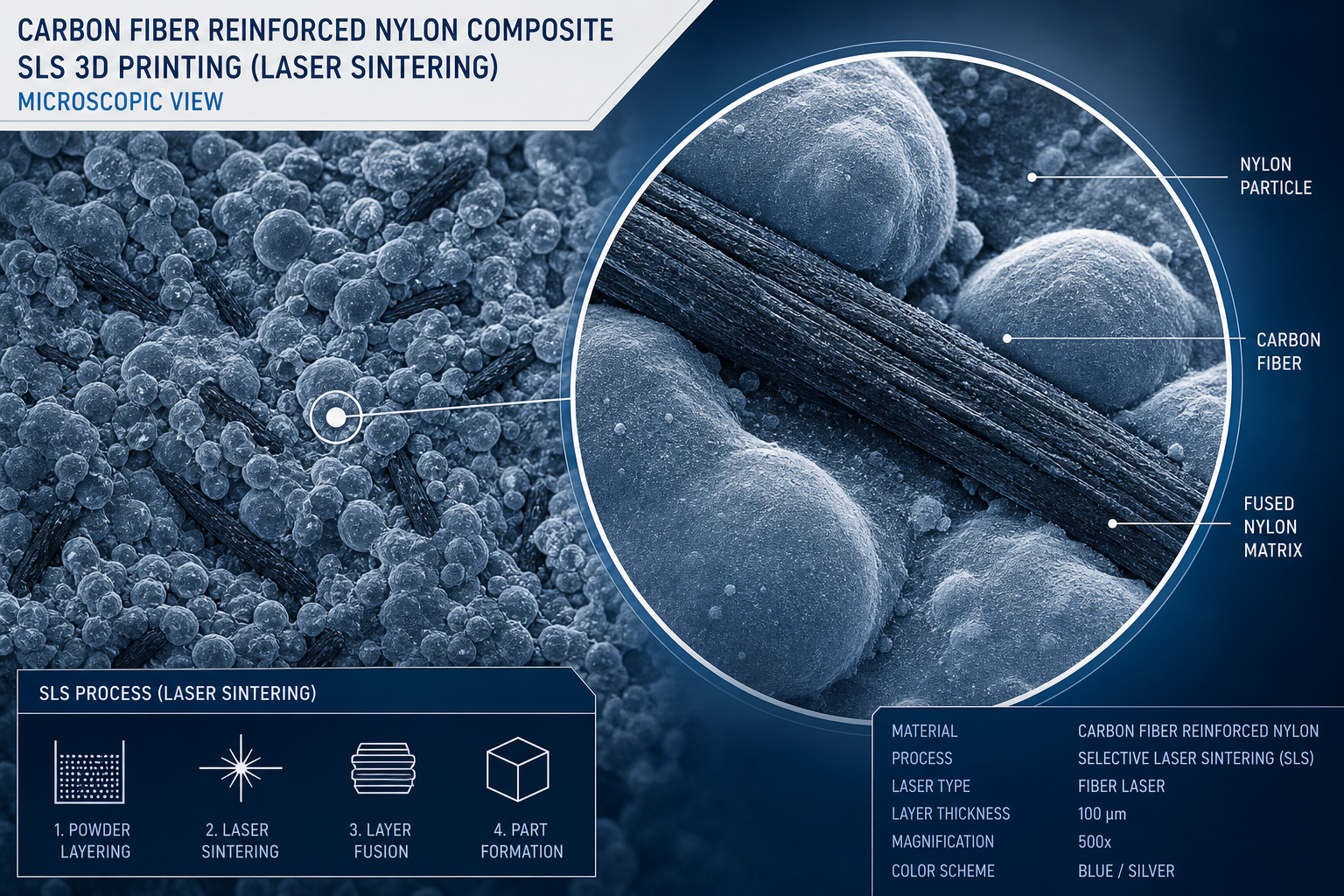
The introduction of carbon fiber has a complex impact on the crystallization process of the nylon matrix, mainly reflected in three aspects: nucleation effect, changes in crystallization rate, and crystal orientation. First, the carbon fiber surface acts as a heterogeneous nucleating agent, significantly lowering the nucleation barrier for nylon crystallization, raising the crystallization onset temperature by 5–10°C, and greatly increasing nucleation density. Experimental data show that adding 10% carbon fiber can increase the nucleation density of PA12 by 2–3 orders of magnitude. Second, the presence of carbon fiber restricts the mobility of polymer chain segments, acting as an obstacle during the crystal growth stage, which leads to smaller spherulites but a greater number of them, forming a more refined grain structure. Third, in the shear flow field of the SLS melt pool, carbon fibers become oriented, inducing nylon molecular chains to crystallize along the fiber direction and forming an anisotropic crystal structure. This orientation effect is especially pronounced in the laser scanning direction, causing differences in mechanical properties between the scanning direction and the direction perpendicular to it of 20%–40%, a characteristic that must be fully considered in design.
Regulation of Crystallinity and Fiber Orientation by Process Parameters
SLS process parameters have a decisive influence on the crystallization behavior of CF/PA composites. Laser power and scanning speed jointly determine the temperature field and cooling rate of the melt pool. Studies show that when the laser energy density (LED) increases from 0.06 J/mm² to 0.12 J/mm², the melt pool cooling rate decreases from about 8000 K/s to 3000 K/s, and crystallinity increases from 18% to 28%. Higher energy density extends the residence time of the melt in the high-temperature zone, providing a more sufficient thermal history for crystal growth. In addition, scanning strategy also significantly affects the distribution of fiber orientation. Using a combined strategy of contour scanning plus island-style infill can make the fibers form a ring-like orientation in the boundary region of the part, effectively improving boundary strength and dimensional accuracy. Preheating temperature is also critical: raising the powder bed temperature from 150°C to 170°C (close to the glass transition temperature of PA12) can reduce internal stress in printed parts, decrease warping deformation, and promote more uniform crystallization and more stable dimensional repeatability.
Microstructure Characterization and Performance Correlation Analysis
Through combined characterization using differential scanning calorimetry (DSC), polarized optical microscopy (POM), and scanning electron microscopy (SEM), a complete process-structure-property relationship can be established. DSC test results show that the optimized CF/P
Submit a model, drawing, image or written notes. Engineers will review material, process, finishing and delivery based on actual use.