
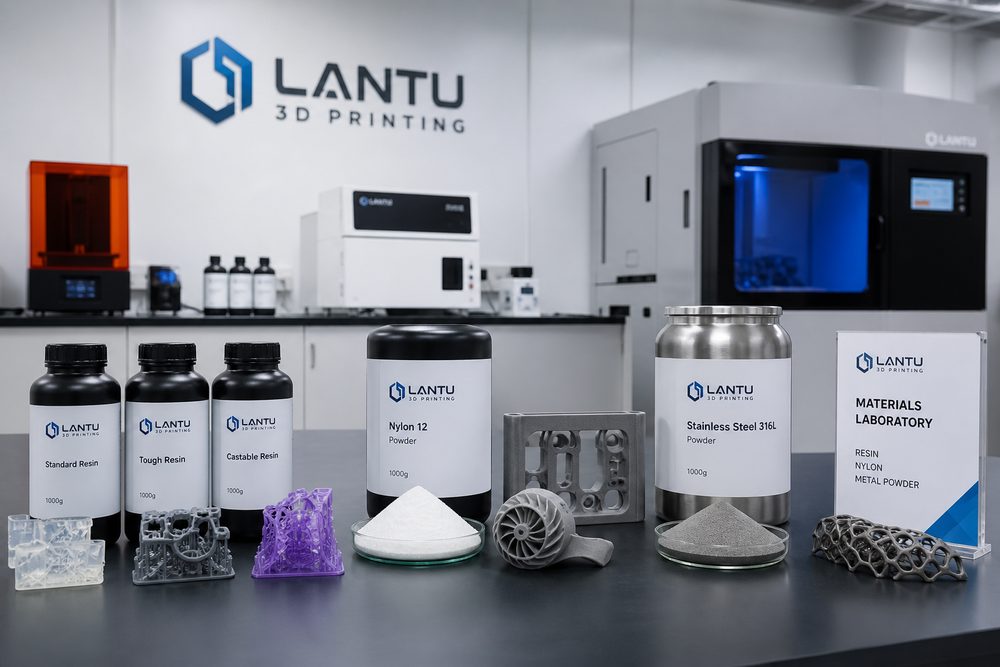
Material Properties of PA12 Nylon Powder
PA12 (Polyamide 12) is the most widely used engineering plastic powder in SLS (Selective Laser Sintering) technology. The long methylene segments in its molecular chain give it excellent low moisture absorption, dimensional stability, and chemical corrosion resistance. Compared with PA6 and PA66, PA12 has a water absorption rate of only 0.25%, allowing it to maintain stable mechanical properties in humid environments.
Core Performance Parameters
| Performance Indicator | Range | Engineering Significance |
|---|---|---|
| Melting Temperature | 178-180°C | Determines the temperature window for laser sintering |
| Density | 1.01g/cm³ | Advantage for lightweight design |
| Tensile Strength | 48-52MPa | Basis for load-bearing structural applications |
| Elongation at Break | 18-25% | Good toughness and impact resistance |
| Water Absorption | 0.25% | Excellent dimensional stability |
| Heat Deflection Temperature | 145-150°C | Suitable for medium-temperature operating conditions |
Principle of SLS Selective Laser Sintering
SLS technology uses a high-power laser (typically a CO₂ laser, 30-200W) to sinter powder materials layer by layer. The workflow is as follows:
- Powder spreading: A powder roller evenly spreads a thin layer of powder (typically 0.1mm) over the surface of the build chamber
- Preheating: The powder is preheated to slightly below the melting point (about 160-170°C) to reduce thermal stress during sintering
- Laser sintering: The laser scans along the sliced path, rapidly raising the powder temperature above the melting point to cause sintering and fusion
- Build chamber lowering: The chamber lowers by one layer thickness, preparing for the next powder spreading step
- Repeat cycle: The above steps are repeated until the part is fully formed
The key advantage of SLS is that it does not require support structures—unsintered powder naturally supports overhanging sections, making it possible to manufacture complex geometries such as internal cavities, lattices, and assembly mechanisms.
SLS Printing Parameter Optimization
Laser Power and Scan Speed
Laser power and scan speed are the key parameters that determine sintering quality. Their matching relationship directly affects:
- Sintering depth: The higher the power and the slower the speed, the greater the sintering depth and the stronger the interlayer bonding
- Porosity: If the energy density (power/speed × hatch spacing) is too low, porosity will be too high, reducing mechanical performance
- Dimensional accuracy: Excessive energy can cause the powder to melt too much, thickening edges and reducing accuracy
Recommended parameters: laser power 30-50W, scan speed 1500-2500mm/s, hatch spacing 0.2-0.3mm, energy density controlled at 0.04-0.06J/mm².
Build Temperature Control
The build temperature (Part Bed Temperature) is typically controlled 10-15°C below the melting point of PA12 (i.e., 165-170°C). If the temperature is too low, the part may warp or crack; if it is too high, the powder may agglomerate, affecting powder spreading quality.
Layer Thickness Selection
The commonly used SLS layer thickness is 0.1mm. A thinner layer thickness can improve Z-axis resolution and surface quality, but it will lengthen printing time. For large functional parts, it can be increased to 0.12-0.15mm to improve efficiency.
Detailed Post-Processing
Sandblasting Cleaning
After the part is removed from the powder bed, unsintered powder remains attached to the surface. Using glass beads or plastic beads for sandblasting (pressure 2-4bar) can clean the surface and produce a uniform matte finish. Sandblasting time should not be too long to avoid excessive wear on fine details.
Media Polishing
The part is placed in a rotating barrel together with ceramic or plastic abrasive media, and the surface is polished through friction. With a processing time of 2-4 hours, surface roughness can be reduced from Ra 15-20μm to Ra 6-10μm.
Dyeing and Impregnation
The porous structure of PA12 can absorb dyes, enabling stable coloration. Common processes include:
- Water bath dyeing: Soak in a dye bath at 80-90°C for 30-60 minutes to achieve an even dark color
- Impregnation sealing Next Step Is this close to what you need?
Submit a model, drawing, image or written notes. Engineers will review material, process, finishing and delivery based on actual use.