Introduction: Why Small-Batch Delivery Needs Traceability Even More
In 3D printing projects, customers often assume that “small batch” means the workflow can be more flexible and the records can be simpler. But based on lantu3D’s project experience, deliveries of 10, 50, or 200 functional parts are actually more likely to run into version mix-ups, unclear material lots, and inconsistent post-processing conditions. This is especially true for SLS nylon, SLA resin, and metal SLM parts. Different machines, build orientations, and curing or heat-treatment batches can all create measurable differences in dimensions, strength, and surface condition. Quality traceability is not about assigning blame after the fact; it is about connecting design files, process parameters, inspection results, and delivery batches so that every repeat order, reprint, and issue diagnosis has a clear basis.
1. Traceability Scope: A Complete Chain from Model File to Shipping Label
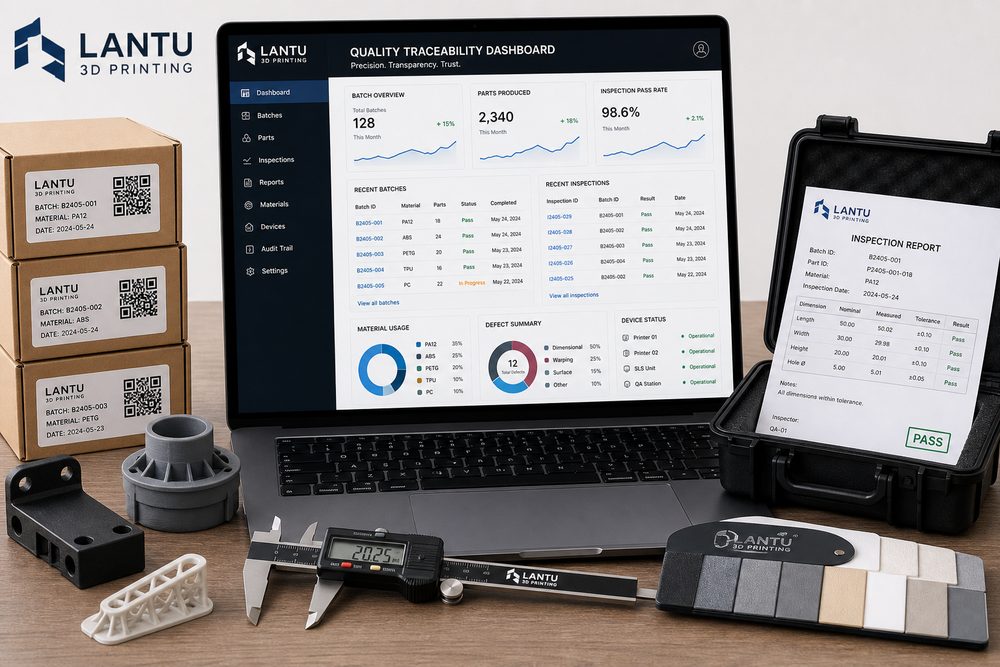
An effective traceability system should cover at least five types of information. The first is design input, including the source file version for STL, STEP, or OBJ files, key dimensions, wall thickness, assembly clearances, and customer approval records. The second is the process route, such as a 0.10-0.12 mm layer thickness, powder refresh ratio, build orientation, and cooling time for SLS nylon parts; a 0.05-0.10 mm layer thickness, support strategy, and secondary curing time for SLA resin parts; and for metal parts, powder lot number, laser power, hatch spacing, and heat-treatment curve. The third is the production equipment and operating time, which should at minimum identify the machine number, job number, start time, end time, and operator. The fourth is post-processing and inspection, including depowdering, cleaning, sandblasting, dyeing, polishing, and CMM or caliper measurement records. The fifth is the packaging and shipping label, with one batch per box and one code per part or per bag, so the traceability chain is not lost at delivery.
2. Common Breakpoints: Why Quality Issues Are Hard to Trace
Traceability failures usually happen not because there are no records, but because the records cannot be linked to one another. A typical problem is disorganized file naming: customers send files labeled “final,” “final2,” or “last confirmed version,” and if production does not freeze the version, it becomes difficult to determine whether a hole deviation found during inspection came from model changes, slicing error, or print deformation. The second breakpoint is when material lots are not tied to the order. For example, if a PA12 nylon project spans two powder replenishment cycles, and powder condition and refresh ratio are not recorded, differences in dimensional stability cannot be explained. The third breakpoint is outsourced or segmented post-processing. If sandblasting pressure, dyeing temperature, or curing duration are not recorded, appearance complaints become subjective disputes. The fourth breakpoint is repackaging small parts for shipment. If a package label only shows the project name and not the batch or quantity, after-sales teams cannot quickly identify the issue from a photo alone.
3. lantu3D-Style Traceability Sheet: Recommended Fields to Record
We recommend creating a six-stage record for each project: order, file, task, batch, inspection, and shipment. The order stage records the customer ID, application, quantity, delivery date, and risk level. The file stage records the file hash, version number, approval time, and screenshots of key dimensions. The task stage records material, process, machine, layer thickness, build orientation, and support strategy. The batch stage records material lot number, production time, operator, unexpected stoppages, and rework notes. The inspection stage records sampling ratio, inspection tools, measured key dimensions, appearance judgment, and photos. The shipment stage records packaging method, box number, waybill number, and packing list. For functional parts, key dimensions should be inspected at least at AQL 1.5 or according to the customer agreement. For assembly parts, it is recommended to keep fit-test photos or videos. For cosmetic parts, it is recommended to retain comparison images showing color difference, texture, and surface treatment before and after.
4. Digital Implementation: Do Not Let Traceability Become an Extra Burden
A traceability system does not have to start with a complex MES platform. Small teams can first build a basic chain using unified naming rules, QR code labels, cloud spreadsheets, and folder templates. The key is to capture records at each workflow node instead of filling them in after the project is over. When an order is received, generate a project number; when the design is approved, freeze the file version; when slicing is done, bind the job number; after production, upload photos automatically or manually; after inspection, enter the key dimensions; before shipment, print the batch label. For repeat orders, the system should be able to copy the previous process route directly and prompt whether the material lot, equipment status, or post-processing conditions have changed. This improves efficiency and reduces the risks caused by relying on memory and experience alone.
5. Business Value of Traceability
Quality traceability delivers value in three ways. First, it reduces communication costs. When a customer reports that a certain batch of snap-fit parts is too tight, the team can locate the file version, material lot, and inspection record within 30 minutes instead of searching through chat logs again. Second, it supports continuous improvement. For example, if statistics show that a certain thin-wall part warps more when built vertically, the team can adjust build orientation or recommend additional ribs. Third, it strengthens customer trust. This is especially important for medical device housings, robot fixtures, and automotive validation parts. Customers care not only about the unit price, but also whether the supplier can reproduce results consistently, explain differences, and take responsibility for delivery.
Conclusion
3D printing quality traceability is not just a management tool for large factories; it is a foundational capability in small-batch, multi-variety, fast-delivery scenarios. lantu3D recommends starting with four areas: file version freeze, process parameter recording, batch labeling, and inspection data, then gradually building a searchable, reviewable, and reusable delivery chain. When traceability becomes part of the daily workflow, quality issues are no longer just after-sales pressure; they become opportunities for process optimization and stronger customer relationships.
Submit a model, drawing, image or written notes. Engineers will review material, process, finishing and delivery based on actual use.