
Introduction: Value of Lean Production in 3D Printing Services
Lean production philosophy originates from the Toyota Production System, with the core being waste elimination and value creation. In the 3D printing service sector, implementing lean production can increase production efficiency by 20-40%, shorten delivery cycles by 15-30%, and reduce inventory costs by 25%.
1. Value Stream Mapping Analysis
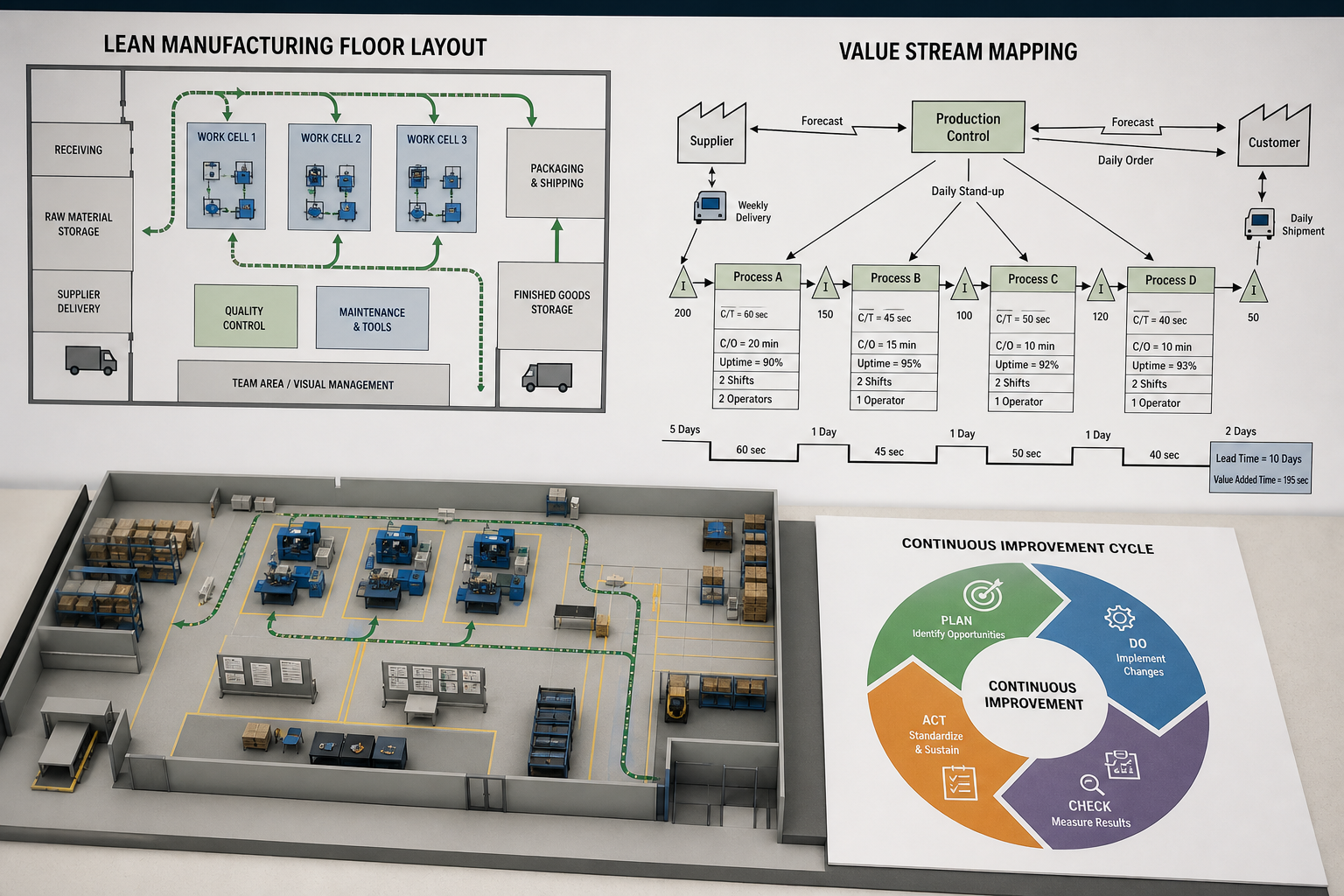
Value stream mapping is the starting point of lean production. Drawing steps include: Identifying product families, tracking material and information flows, recording time at each stage (value-adding time, waiting time, movement time), and calculating value-adding ratios. Typical 3D printing services have value-adding time ratios often below 30%, indicating significant room for improvement. Lean production defines seven types of waste: Overproduction, waiting, transportation, over-processing, inventory, motion, and defects.
2. Production Process Optimization
Based on value stream analysis, optimize production processes: Establish fast-track file preprocessing to reduce queue times; Optimize equipment scheduling to improve equipment utilization; Balance printing and post-processing capacity to eliminate bottlenecks; Simplify inspection processes to reduce non-value-adding activities. Combine related processes into production cells, with each cell equipped with complete printing, post-processing, and inspection equipment.
3. Pull Production
Establish kanban control systems: Production kanbans control production rhythm at each process; Movement kanbans control material flow; Electronic kanbans enable visual management. Implement just-in-time production strategies: Establish just-in-time delivery relationships with suppliers; Arrange production plans according to customer orders; Reduce safety stock to improve capital turnover.
4. Continuous Improvement Culture
Establish a mechanism for all-employee participation: Encourage employees to propose improvement suggestions; Establish proposal review and implementation processes; Provide rewards for effective proposals. Standardization is the foundation of continuous improvement: Establish standard operating procedures; Regularly update standard documents; Continuously optimize through PDCA cycles.
Submit a model, drawing, image or written notes. Engineers will review material, process, finishing and delivery based on actual use.